Sleep & routines • Ages 1–6
Daylight Saving Time and Toddler Sleep: A Gentle “Fall Back” Plan (+ Free Printable Sleep Planner)
Clocks go back one hour on Sunday, November 1, 2026, and your toddler’s body clock won’t get the memo. Here’s a calm, night-by-night plan to protect bedtime, naps and those precious extra minutes of morning sleep, plus a free printable planner.
🌟 By the end of this page you’ll have…
- a simple 4-night plan you can start tonight (Wednesday) and finish by Sunday’s clock change
- how much sleep toddlers and preschoolers need, with an age-by-age table
- what to do if you didn’t prepare at all (a “Plan B” that still works)
- how to handle 5 a.m. wake-ups, naps and the Halloween-night twist this year
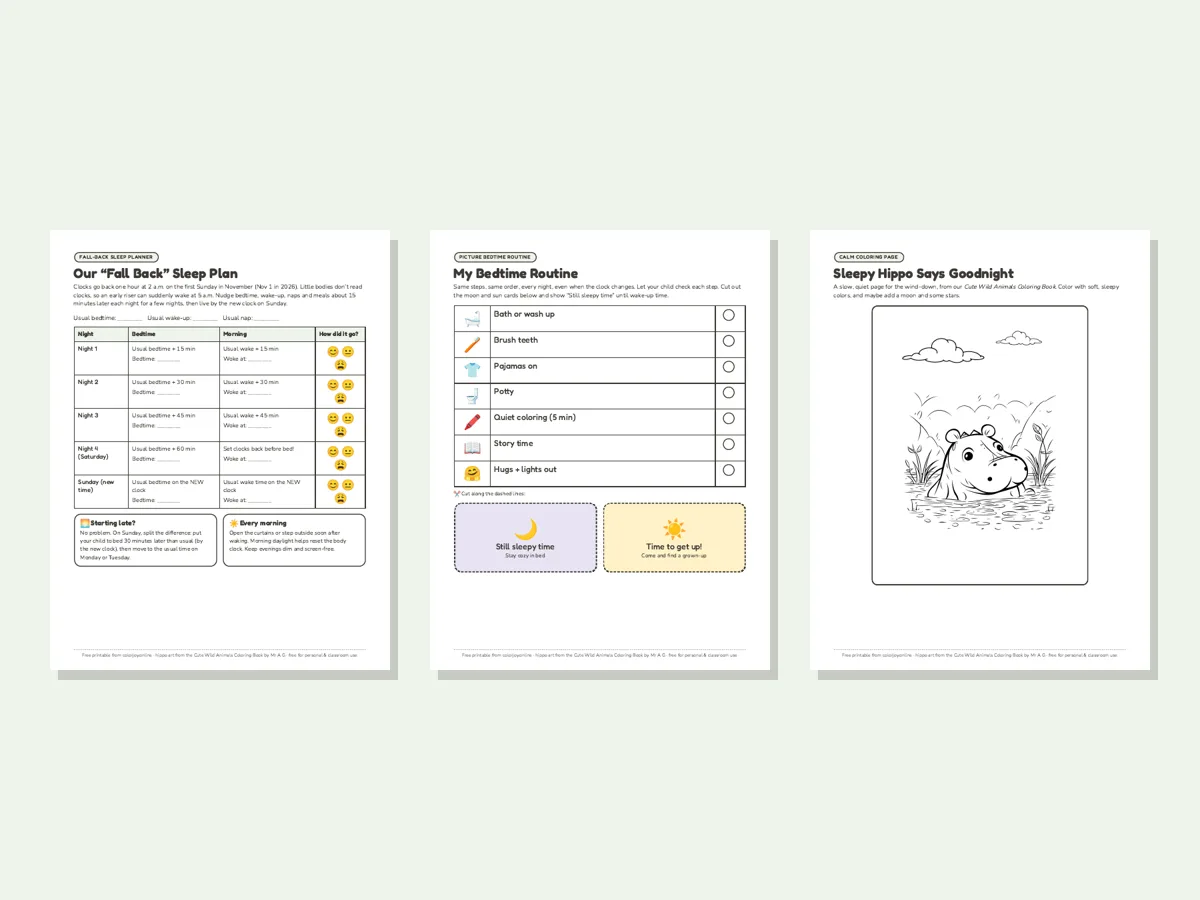
- a free 3-page printable: a fall-back sleep planner, a picture bedtime routine with moon and sun cards, and a calm coloring page
🎨 New here? Hi, we’re ColorJoy
ColorJoy makes bold, easy coloring books and free printables for little hands, plus warm, practical guides for real-life parenting. Our promise: realistic advice from trusted pediatric and sleep sources, never perfection, and a free printable in every guide. If your evenings already feel chaotic, our daily routine chart guide and quiet time ideas pair well with this plan.
Real-life moments
Sound familiar?
Every fall, plenty of parents wake up to the same Sunday-morning surprise. You’re not doing anything wrong. Little bodies simply run on their own clocks.
The 5:00 a.m. “good morning”
Your toddler usually wakes at 6:00. On Sunday, the clock says 5:00, but their body says it’s time to play, and they’re bouncing in the crib or standing by your bed.
Try this: shift wake-up 15 minutes later for a few days before the change, and keep the room dark until the new wake-up time.
The bedtime that isn’t sleepy
At “7:00” on the new clock, your preschooler’s body thinks it’s only 6:00. Bedtime turns into a long, giggly negotiation.
Try this: nudge bedtime later in small steps, and keep the same calm routine in the same order every night.
The nap that went sideways
The morning nap starts too early, the afternoon nap runs long, and by dinner everyone is cranky, including you.
Try this: move naps and meals along with bedtime, and protect a short, early-evening wind-down.

The why
Why the time change hits little kids hard
In the United States, clocks “fall back” one hour on the first Sunday in November, when daylight saving time ends (HealthyChildren.org, AAP). In 2026 that’s Sunday, November 1, at 2:00 a.m. For adults, it can feel like a gift: an extra hour in bed. For toddlers and preschoolers, it often means the opposite, because their internal body clock (their circadian rhythm) doesn’t reset just because the microwave clock did.
Nationwide Children’s Hospital compares it to jet lag: when the clock suddenly shifts, a child’s body clock takes a few days to catch up, so they may be up before dawn or struggle to fall asleep at their usual time (Nationwide Children’s). Most young children are natural “morning people,” which is why the fall change so often shows up as early waking rather than late nights.
The American Academy of Sleep Medicine (AASM) notes that the spring and fall time changes can disrupt our sleep schedule and the quality of our sleep, and it suggests giving kids extra time to adjust (AASM Sleep Education). The good news: a one-hour change is small, and with a little planning most families are back on track within a few days to a week.
🧠 The body-clock basics
Three “clocks” guide sleep: the body clock inside us, the social clock (meals, school, bedtime) and the sun. Seattle Children’s explains that sleep goes best when all three line up, and that keeping meals and the bedtime routine on schedule helps reduce the time change’s impact (Seattle Children’s). That’s exactly what the plan below does.

The numbers
How much sleep do toddlers and preschoolers need?
Before you start shifting times, it helps to know your target. The AASM guidelines, which the American Academy of Pediatrics supports, count total sleep in 24 hours, including naps (HealthyChildren.org).
| Age | Recommended sleep per 24 hours (incl. naps) | What it often looks like |
|---|---|---|
| 4–12 months | 12–16 hours | Night sleep plus 2–3 naps |
| 1–2 years | 11–14 hours | Night sleep plus 1–2 naps |
| 3–5 years | 10–13 hours | Night sleep, maybe a short nap or quiet time |
| 6–12 years | 9–12 hours | Night sleep only |
The CDC’s milestone guide for 4-year-olds also repeats the 10 to 13 hours a day (including naps) and recommends a calm, quiet bedtime routine with no screens for 1 to 2 hours before bed (CDC). If your child is already short on sleep, the AASM advises not pushing bedtime later before the fall change, so they can bank the “extra” hour instead (AASM).
💡 Quick check
Is your toddler waking happy most days and getting through the afternoon without falling apart? Then their current schedule is probably fine, and your only job this week is to slide it gently by one hour.
The plan
The gentle 4-night fall-back plan (start tonight)
Sleep experts agree on the core idea: shift things gradually. The AASM suggests moving bedtime 15 to 20 minutes later each night for a few nights before the fall change, adjusting mealtimes to match, and setting clocks to the new time on Saturday evening (AASM). Dayton Children’s recommends 10 to 15 minutes a night for little ones (Dayton Children’s). Today is Wednesday, October 28, so you have exactly four nights. Here’s what that looks like for a child whose usual bedtime is 7:00 p.m. and wake-up is 6:30 a.m.:
| Night | Bedtime (current clock) | Next morning wake-up | Meals and naps |
|---|---|---|---|
| Wed, Oct 28 | 7:15 p.m. | 6:45 a.m. | Dinner and naps 15 min later |
| Thu, Oct 29 | 7:30 p.m. | 7:00 a.m. | 30 min later |
| Fri, Oct 30 | 7:45 p.m. | 7:15 a.m. | 45 min later |
| Sat, Oct 31 | 8:00 p.m. (then set clocks back) | Sunday 6:30 a.m. on the NEW clock | 1 hour later = normal on the new clock |
| Sun, Nov 1 onward | 7:00 p.m. on the NEW clock | 6:30 a.m. on the NEW clock | Normal times on the new clock |
- Pick your step size. 15 minutes a night works for most toddlers. If your child is very sensitive, use 10 minutes and start a night earlier next year.
- Move the whole day, not just bedtime. Wake-up, naps, meals and bath all slide by the same amount. HealthyChildren.org suggests nudging naps and bedtime in the direction the clocks will change, ideally starting about a week ahead (AAP).
- Keep the routine identical. Same steps, same order, same songs. Dayton Children’s stresses keeping your normal bedtime routine intact while you shift the timing.
- Change the clocks Saturday evening. Seattle Children’s suggests moving clocks back on Saturday night so the household wakes up on the new time on Sunday.
- Get outside Sunday morning. Morning daylight in the days after the change helps reset the internal clock (AASM).
- Be patient for a week. Most kids adjust within a few days; some take up to a week.

🪄 Write it on the fridge
Our free printable has a fill-in planner for exactly this: usual times at the top, then a row for each night. Ticking off each night also helps you notice what’s working.
By age
Fall-back plan by age
The plan above works for most kids, but every age has its own sticking point. Here’s what to focus on.
| Age | Main challenge | Best approach | Watch out for |
|---|---|---|---|
| Babies (under 12 months) | Feeding and nap timing | Shift feeds and naps by 10–15 min a day; keep the bedtime routine short and the same | Talk to your pediatrician about any sleep concerns; follow safe sleep rules |
| Young toddlers (1–2) | Early waking, 2 naps → 1 nap | Shift naps with bedtime; keep the room dark until the target wake time | An overlong afternoon nap pushing bedtime later |
| Older toddlers (2–3) | Bedtime stalling | Picture routine chart, two choices (“blue or green pajamas?”), same book order | Extra stories creeping in each night |
| Preschoolers (3–5) | Excitement, dropping naps | Quiet time instead of a nap; a sun/moon “okay to wake” card or clock | Late-afternoon naps that steal night sleep |
| School-age (6+) | Weekend sleep-ins | Keep wake time consistent on weekends; explain the change | Screens in the evening |
Nationwide Children’s notes that naps can be the trickiest part for babies and toddlers: adjust them gradually along with bedtime and try not to let them run too long, or bedtime becomes harder (Nationwide Children’s). If your preschooler is dropping naps anyway, this week is a good time to swap the nap for a quiet time routine.

This weekend
The 2026 twist: Halloween is the night before the clock change
This year, Halloween falls on Saturday, October 31, the very night clocks go back. That’s a lot for little ones: costumes, candy, excitement and a late night, then a time change. Here’s how to make it work in your favor.
- Let Halloween be the “+1 hour” night. If you’re following the plan, Saturday bedtime is already one hour later than usual. A slightly later trick-or-treat night fits right in.
- Go early, come home early. Trick-or-treat at dusk, then head home for the usual bath, pajamas and story. Our trick-or-treating with toddlers guide has a calm, early plan.
- Wind down after the excitement. Sort candy together, then switch to dim lights, quiet coloring and the usual bedtime songs.
- Set the clocks back before bed, so Sunday starts on the new time.
- Keep candy for daytime. A treat after lunch on Sunday is easier on sleep than sugar at 9 p.m.
- Expect a wobbly Sunday. A late night plus a time change can mean a short temper. Plan a slow, outdoorsy morning and an early, calm evening.

Halloween at home this year? Our fall bucket list for kids has cozy, low-key ideas for the whole weekend.
Plan B
Plan B: you didn’t prepare (that’s okay)
Life happens. If you’re reading this on Saturday night or Sunday morning, you can still make the change easier. HealthyChildren.org says that if you aren’t able to plan and prepare, there are other ways to help your child adjust, starting with good sleep habits (AAP).
- Option 1: Split the difference. On Sunday, put your child to bed 30 minutes later than usual on the new clock (for example, 7:30 instead of 7:00), then move to the usual time on Monday or Tuesday.
- Option 2: Switch straight away. Some kids, especially older preschoolers, adapt quickly if you simply live on the new clock from Sunday morning: meals, naps and bedtime at the normal clock time.
- Use daylight on purpose. Get outside in the morning sunshine on Sunday and Monday. Seattle Children’s notes that morning sunlight (even on an overcast day) and physical activity help, particularly on the first day of the change.
- Protect the evening. Dim lights, no screens for at least an hour before bed, and a calm, predictable routine.
- Don’t fight the first few nights. If your child isn’t sleepy at the new bedtime, keep things quiet and boring in the bedroom: a book, a song, a cuddle.

Early birds
Fixing the 5 a.m. wake-ups
Early waking is the classic fall-back problem. At 5:00 a.m. on the new clock, your toddler’s body thinks it’s 6:00. These ideas help the body clock catch up.
- Keep the room dark until wake-up time. For the fall change, the AASM suggests minimizing light exposure until your target morning wake time (AASM). Room-darkening curtains or a blackout blind can help, as Nationwide Children’s suggests for kids who wake with the sun.
- Try an “okay to wake” signal. Dayton Children’s suggests okay-to-wake clocks and night lights, set 10 to 15 minutes later each day in the week before the change. Our printable has free moon and sun cards you can use the same way: moon until a grown-up flips it to sun.
- Respond calmly and quietly. If your child wakes very early, keep lights low and voices soft, and offer a quiet activity in bed or in their room. Save the bright, exciting morning for the target time.
- Move breakfast later too. Food is a strong “daytime” signal for the body. Serve breakfast at your target time, not the moment they wake.
- Shift evening light. Nationwide Children’s suggests encouraging natural light later in the day after the fall change, which helps the body clock shift later. An afternoon walk is perfect.


💡 One week, not one night
It’s normal for early waking to drift back over several mornings. If it’s still happening after a week or so, Dayton Children’s suggests checking in with your pediatrician.
Naps
Naps and meals: the hidden half of the plan
Bedtime gets all the attention, but naps and meals are what really move the body clock. Here’s how to shift them without a meltdown.
| If your child… | Then… |
|---|---|
| takes two naps (most young toddlers) | Move both nap start times later by the same 15 minutes each day, and cap the afternoon nap so bedtime stays sleepy. |
| takes one afternoon nap | Push the nap start later along with lunch. If they get tired before the nap, bring in a calm activity, not a car ride (that 5-minute car snooze can steal the whole nap). |
| has stopped napping | Offer 30–45 minutes of quiet time in the early afternoon: books, puzzles, coloring. |
| is hungry early | Offer a small, filling snack and keep the main meal at the shifted time. HealthyChildren.org also notes that eating too close to bedtime can make it harder to sleep. |
The AASM recommends adjusting other daily routines, such as mealtimes, to match your new schedule before the time change (AASM). In practice, that means dinner, bath and bedtime all slide together, like a train with its carriages.

Wind down
A calm wind-down routine that works on any clock
When the clock changes, the bedtime routine is your anchor. HealthyChildren.org recommends set nighttime routines (for younger kids, a “brush, book, bed” routine, cuddling or quiet music), limiting screens before bed and choosing quiet activities like stretching or yoga later in the day (AAP).
- Lights down (30–60 minutes before bed). Switch to lamps, close the curtains and turn off the TV and tablets. The AAP recommends turning off all screens at least an hour before bedtime and keeping them out of children’s bedrooms (AAP).
- Bath or wash-up. Warm water and pajamas are strong “nighttime” cues.
- Teeth and potty. Same order every night.
- Five minutes of quiet coloring. A simple, bold page and a few crayons at the kitchen table or on a lap tray. It’s calm, focused and screen-free.
- Belly breaths. Three slow “smell the flower, blow the candle” breaths together. Our mindfulness activities for kids have more ideas.
- Story and song. One or two books (agree on the number before you start), then the same song.
- Hugs and lights out. A short, warm goodnight, and the same words each night.


The routine is also where a picture chart shines: toddlers love checking off each step themselves. Page 2 of our free printable is a ready-made bedtime routine chart, and our routine chart guide shows how to build one for the whole day.

🌙 From the ColorJoy shelf
A calm page for the wind-down
Our Calming Mindful Coloring Book has relaxing patterns, mandalas and peaceful nature scenes with thick lines and single-sided pages. It’s made for all ages, so you can color a page next to your child as part of the routine.
See it on Amazon ($9.99) →Our own book; we earn money if you buy it.
Health
When to talk to your pediatrician
A time change is a short bump for most families. Dayton Children’s says children should adjust within a week or so, and that if it takes longer, it’s worth talking with your pediatrician about whether a pediatric sleep specialist could help (Dayton Children’s). Also check in if you notice:
- loud snoring, pauses in breathing or very heavy breathing during sleep (HealthyChildren.org lists these among common sleep problems to discuss with your pediatrician)
- sleep trouble that started before the time change and isn’t getting better
- daytime sleepiness that affects your child’s mood, play or learning
- you’re considering melatonin or any sleep aid: HealthyChildren.org says to talk to your pediatrician first
⚠️ Safe sleep for babies
For babies, always follow safe sleep guidance from your pediatrician. Shifting a schedule never means changing where or how your baby sleeps.
Feeling the strain yourself? You’re not alone. Our guide to the overstimulated toddler has calming ideas for the whole family when evenings get loud.
Freebie
Free printable: fall-back sleep planner, bedtime routine chart and calm coloring page
🎁 Free printable
The ColorJoy Fall-Back Sleep Kit (3 pages)
Page 1 is a fill-in “fall back” sleep planner for five nights, with a Plan B box. Page 2 is a picture bedtime routine chart with cut-out moon and sun “okay to wake” cards. Page 3 is a sleepy hippo coloring page from our Cute Wild Animals Coloring Book.
Download the free printable (PDF) →
Free for personal and classroom use. No email or sign-up needed.
We share a new free printable every week, so bookmark our activity ideas hub and come back for the next one. Spring forward is on Sunday, March 14, 2027, and the same planner works in reverse: just move times 15 minutes earlier each night instead. Teaching your child to read the clock? Our guide to teaching kids to tell time turns the time change into a fun mini-lesson.
Your plan
What to do tonight (about 15 minutes)
It’s Wednesday, October 28: the perfect night to start. Here’s your quick setup.
3 minutes
Print the planner
Download the free sleep kit and write your child’s usual bedtime, wake-up and nap times at the top.
2 minutes
Move tonight’s bedtime 15 minutes later
Push bath, story and lights-out by 15 minutes. Same routine, same order.
5 minutes
Darken the bedroom
Check curtains or blinds, and plan to keep the room dim until tomorrow’s target wake-up time.
5 minutes
Color together
Swap the last screen of the evening for one calm coloring page side by side, then brush, book, bed.
💛 Be kind to yourself
If this week doesn’t go to plan, that’s okay. Clocks change, kids adjust and so will you. Look after your own sleep too.
Cozy
A peaceful bedtime, in pictures


From the ColorJoy shelf
Our wind-down pick: Calming Mindful Coloring Book for All Ages
Our wind-down pick
Calming Mindful Coloring Book for All Ages: Relaxing Patterns, Mandalas & Nature Scenes
Soothing patterns, mandalas and peaceful nature scenes with thick lines and single-sided pages, for kids, teens, adults and seniors.
$9.99paperback · 69 pages · all ages
Our own book; we earn money if you buy it. Price as listed on Amazon.com when we checked on 28 October 2026; please confirm on the product page.
Here’s why it fits the time-change week. When the clock shifts, the bedtime routine is what tells your child’s body that night is coming, and a few minutes of quiet coloring is one of the easiest calm steps to add. It keeps hands busy and eyes off screens, and it gives restless kids something gentle to focus on while you shift bedtime later. Because the book is made for all ages, you can color your own page right next to them, which many little ones love more than coloring alone.
Tip: for toddlers, choose the simplest, boldest patterns and offer just three or four chunky crayons. For preschoolers, try “color one ring of the mandala each night” as a small nightly ritual while you shift to the new schedule. Browse all our titles in the Mr A G author store on Amazon. Prefer printables? Our Kids Printable Mega Bundle on Payhip ($14.99) has 11 coloring, tracing and flashcard PDFs (a separate product, not this book).
📚 Related books from ColorJoy
If this topic is on your mind, these titles from our own shelf fit well alongside it.

Cute Wild Animals Coloring Book (Ages 4–8)
Fifty happy wild animals with thick, simple lines: the sleepy hippo in our free printable comes from this book, and toddlers love a familiar animal at bedtime.
$12.99 paperback on Amazon.com · Paperback, shipped by Amazon

Toddler Animal Coloring Pages (printable PDF)
Big, bold animal pages to print at home for $1.99: print one fresh page each night for the wind-down routine.
$1.99 printable PDF on Payhip · Instant PDF download; print at home

Toddler Parenting Guide: Tantrums, Hitting & Picky Eating (PDF)
A short, practical PDF guide for the toddler years when tantrums, hitting and picky eating make evenings harder.
$3.99 printable PDF on Payhip · Instant PDF download; print at home
These are our own books and printables, and we earn money if you buy them. Prices as listed on Amazon.com and Payhip when we checked on 28 October 2026; prices can change, so please confirm on the product page.
Frequently asked questions
When does daylight saving time end in 2026?
In the United States, daylight saving time ends on Sunday, November 1, 2026, at 2:00 a.m., when clocks fall back one hour. It always ends on the first Sunday in November.
How do I adjust my toddler’s sleep for the fall time change?
Starting a few nights before the change, move bedtime, wake-up, naps and meals about 10 to 15 minutes later each night, keep the bedtime routine exactly the same, set clocks back on Saturday evening and get outside in morning daylight on Sunday. Most toddlers adjust within a few days to a week.
My toddler is waking up at 5 a.m. after the time change. What do I do?
Keep the room dark until your target wake-up time, respond quietly, use a simple “okay to wake” signal such as a sun card or clock, serve breakfast at the target time and get some natural light later in the day. Early waking usually improves over several mornings.
Should I move my toddler’s bedtime earlier or later for fall back?
Later, in small steps, before the change. If your child is already short on sleep, the AASM suggests not pushing bedtime later, so they can benefit from the extra hour instead.
What if I didn’t prepare before the time change?
You can split the difference on Sunday by putting your child to bed about 30 minutes later than usual on the new clock, then move to the normal time a day or two later. Or simply switch to the new clock right away, with plenty of morning light and a calm, dim evening.
How long does it take a toddler to adjust to daylight saving time?
Most children adjust within a few days to a week. If sleep problems last longer than that, talk to your pediatrician.
Can coloring help my child wind down at bedtime?
A few minutes of quiet, screen-free coloring can be a calm step in a bedtime routine. Choose simple, bold pages and a few crayons, keep the lights low and do it before bath and story time.
Sweet dreams, little ones 🌙
ColorJoy makes bold, easy coloring books and free printables for little hands, plus warm, practical guides for real-life parenting. New guides and printables go up every week, so come back soon, and good luck this weekend.
For a calm, screen-free wind-down this week, our pick is the Calming Mindful Coloring Book for All Ages.
Get the Calming Mindful Coloring Book →
Next up: winter break activities for kids at home or indoor gross motor activities for dark afternoons.
Photos: Unsplash (Unsplash License). Illustrations: AI-generated for ColorJoy. Book images and printable art: ColorJoy / Mr A G. This guide is general information, not medical advice. Talk to your pediatrician about your child’s sleep.