Early math • Ages 3–7
How to Teach Kids to Tell Time: A Step-by-Step Guide for Ages 3–7 (+ Free Clock Kit and “Fall Back” Plan)
“Is it time yet?” “How long is five minutes?” “Is tomorrow after this nap?” Little kids live in the present, so clocks can feel like a mystery. This guide shows you how to teach telling time in small, playful steps, from “before and after” to o’clock, half past and five-minute times, with games, an age-by-age table and a free printable clock kit. And with clocks falling back on November 1, this week is the perfect time to start.
🌟 By the end of this page you’ll have…
- when children are usually ready to learn to tell time, and what U.S. schools expect in first and second grade
- a 9-step sequence that moves from daily routines to reading hours, half hours and five-minute times
- 15 low-prep clock games you can play in the kitchen, the car or at bedtime
- how to turn the end of daylight saving time (Sunday, November 1, 2026) into a real-life telling-time lesson and a smooth bedtime shift
- a free 3-page printable: a cut-out paper clock, a “my day in clocks” page and a 7-night “fall back” bedtime plan
🎨 New here? Hi, we’re ColorJoy
ColorJoy is a small family-focused site that makes bold, easy coloring books, workbooks and printables for little hands, and writes practical, screen-light guides for parents. Every guide includes a free printable. Our books are on Amazon (author name Mr A G) and our printables are on Payhip. This guide pairs well with our daily routine chart guide and our letter sounds guide.
⭐ Featured ColorJoy book for this guide
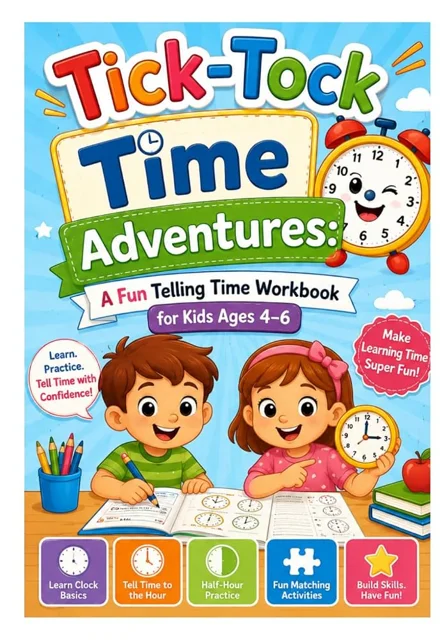
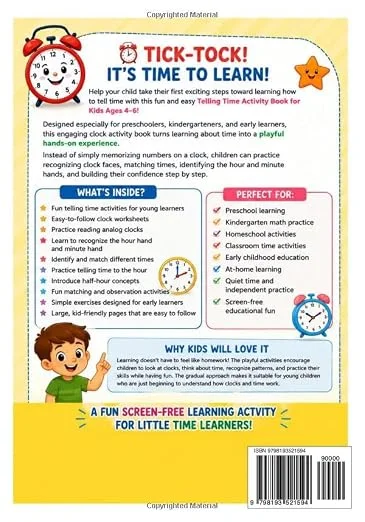
Tick-Tock Time Adventures (Ages 4–6)
A telling-time workbook for preschool and kindergarten: clock faces, hour and minute hands, time to the hour and half hour, and matching activities on large, kid-friendly pages.
See it on Amazon ($9.99) →Our own book; we earn money if you buy it.
Real-life moments
Sound familiar?
Every parent has been here. Time is one of the trickiest ideas for small children, and it’s not because they aren’t trying.
“Is it tomorrow yet?”
Your 4-year-old wakes up from a nap and asks if it’s tomorrow. You explained it twice yesterday. They still look puzzled.
Try this: tie time to events they already know: “After dinner and bath, then you sleep, and when you wake up, it’s tomorrow.”
The five-minute warning that means nothing
You say “five more minutes” at the park. Your child either melts down immediately or keeps playing for twenty.
Try this: use a visual timer or a song, so five minutes becomes something they can see or hear.
The homework clock
Your first grader brings home a worksheet full of clock faces and gets every half hour wrong by exactly one hour.
Try this: check the short hand first. At half past, it sits between two numbers, and the hour is the one it just passed.
Readiness
When are kids ready to learn to tell time?
Time is abstract. You can’t hold an hour or see a minute, so young children learn time in layers. First they learn the order of events (“first breakfast, then park”), then words like before, after, later and tomorrow, and only later the numbers on a clock.
Early childhood experts Sallee Beneke, Michaelene Ostrosky and Lilian Katz, writing for NAEYC’s Young Children journal, point out that there is little evidence that calendar activities marking long stretches of time are meaningful for children below first grade, but that preschoolers can grasp time ideas like later, before and after in the context of their daily activities (NAEYC, 2008). In other words: routines first, clocks second.
In U.S. schools that follow the Common Core math standards, clock reading is formally taught in first and second grade. First graders are expected to tell and write time in hours and half-hours using analog and digital clocks, and second graders to tell time to the nearest five minutes, using a.m. and p.m. So if your preschooler isn’t reading clocks yet, they’re right on track.
✅ Signs your child is ready for the clock
- Recognizes the numbers 1 to 12
- Understands “before” and “after” in their day
- Can follow a simple routine in order (bath, pajamas, teeth, book)
- Asks time questions: “When is lunch?” “How long until Grandma comes?”
- Is starting to count by fives (needed later for minutes)
By age
Telling time by age: what to expect
Use this table as a loose guide. Some children race ahead, some need longer, and both are normal.
| Age | What they can usually learn | Try this | Skip for now |
|---|---|---|---|
| 3 | Order of the day, words like first, next, later, morning and night | Picture routine chart, “what comes next?” games, visual timers | Reading the clock face |
| 4 | Before and after, yesterday and tomorrow (still fuzzy), numbers 1–12 on a clock | Make a paper clock, find the numbers, play “what time do we…?” | Minutes and half hours |
| 5 (kindergarten) | O’clock times with the hour hand, the idea that the long hand means minutes | One-handed clock trick, o’clock matching, routine clocks | Quarter past, five-minute times |
| 6 (1st grade) | Hours and half hours on analog and digital clocks (a Common Core standard) | Half-past games, matching analog to digital, workbook practice | a.m./p.m. and elapsed time |
| 7 (2nd grade) | Five-minute times, a.m. and p.m. (a Common Core standard) | Count by fives around the clock, “what time will it be in 10 minutes?” | Nothing! Keep it fun |
Step by step
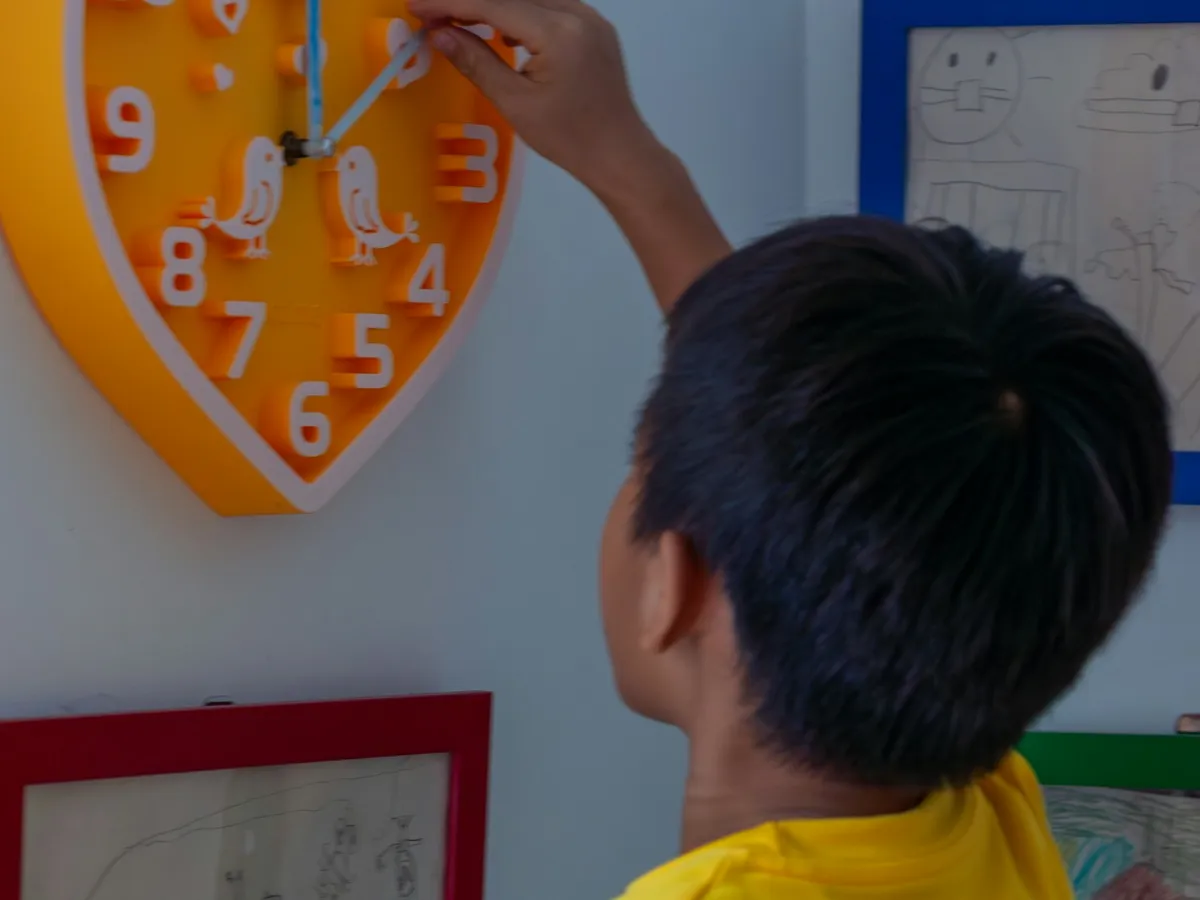
How to teach telling time: the 9-step method
Each step builds on the last. Spend a few days or a few weeks on each one, and go back a step whenever your child seems frustrated. Five to ten minutes a day is plenty.
- Talk about time all day. Use time words in real life: “First we’ll eat, then we’ll go to the park.” “We read stories before bed.” This builds the sense of order that clocks depend on.
- Sequence the day. Take photos or draw pictures of your routine and let your child put them in order. Our routine chart guide has a free printable for this.
- Meet the clock face. Point out that the numbers go around in a circle from 1 to 12, always in the same order. Make the paper clock from our free kit and let your child color the numbers.
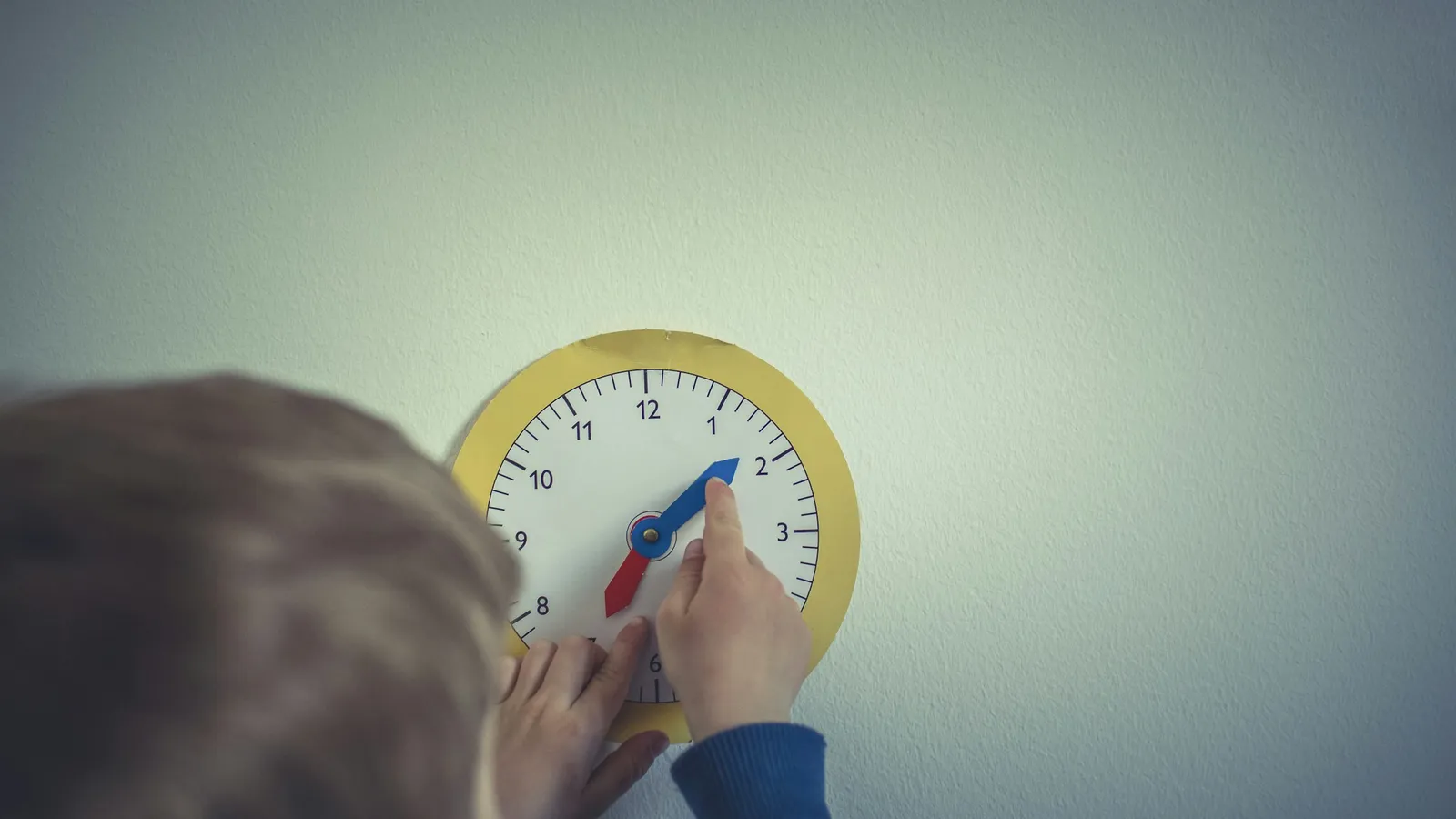
- Start with only the hour hand. Many teachers use a one-handed clock first. With only the short hand, your child learns that it points to (or just past) the hour. “It’s pointing at the 3, so it’s about 3 o’clock.”
- Practice o’clock times. Now add the long hand and keep it pointing straight up at 12. “When the long hand is on 12, it’s something o’clock.” Match it to real moments: 7 o’clock breakfast, 12 o’clock lunch.
- Explain the minute hand. The long hand shows minutes and goes all the way around in one hour. Count by fives together as you move it from number to number: 5, 10, 15… 60.
- Learn half past. When the long hand points to 6, it has gone halfway around: 30 minutes. The short hand is halfway between two numbers. The hour is the number it has just passed.
- Add quarter past, quarter to and five-minute times. Usually a second-grade skill. Use “quarter” language alongside numbers: quarter past 4 is 4:15.
- Match analog to digital. Put a digital clock or phone next to your paper clock. Show that 4:30 on the digital clock looks like “half past 4” on the analog one.
🪄 Parent hack: color-code the hands
Paint or tape the short hour hand red and the long minute hand blue, on a paper clock or even a real wall clock. Then say “red tells the hour, blue tells the minutes” until your child says it back to you.
⏰ Practice pages that follow these steps
Tick-Tock Time Adventures
Our workbook moves from recognizing clock faces and the two hands to telling time to the hour and introducing half hours, with matching activities and large pages that are easy to follow. A quiet 10-minute practice after the hands-on games.
Look inside on Amazon ($9.99) →Our own book; we earn money if you buy it.
Troubleshooting
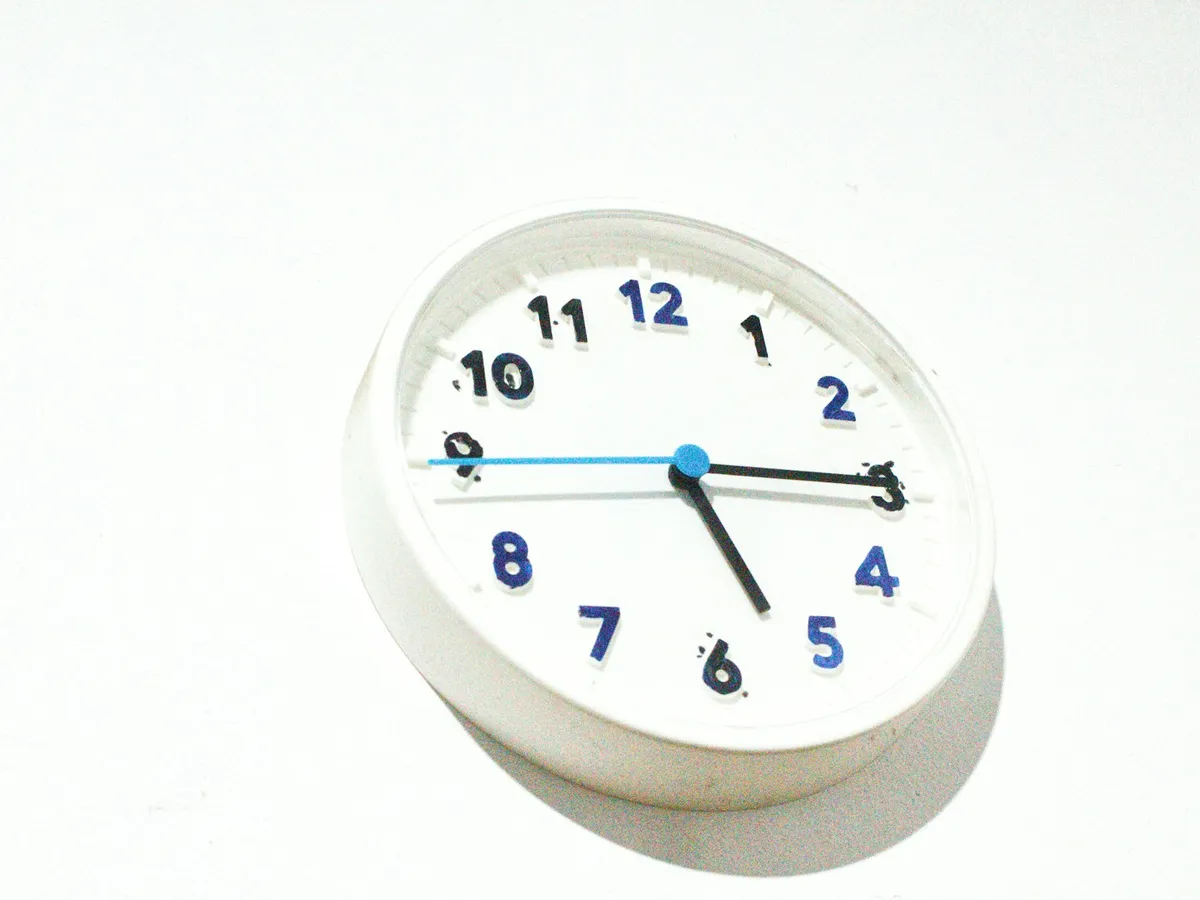
The most common telling-time mix-ups (and how to fix them)
Almost every child makes these mistakes. They’re a normal part of learning, not a sign that your child is “bad at math.”
| Mix-up | Why it happens | Quick fix |
|---|---|---|
| Mixing up the hands | Both hands point at numbers, so it’s easy to read the long hand as the hour | Color-code them and always ask, “Where’s the short hand?” first |
| Reading 4:30 as 5:30 | At half past, the short hand is close to the next number | Say “the hour is the number it just passed” and trace the hand back |
| Saying “6 o’clock” when it’s half past | The long hand is pointing at the 6 | Remind: the long hand counts minutes. 6 on the minute hand means 30 |
| Thinking the minute hand points to minutes 1 to 12 | The numbers on the clock are hour numbers | Count by fives out loud each time you move the long hand |
| Confusing a.m. and p.m. | The same time happens twice a day | Link it to the sky: a.m. is morning, p.m. is afternoon and evening |
Play
15 low-prep clock games
Kids learn time best through play and real routines, not drills. Pick two or three of these and rotate through the week.
- What time do we…?Name a daily event and ask your child to set the paper clock to the time it usually happens. Page 2 of our free kit makes this a keepsake.
- Clock hopDraw a big clock with chalk outside or tape on the floor. Call out a time and your child jumps to the hour, then lies on the floor to show the hands.
- Beat the timerSet a one-minute timer and see how many blocks your child can stack or how many socks they can match. It builds a feel for how long a minute is.
- Clock detectiveHunt for clocks around the house and in stores: ovens, microwaves, cars, phones. Which ones have hands and which have digits?
- Human clockYour child stands still as the center, using one short arm and one long arm (a cardboard tube helps) to show times you call out.
- Hour hand guessCover the minute hand with a sticky note and ask, “About what time is it?” Great practice for step 4.
- Snack o’clockAgree that snack happens at 3 o’clock. Let your child watch the kitchen clock and tell you when it’s time.
- Clock memoryMake pairs of cards: one analog clock and one digital time. Flip and match.
- Bath-time countdownCount down five minutes before bath with a visual timer, then talk about what changed: “It was 6:00, now it’s 6:05.”
- Morning or night?Show pictures (breakfast, the moon, school pickup) and sort them into morning, afternoon and night.
- Clock bingoFill a 3 × 3 grid with times. Call out times and cover the matching clocks.
- Story clocksWhile reading, ask “What time do you think it is in the story?” and set the paper clock.
- Car-ride clock checkRead the car clock at the start and end of a trip. How many minutes did it take?
- Freeze the handsPlay music and spin the clock hands; when the music stops, read the time.
- Count by fives songSing or chant 5, 10, 15… up to 60 while walking around the paper clock. Clap on each number.
Looking for more learning-through-play ideas? See fun educational activities that feel like play and our kindergarten readiness activities.

This week
Daylight saving time is a free telling-time lesson
In 2026, daylight saving time ends on Sunday, November 1 at 2 a.m. local time, when clocks go back one hour (NIST). Hawaii and most of Arizona don’t observe daylight saving time, so families there can skip this part.
For kids learning time, “fall back” is a perfect hands-on moment. On Saturday evening, let your child help turn a wall clock or the oven clock back one hour. Ask: “If it says 7 o’clock now, what will it say after we turn it back?” Then compare it with your phone, which changes on its own.
Helping your child’s sleep adjust
The fall time change can be a little tricky for young children. The American Academy of Pediatrics notes that it can cause younger kids to crash before bedtime and wake up earlier than usual. Its advice for younger children is to nudge naps and bedtime in the direction the clocks will change, a few minutes each day, ideally starting about a week before (HealthyChildren.org). With November 1 exactly one week away, tonight is a great night to start.
- Nudge bedtime a little later each night this week (our free plan has a 7-night tracker).
- Keep the bedtime routine the same: bath, pajamas, teeth, book. The American Academy of Sleep Medicine says children may need extra time to adjust, so steady routines help (AASM).
- Get outside in the morning. The AASM recommends early morning sunlight in the days after the change to help reset the body clock.
- Put screens away before bed. The AAP suggests keeping screens away for at least an hour before bedtime.
- Be patient. The AAP notes kids usually adjust within about a week. If sleep problems continue, talk with your pediatrician.
If bedtime is already a struggle, our 7-night toddler sleep routine walks you through a calm plan step by step.
Good to know
Analog or digital: does it still matter?
Many parents wonder whether kids even need to read a clock with hands when phones show the time in numbers. There are good reasons to teach both. Common Core standards ask first and second graders to read analog and digital clocks, and analog clocks are still on classroom walls, in tests and in many homes.
Analog clocks also show time as a picture. Children can see how much of the hour has passed and how much is left, which helps them understand “half an hour” or “almost time.” A digital display gives the answer, but not that picture.
🧠 A balanced approach
Start with an analog clock for understanding, then match it to digital once your child knows o’clock and half past. Seeing both side by side (step 9) makes each one easier.
Checklist
Printable telling-time skills checklist
Print or screenshot this list and check off skills as your child masters them. There’s no rush. Each one is a small win to celebrate.
- Puts 3–4 routine pictures in order
- Uses before, after, morning and night correctly
- Finds the numbers 1–12 on a clock face
- Knows the short hand is the hour hand
- Reads o’clock times
- Knows the long hand is the minute hand
- Counts by fives to 60
- Reads half past times (1st grade)
- Matches analog and digital times
- Reads quarter past and quarter to
- Reads times to five minutes (2nd grade)
- Knows a.m. from p.m.
Freebie
Free printable: telling-time clock kit and “fall back” plan
🎁 Free printable
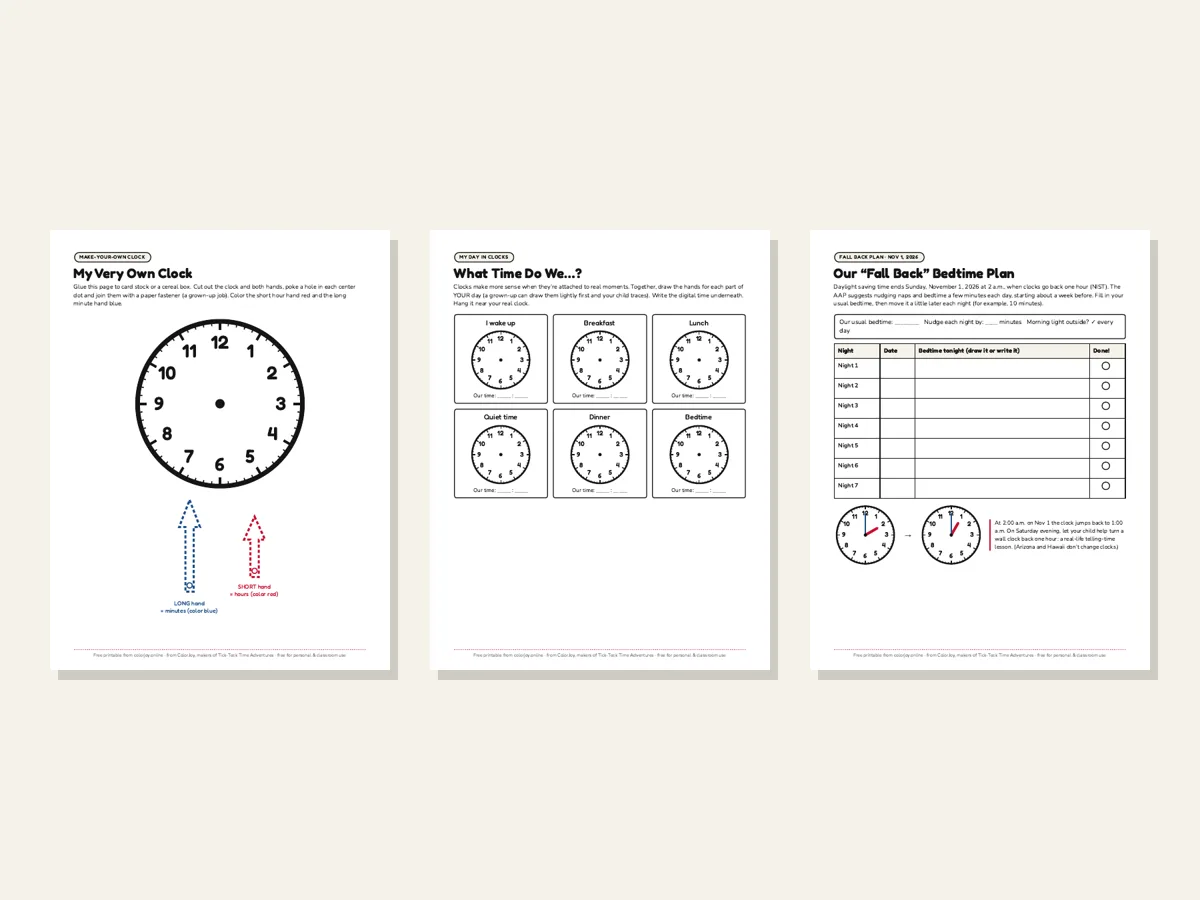
The ColorJoy Telling-Time Kit (3 pages)
Page 1 is a large cut-out clock with color-coded hour and minute hands (add a paper fastener). Page 2 is “What time do we…?”: six blank clocks for your own daily routine. Page 3 is a 7-night “fall back” bedtime plan for the November 1 clock change, with a before-and-after clock showing 2:00 a.m. turning into 1:00 a.m.
Download the free printable (PDF) →
Free for personal and classroom use. No email or sign-up needed.
We add a free printable to every guide, and new ones go up every week. You’ll find more learning printables in our preschool worksheets guide and our printable shop.
Your plan
What to do tonight (about 15 minutes)
Daylight saving time ends in exactly one week, so tonight is the perfect night to start.
5 minutes
Make the paper clock
Cut out the clock and hands together and join them with a paper fastener (or a pencil and a bit of tape).
2 minutes
Set tonight’s bedtime
Move the paper clock to bedtime and write it on Night 1 of the plan, a few minutes later than usual.
5 minutes
Play one game
Try “What time do we…?” with three moments from tomorrow: breakfast, lunch and bath.
💛 Be kind to yourself
Learning to tell time takes months, not days, and that’s normal. A few relaxed minutes with a paper clock each evening adds up faster than you’d think.
From the ColorJoy shelf
Our telling-time pick: Tick-Tock Time Adventures
Our telling-time pick
Tick-Tock Time Adventures: A Fun Telling Time Workbook for Kids Ages 4–6
An easy clock-learning activity book for preschool and kindergarten: recognizing clock faces, the hour and minute hands, time to the hour, half-hour concepts, time matching and observation activities.
$9.99paperback · 31 pages · 7 × 10 in · ages 4–6
Our own book; we earn money if you buy it. Price as listed on Amazon.com when we checked on 25 October 2026; please confirm on the product page.
Here’s how it fits the method above. Steps 3 to 7, meeting the clock face, learning the hour hand, o’clock times and half past, are exactly what this workbook practices. Instead of memorizing numbers, children look at clock faces, find the hour and minute hands, match times and build confidence step by step. The large, simple pages are easy for a 4- to 6-year-old to follow.
We suggest using it after a hands-on game: play “What time do we…?” with the paper clock, then sit down for one workbook page while the idea is fresh. It works for quiet time, homeschool or a little extra kindergarten math practice, with no screens. Browse every title in the Mr A G author store on Amazon, or visit our Tick-Tock Time Adventures page.
📚 Related books from ColorJoy
If this topic is on your mind, these titles from our own shelf fit well alongside it.

Phonics Practice Workbook (Ages 4–6)
Letter sounds, beginning reading and word families for ages 4–6: the reading partner to a time workbook.
$12.99 paperback on Amazon.com · Paperback, shipped by Amazon
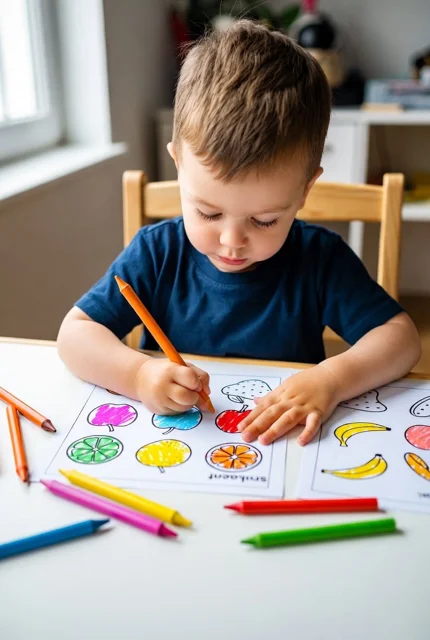
Preschool Coloring & Activity Bundle (printable PDF)
Seven kinds of printable preschool activities, including matching and cut-and-paste, for extra hands-on practice.
$8.99 printable PDF on Payhip · Instant PDF download; print at home
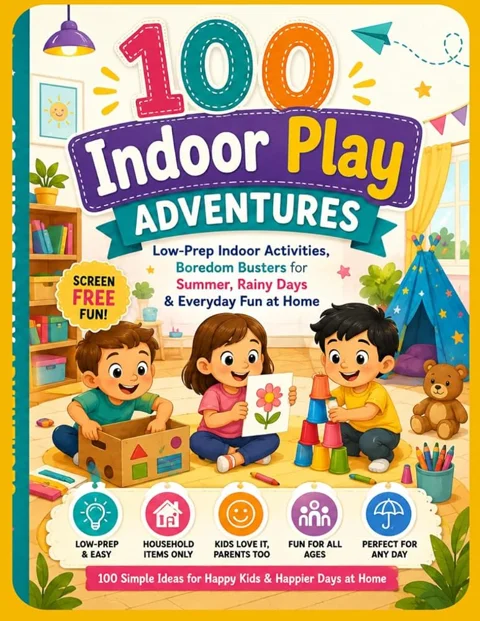
100 Indoor Play Adventures
One hundred low-prep indoor activities for the extra hour of dark evenings after the clocks fall back.
$14.99 paperback on Amazon.com · Paperback, shipped by Amazon
These are our own books and printables, and we earn money if you buy them. Prices as listed on Amazon.com and Payhip when we checked on 25 October 2026; prices can change, so please confirm on the product page.
Frequently asked questions
At what age should a child be able to tell time?
In U.S. schools that follow the Common Core, children learn to tell time to the hour and half hour in first grade (around age 6–7) and to the nearest five minutes, with a.m. and p.m., in second grade (around age 7–8). Preschoolers can start with routines, time words and the numbers on a clock.
How do I start teaching my child to tell time?
Start with daily routines and words like before, after, morning and night. Then introduce the clock face, use only the hour hand at first, practice o’clock times, explain the minute hand by counting by fives, and move on to half past.
Should kids learn analog or digital clocks first?
Many teachers start with analog clocks because they show time as a picture, then match them to digital times. Common Core standards ask first and second graders to read both analog and digital clocks.
When does daylight saving time end in 2026?
In the United States, daylight saving time ends on Sunday, November 1, 2026, at 2 a.m. local time, when clocks go back one hour, according to NIST. Hawaii and most of Arizona do not observe daylight saving time.
How do I help my child adjust to the fall time change?
The American Academy of Pediatrics suggests nudging naps and bedtime a few minutes each day in the direction of the clock change, starting about a week before. Keep the bedtime routine steady, get morning sunlight, and limit screens before bed. Kids usually adjust within about a week.
What age is Tick-Tock Time Adventures for?
It’s a telling-time workbook designed for kids ages 4–6 in preschool and kindergarten, covering clock faces, hour and minute hands, time to the hour, half hours and matching activities.
Here’s to happy clock-watching ⏰
ColorJoy makes bold, easy coloring books, workbooks and free printables for little hands, plus practical guides for parents. New guides and printables go up every week, so come back soon.
For gentle daily practice, our pick is Tick-Tock Time Adventures: big, friendly clock pages for ages 4–6.
Get Tick-Tock Time Adventures →
Next up: make a routine chart or try quiet time activities for those early-dark evenings.
Photos: Unsplash (Unsplash License). Book images and printable: ColorJoy / Mr A G. This guide is general information; for sleep concerns, talk with your pediatrician.