Toddler Development • Ages 1–3
What Age Can Toddlers Color? Milestones, Tips and Easy First Pages
Your toddler grabs a crayon, bangs it on the table and tries to taste it. Is that coloring yet? Here is a calm, age-by-age look at when little ones start scribbling, when neat coloring shows up, and how to set up a happy first crayon moment at home.

In this guide
The short answer
Most toddlers make their first crayon marks somewhere between about 12 and 18 months. Interest in drawing usually becomes steadier around the second birthday, and staying neatly inside the lines tends to arrive later, during the preschool years. Every one of those ages is approximate, because children reach drawing milestones at their own pace.
By the end of this guide you will know
- What “coloring” really looks like for a 1-year-old, a 2-year-old and a 3-year-old
- Why scribbles are the first and most important step
- Which crayons, paper and setup make life easier
- Six small habits that keep the crayon moving
- Which bold, simple pages make good first printables
If you have ever searched “what age can toddlers color”, you probably noticed that the answers sound a little vague. That is because there is no single birthday when a child becomes a colorer. There is a gentle path instead: first the taps and zigzags, then loops and lines, then the first shapes and pictures, and only later the careful filling-in that we usually picture when we hear the word “coloring”.
The good news is that you do not need to wait for the “right” age to offer a crayon. You only need to match the activity to where your child is today. This guide draws on well-known child-development resources such as OT Toolbox, ZERO TO THREE, Pregnancy, Birth and Baby and Lovevery, and we point to them as we go. Please treat all ages here as general guidance, not a test your child has to pass.
Real-life moments
Does this sound familiar?
These small scenes happen in almost every home with a new crayon owner. None of them means anything is wrong.
The crayon goes straight in the mouth
You hand over a shiny crayon and it heads for the tongue before it touches the paper.
Try this: stay close, offer a big chunky crayon, and keep sessions short. Mouthing is common at this age and usually fades as children get older.
The paper ends up on the floor
Your toddler slides the page off the table, then crawls after it. The marks land on the rug.
Try this: tape the paper down at the corners so it stays put, or tape a big sheet to the floor.
Two seconds and done
They make one zigzag, announce “all done” and wander off to do something else.
Try this: that is a real coloring session. Put the crayons away somewhere visible and offer them again tomorrow.
When do toddlers start scribbling and coloring?
Drawing starts long before a child can name a color. The first stage is simply making marks, and it is driven by curiosity: “When I move this, a line appears.” That cause-and-effect discovery is the real beginning of coloring.
First marks: about 12 to 18 months
According to the OT Toolbox, around 12 months a baby may make a short mark about an inch long, and between 15 and 18 months children typically make scribbles and lines. MedlinePlus also lists scribbling by 15 to 18 months among the expected fine motor skills for toddlers. Lovevery says a child may be ready to try crayons from roughly 11 to 18 months, but adds that your toddler may color for only a moment or two, or may not be interested yet at all.
So if your 14-month-old taps a crayon on the page twice and loses interest, that is perfectly typical. Offer again another day.
Steady interest builds around age 2
Pregnancy, Birth and Baby explains that most toddlers show an interest in making marks with crayons or pencils from around 2 years of age. They usually scribble with lots of lines and dots and circles, without drawing a recognizable picture, and that is exactly what we would expect. ZERO TO THREE describes the first stage as random scribbling from about 15 months to 2½ years, using big movements from the shoulder with the crayon held in a fist.

Why scribbling counts
It is easy to dismiss scribbles as mess, but they are doing a lot of work. Making marks teaches cause and effect, helps hand-eye coordination, and builds the arm, hand and finger control that later supports drawing and writing. The OT Toolbox lists eye-hand coordination, fine motor development and the foundation of pre-writing skills among the benefits of drawing. A scribble is also a first piece of communication: your child made something, and they want you to look at it.
🧠 Why it works
Big, sweeping arm movements come first. Finger control comes later. That is why toddlers scribble from the shoulder at first and gradually shift to wrist and finger movements as their muscles and coordination grow.
How to tell your toddler might be ready
Pregnancy, Birth and Baby suggests the first clue is simple interest. Your child may look for a crayon, hold it in their hand and make attempts at drawing. If they seem unsure, you can draw a few simple lines yourself so they see how a crayon meets the paper, then hand it over.
- They reach for crayons, pencils or markers when they see you using them
- They make marks when you hand them a crayon, even if only for a moment
- They watch you draw a line and try to copy the movement
- They are past the stage where every object goes straight in the mouth (or you can stay close while they explore)
⚠️ Safety note
Coloring at this age often involves mouthing. Stay close while your child draws, choose non-toxic crayons labeled for their age, and pick tools large enough that they are not a choking hazard. If your child swallows more than a tiny bit of crayon or you are worried, contact your pediatrician or your local poison information line.
What coloring looks like at 1, 2 and 3 years
Here is an at-a-glance look at what many children do at each stage. Remember that these are approximate and overlap. A child can scribble in loops on Monday and go back to taps on Tuesday.
| Age | What you may see | Typical grip | Try this |
|---|---|---|---|
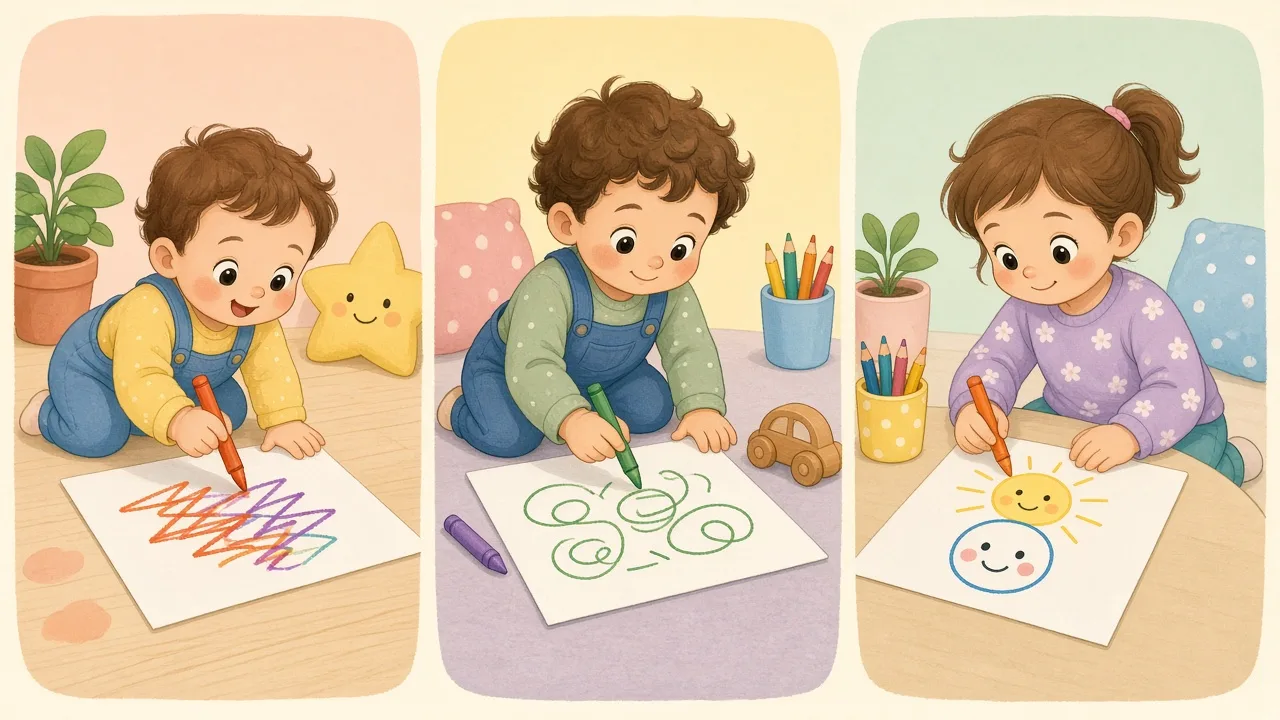
| Around 1 year (12–18 months) | Taps and big back-and-forth scribbles; lots of mouthing; short attention | Whole hand or fist | Big paper taped to the floor, one chunky crayon, you sitting nearby |
| About 18 months to 2 years | Spontaneous scribbles; imitates a vertical line you draw; may keep marks on the paper if reminded | Mostly fist, sometimes thumb and fingers | Narrate “up and down”, offer 2–3 colors, tape the page down |
| About 2 to 3 years | More controlled scribbling: lines, loops and circles; may “read” their drawing to you | Fist at times, thumb-and-fingers more often | Bold-outline pages for scribbling, short bursts, lots of choice |
| About 3 to 4 years | Circles, crosses and dots; first simple figures; names the picture | Fingers on the crayon; mature pencil grip still developing | Bold pages with big shapes, drawing together, “tell me about it” |
Around 1 year: taps, zigzags and mouthing
At this age, coloring is mostly sensory. ZERO TO THREE notes that many young children are interested in how the crayon feels and, sometimes, tastes. Lovevery describes the typical marks as small taps and big scribbles, made with the whole hand wrapped around the crayon. Huggies suggests starting with a large sheet of paper taped to the floor and a single short, fat crayon, because wide arm movements need a lot of room.
Keep it playful: you can scribble beside your child, say “round and round” or “bump, bump, bump”, and let them discover that the crayon makes lines. There is no need to name the colors yet, although a quiet “you picked red” does no harm.
Around 2 years: lines, loops and a bit more control
Around the second birthday, scribbles often become more controlled. Lovevery says that between about 18 and 24 months a toddler may imitate a vertical line you draw, and around 20 to 24 months may start imitating circular scribbles, with horizontal lines coming a little later. Between roughly 23 and 25 months, some children begin gripping the crayon with their thumb and fingers, though a fist grip often comes back when they want to press hard. Grasp is one of the most variable milestones, so do not worry if your child switches between grips.
The OT Toolbox describes age two as the start of controlled scribbling: lines and looping strokes, with movement still coming from the elbow and whole hand. This is a lovely age to add more colors, because toddlers enjoy choosing for themselves.
Around 3 years: circles, dots and the first “pictures”
By three, many children can make basic circles, crosses and dots, and sometimes poorly formed squares, according to the OT Toolbox. They may tell you what their drawing is even when it is not recognizable to anyone else, and a person often looks like a big head with floating legs. ZERO TO THREE describes a stage from about 3 to 5 years when children begin to draw pictures of objects and people and add more detail over time.
The OT Toolbox also notes that a mature, tripod-style pencil grasp is not expected until around age 4, and Lovevery places the pencil-style grip somewhere between 4 and 6 years. So a 3-year-old holding a crayon in a fist or a “scooped” grip is still well within the usual range.
💡 Quick tip
Ask “Can you tell me about your picture?” instead of “What is it?” Open questions keep the focus on the child’s idea. Pregnancy, Birth and Baby also notes that from about 2 to 3 years, children start to recreate images from memory, and their drawings make perfect sense to them even if no one else can tell what they are.
🩺 When to talk to your pediatrician
Children differ, and a slower start is usually nothing to worry about. Pregnancy, Birth and Baby suggests seeing your doctor or child health nurse if a 2- or 3-year-old has difficulty using small objects like a crayon, does not scribble or try to draw, or loses physical skills they had before. If something feels off to you, talk to your pediatrician; they know your child and can point you to the right support.
When can toddlers color inside the lines?
This is the question behind most searches for “what age can toddlers color”: when will my child color a picture the way I remember doing it? The honest answer is that there is no set age. Control over a crayon grows with hand strength, hand-eye coordination, attention and plain practice, and those develop on different schedules.
As a rough guide, scribbling is the norm through age 2 and into 3. Many children begin to stay mostly inside big, simple shapes sometime in the preschool years, and fine, careful coloring tends to come later still. Some children are neat at 3½ and others are happily scribbling at 5. Both are normal.
Free drawing and coloring pages can live side by side
Pregnancy, Birth and Baby recommends avoiding colouring-in or copying exercises in the very early stages of drawing, because they can feel restrictive and limit imagination. That is a useful reminder: blank paper and open-ended scribbling matter. At the same time, a simple picture can be a fun target for a child who likes it. A friendly way to hold both ideas is to offer blank paper most days and a bold-outline page now and then, with no rules attached.
A gentle ladder from scribbles to coloring in
- Blank-paper scribbles. Big paper, one or two chunky crayons, no goal. This is where every child starts.
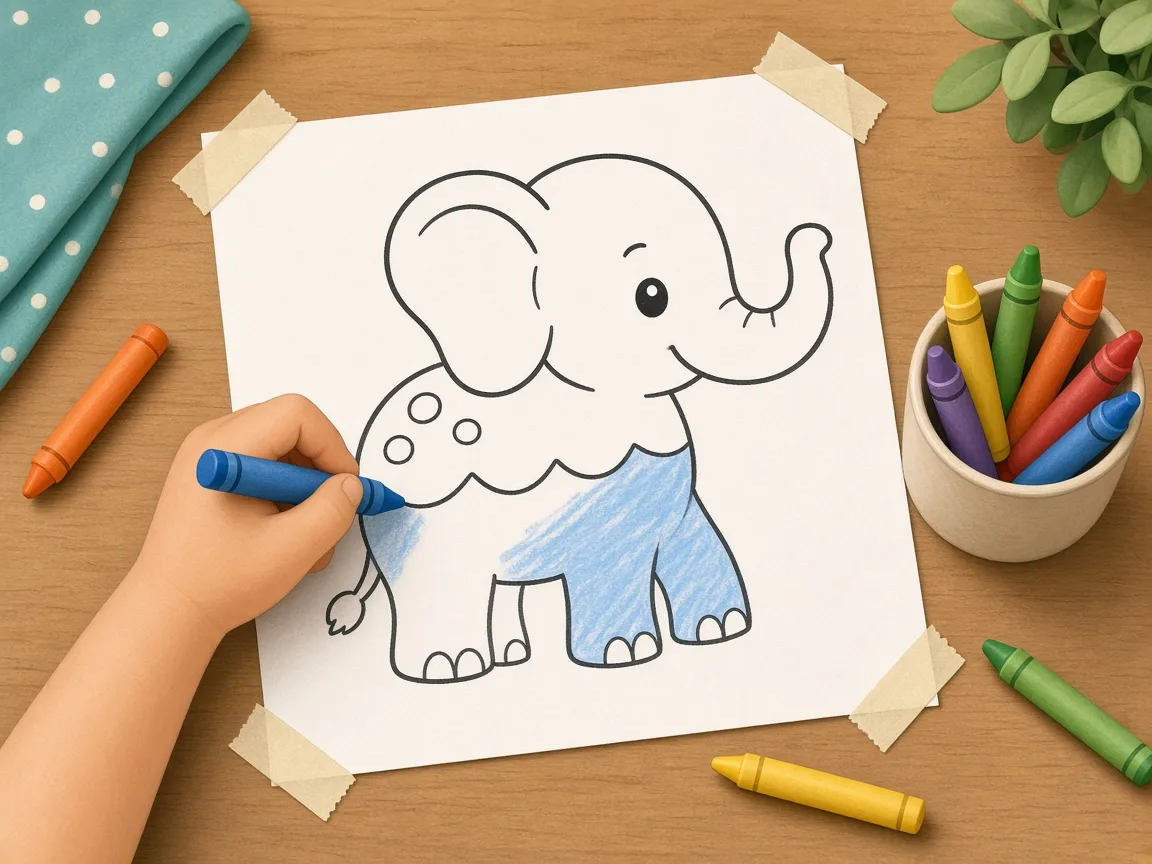
- Scribbles on a big picture. Offer a bold-outline animal and let your child scribble anywhere, including over the lines and off the page. Do not correct.
- Color the big parts. Point out a large area, like an elephant’s ear or body, and let them fill what they want. Praise effort and color choices.
- Mostly inside, mostly of the time. You may notice more control around the outline. Smaller sections and thinner lines can come next.
- Careful details. Later in the preschool years and beyond, children enjoy adding patterns, backgrounds and finishing touches.
You can move up and down this ladder freely. A tired or excited child might go back to scribbling, and that is fine.
🪄 Mom/Dad hack
Celebrate the choice, not the neatness. Try “You used so much orange!” or “That elephant has purple ears. Tell me about them.” When you do not correct the lines, children stay relaxed, and relaxed children keep coloring.
🧠 Why it works
The OT Toolbox says tracing and copying will not by themselves build creativity, but they do help with eye-hand coordination, fine motor skills and attention. That is why both free drawing and simple pages have a place.
Best crayons and paper for little hands
A good setup can make the difference between two seconds and ten minutes of coloring. You do not need anything fancy: you need tools that fit small hands and a surface that does not move.
| Tool | Why it works for toddlers | Keep in mind |
|---|---|---|
| Chunky or jumbo crayons | Easy to grip with a whole hand, harder to snap, and large enough that they are not a small-parts risk | Choose crayons labeled non-toxic and suitable for your child’s age |
| Short, thick crayon pieces | Some parents like the way a short crayon invites a fingertip grip as children get older | Make sure pieces are not small enough to be swallowed; supervise closely |
| Washable markers | Bright color with very little pressure, which can feel exciting for children who press lightly | Better for older toddlers and preschoolers; caps need supervision and the tips can fray |
| Large plain paper | Gives wide arm movements room, so marks stay on the page | Tape it down so it does not slide |
| Bold-outline printable pages | A simple target with big shapes and thick lines | Print one page at a time on regular paper; add cardstock if using markers |

The OT Toolbox suggests that very small crayons and pencils are hard for tiny, still-developing hands, and that children can get “stuck” in an early grasp when handed small tools too soon. Their takeaway is that coloring is fine when a child is interested, and that it should never be forced. A chunky crayon and a short, relaxed session beat a perfect technique every time.
Where to color
A low table with a child-sized chair is ideal, and a big sheet of paper taped to the floor is great for the youngest scribblers. Some families like an easel or paper taped to a wall for older toddlers. Whatever you choose, make sure your child can sit or stand comfortably and reach the paper without stretching.
Your five-minute setup checklist
- Masking tape for the paper corners
- Big plain paper or one printed page
- Three or four chunky, non-toxic crayons in a cup
- A wipe or damp cloth nearby
- An old shirt or smock (optional)
- A tray or placemat to catch crayon bits
⚠️ Safety note
Keep art supplies labeled for older children out of reach of toddlers, and follow the age guidance on every package. Stay within arm’s reach while your child colors, especially if they still put things in their mouth.
6 simple tips to make coloring stick
Coloring is a habit that grows from lots of tiny, happy moments. These six simple tips come from everyday coloring with little ones and echo the advice on our Toddler Animal Coloring Book page.
- Print one page at a time. A single animal feels exciting. A big stack can feel like too much for a two- or three-year-old. When one page is finished, you can always print another.
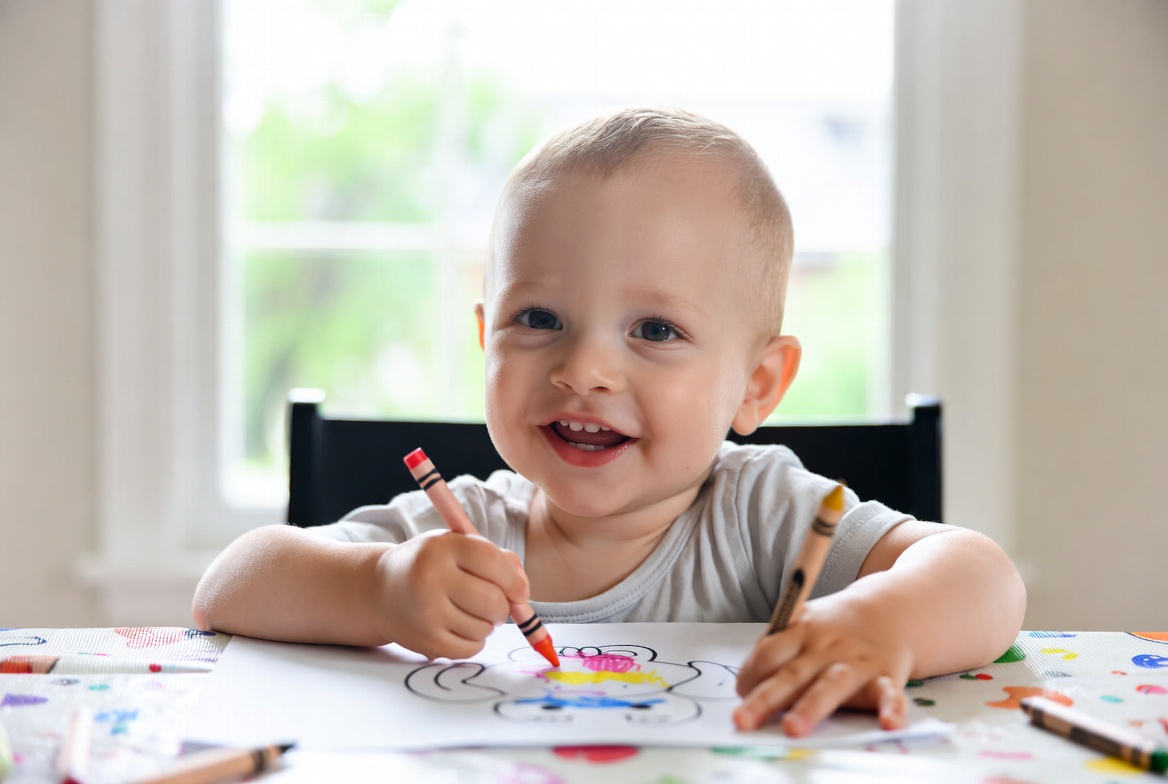
- Use chunky crayons. Thick crayons are easier for small hands to grip and harder to snap. Always supervise very young children with art supplies.
- Tape the page down. A bit of masking tape on the corners stops the paper sliding, so your child can focus on the marks instead of chasing the page.
- Talk about it. “What sound does a lion make?” Naming animals, colors and body parts turns coloring into a language game, and your toddler hears new words in a happy context.
- Forget the lines. Scribbles are the start of coloring. Staying inside the outline comes with time and practice, so let your child color the elephant any way they like.
- Keep it short. Five to ten minutes is plenty for many toddlers. Stop while it is still fun and come back later, so your child leaves wanting more.
🪄 Mom/Dad hack
Build coloring into a routine your child already enjoys, such as right after snack or while dinner is cooking. A predictable moment makes it easier to say yes, and it gives you a few quiet minutes too.
Keep the learning going
Once your child enjoys marks and simple pages, you can build hand strength and control through play. Our fine motor activities for 3-year-olds guide has dozens of easy ideas, from squeezing and pinching to threading and snipping, and it explains what is typical at each age.
What to do tonight
2 minutes
Set the stage
Tape a sheet of paper to a low table or the floor. Put out two or three chunky crayons.
5 minutes
Sit and scribble together
Draw big circles and lines beside your child. Describe what you see: “red zigzag!”
1 minute
Display it
Put a scribble on the fridge. It tells your child that their marks matter.
💛 Be kind to yourself
Some days the crayon never leaves the cup, and that is okay. Offering the invitation is the job; accepting it is your child’s.
Easy first coloring pages to print
If you would like to try printable pages, the best first pages share a few traits: one big subject, thick outlines, plenty of white space and a friendly face. Tiny details and busy backgrounds can come later. Here are some simple ones to start with.
What makes a good first coloring page
- One large animal or object, not a whole scene
- Thick, bold outlines that are easy to see
- Big open areas that invite scribbling
- A friendly face, because toddlers love to spot eyes and smiles
- Plain paper print-outs, so there is no pressure to keep them neat
In pictures
Four easy animal pages to start with
These are real pages from the ColorJoy Toddler Animal Coloring Book. Print one at a time.


Our pick: the Toddler Animal Coloring Book
The Toddler Animal Coloring Book is a printable PDF that its page lists as 58 animal pages: lions, elephants, pandas, giraffes, tigers and more, drawn with bold outlines for little hands. The page lists the book for ages 3 to 8, and its FAQ says a 2-year-old can use it with you nearby, because two-year-olds usually scribble rather than color neatly, and that is exactly how they practise.

Our pick for first pages
Toddler Animal Coloring Book
Bold-outline animal pages (the page lists 58) in an instant-download printable PDF. Print as many copies as you like for your family.
$1.99price as shown on the book page · ages 3–8 listed
Our own printable. ColorJoy may earn from purchases made through links on this site. Price as shown on the page when we checked.
Animal games for after the coloring
When a page is finished, you can stretch the fun: hold it up and let your child make the animal sound, stick finished pages on a door for “zoo tours”, or count ears, legs and tails together. These little games turn a short coloring session into language practice without any extra prep.
🩺 A gentle note
This guide shares general information for parents and is not medical advice. Every child develops differently, so if you have questions about your toddler’s fine motor skills or development, talk to your pediatrician.
Sources and further reading
FAQ: What age can toddlers color?
What age can toddlers start coloring?
Most toddlers make their first crayon marks somewhere between about 12 and 18 months, and interest in drawing usually becomes steadier around age 2. Early “coloring” is really scribbling, which counts. Ages are approximate, and every child is different.
Is it normal for my 2-year-old to only scribble?
Yes. Scribbling is the usual form of drawing at 2, and it is how children practise the arm, hand and finger control they will use later. Staying inside the lines usually comes later in the preschool years. If your child does not scribble or try to draw, or has trouble using small objects like a crayon, mention it to your pediatrician.
When will my child hold a crayon “properly”?
A mature, tripod-style grip is usually not expected until around age 4, and some sources place it between 4 and 6 years. Younger children often hold crayons in a fist or with the whole hand, which is a normal stage. Offering chunky crayons, lots of play and short sessions helps the grip develop over time.
Are coloring books good for 2-year-olds?
They can be a fun option if your child enjoys them, especially bold-outline pages with big shapes. Offer blank paper too, because open-ended drawing is important. Expect scribbles rather than neat coloring, keep sessions short, and stay close.
How long should a toddler color for?
Short is fine. Five to ten minutes is plenty for many toddlers, and some will only stay for a minute or two. Stop while your child is still enjoying it, and offer the crayons again another day.
What should I do if my toddler eats crayons?
Mouthing is common in younger toddlers, so choose non-toxic crayons labeled for your child’s age, supervise closely and keep sessions short. If your child swallows more than a small bit or you are worried, contact your pediatrician or your local poison information line.
Scribbles count. Start there.
Tape down a page, hand over a chunky crayon and let your toddler lead. Our bold animal pages are there when you are ready.