Holiday travel • Ages 1–5
Road Trip Activities for Toddlers: 30 Car-Seat-Friendly Ideas for Holiday Travel
Thanksgiving at Grandma’s, a winter-break drive, a long weekend away: the holidays put a lot of families on the road with a toddler buckled in the back. A toddler can’t stretch, can’t move around and can’t wait. This guide gives you 30 road trip activities for toddlers that actually work from a car seat, sorted by age, plus a simple plan for timing the drive, what’s safe to hand back, what to do if your little one gets carsick, and a free printable road trip bingo set.
✓ 30 easy ideas✓ Age-by-age table✓ Carsick tips✓ Free printable car bingo
In this guide
- Why road trips are hard for toddlers
- Safety first: car seats and what to hand back
- Plan the drive around your toddler
- 30 road trip activities for toddlers
- Best activities by age
- If your toddler gets carsick
- Screens on the road: a balanced plan
- Packing checklist + free printable
- For vehicle-loving kids: our coloring book
- FAQ & final thoughts
Why road trips are hard for toddlers
If your toddler melts down an hour into a drive, nothing is wrong with your child or your parenting. Long car rides ask toddlers to do the three things they find hardest: sit still, wait, and cope with boredom, all while strapped in, unable to see much, and often off their usual nap and snack schedule.
● What’s going on for your toddler
- They need to move. Toddlers learn and regulate their bodies through movement. Being buckled for hours is genuinely uncomfortable for them.
- Short attention spans are normal. A 2-year-old may play with one toy for just a few minutes before wanting something new. That’s typical development, not a behavior problem, and it’s why a rotation of small activities beats one big toy.
- Rear-facing means a limited view. Many toddlers ride rear-facing (which is safest, more on that below), so they see the back seat rather than the scenery you’re pointing at.
- Routines go out the window. Missed naps, late meals and new places make every child more fragile.
- They can’t understand “two more hours.” Time is abstract for toddlers. A visual countdown helps more than repeated reassurance.
The good news: you don’t need a car full of expensive gadgets. What helps most is a simple plan, a bag of small surprises you hand out slowly, a few no-prep games you can play from the front seat, and real breaks to run around. That’s what the rest of this guide covers.
💚 The mindset that helps
Safety first: car seats and what to hand back
Before activities, a quick safety check, because the best entertainment plan never comes before a correctly used car seat. These points come straight from the American Academy of Pediatrics (AAP) and Safe Kids Worldwide.
● Car seat basics for holiday drives
- Rear-facing as long as possible. The AAP’s car seat guidance for families says infants and toddlers should ride rear-facing as long as possible, until they reach the highest weight or height their seat allows. Most convertible seats allow rear-facing for 2 years or more.
- Snug harness, every ride. If you can pinch slack in the harness strap at the shoulder, it’s too loose (the AAP’s “pinch test”). The chest clip goes at armpit level.
- No puffy coats under the harness. The AAP’s winter car seat safety tips explain that bulky coats flatten in a crash, leaving the straps too loose. Dress your toddler in thin layers, buckle them in, then put a blanket or their coat on backwards over the straps. That’s especially important for Thanksgiving and winter-break travel.
- Back seat for every child under 13, per the AAP, and never a rear-facing seat in front of an active airbag.
- Never leave your child alone in the car, even for a minute at a gas station. The AAP warns that temperatures inside a car can reach dangerous levels in minutes.
● What’s safe to hand back
Safe Kids Worldwide’s car seat tips advise choosing toys that are soft and won’t hurt your child in a crash, and securing loose objects in the car. In practice that means:
On snacks: the CDC’s choking hazards page actually advises avoiding letting young children eat in the car, because you can’t watch them closely while driving. Many families save snacks for stops or have an adult sit in back during snack time. If your toddler does eat on the road, choose soft, easy-to-chew foods and keep an adult’s eyes on them.
⚠️ This article is general information
Plan the drive around your toddler
The single biggest factor in a calm car ride is when you drive. Toddlers who sleep well in the car can make a long drive almost easy; toddlers who fight car naps need more activity planning.
● Use nap time, but don’t count on it
Leaving 20–30 minutes before your toddler’s usual nap often means they doze off once the car gets moving. Bring their sleep cues: the same lovey, the same song, a muslin over the window shade area (secured, not loose). If naps are already a struggle at home, our 7-night routine for toddlers who won’t sleep has ideas you can adapt for travel nights at relatives’ houses.
● Match the plan to the length of the trip
● The “drip-feed” surprise bag
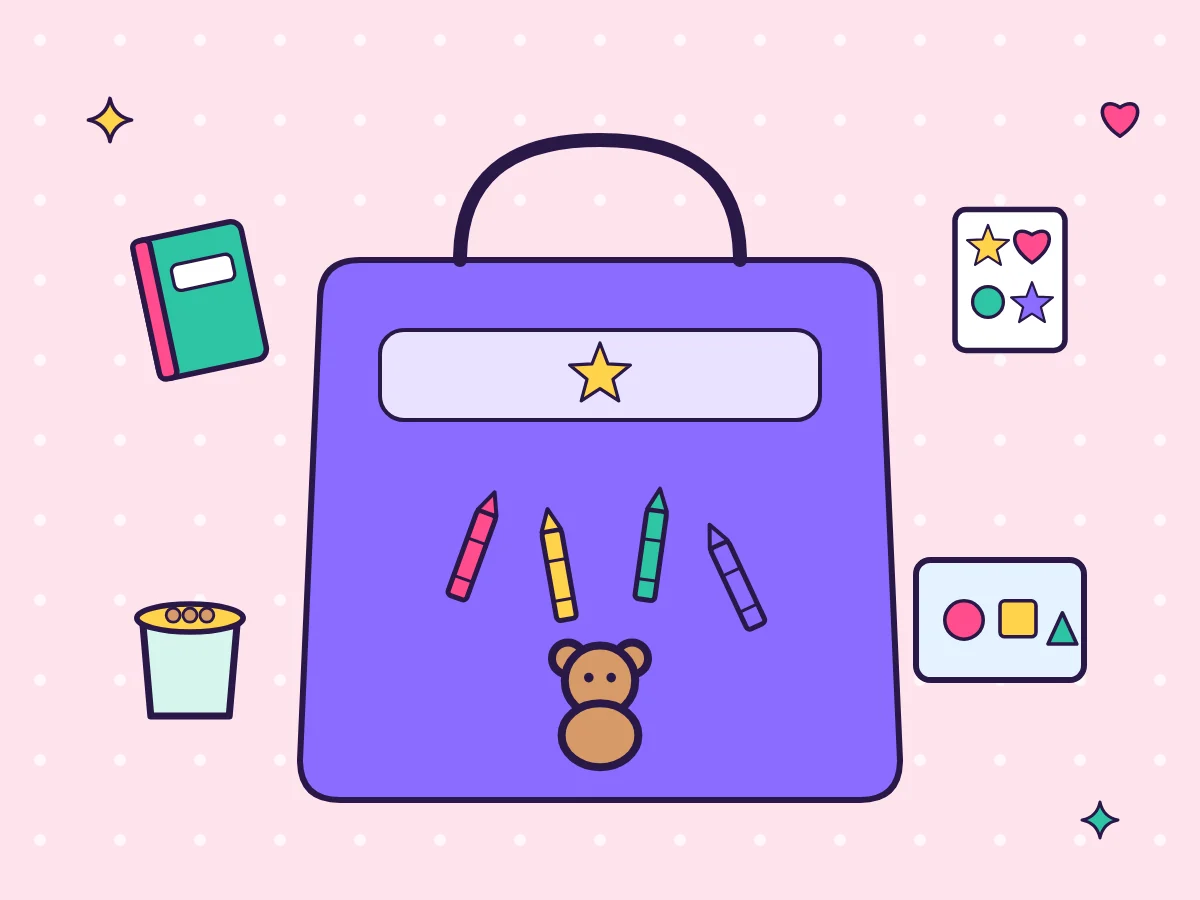
Wrap or bag small items separately and hand out one at a time, only when the current activity stops working. New-to-them items hold attention longer than toys from home, and they don’t have to be expensive: a dollar-store sticker pad, a new board book from the library, a small roll of painter’s tape, a fresh pack of chunky crayons. Unwrapping is half the fun.
● Plan real stops, not just gas stops
Toddlers need to burn off energy. Look for rest areas with grass, a park a few minutes off the highway, or an indoor play area at a mall or library for cold days. Even 10 minutes of running, jumping and climbing can buy you a calmer next leg. Many parents find stopping every couple of hours, or whenever a meal falls, works far better than pushing through.
30 road trip activities for toddlers
Here are 30 road trip activities for toddlers, grouped so you can pick quickly: no-prep games for when your hands are on the wheel, busy-bag items to hand back, mess-free art, and wiggle-break games for stops. Rotate between groups: a game, a bag item, a song, a snack, a stop.
Group 1 • No prep, no supplies
8 games you can play from the front seat
- Sing-and-do songs. “Wheels on the Bus,” “Old MacDonald,” “If You’re Happy and You Know It.” Leave out a word and let your toddler shout it.
- Animal sounds game. You say an animal, they make the sound, then swap. Toddlers love it when the grown-up gets it “wrong.”
- Color spotting. “Can you find something red?” Works even rear-facing: red seat belt buckle, red cup, red car behind you.
- Peekaboo with a mirror or blanket. A grown-up in the back can play peekaboo with a light muslin. (Skip add-on car seat accessories unless your seat’s manufacturer approves them; the AAP advises against extra products that didn’t come with the seat.)
- Story starters. “Once upon a time there was a little truck who…” Let your child add the next bit, even if it’s just “BEEP!”
- Count everything. Count trucks, cows, bridges or red cars. For younger toddlers, just say “one, two, three trucks!” together.
- Quiet-whisper challenge. Everyone whispers for one song. It’s silly, it’s calming, and it gives the driver a break.
- Name the sounds. Close your eyes (passengers only!) and name what you hear: the blinker, rain, a truck, music.
Group 2 • Busy bag
10 hand-back activities
- Sticker books. Reusable or regular sticker pads are a top car activity. Peel the edges for younger toddlers so they can grab them.
- Painter’s tape. A small roll is magic: stick strips on the car seat tray or window, peel them off, stick them on a doll.
- Water-reveal pads. Paint with water, colors appear, then fade so you can reuse. No mess.
- Felt board. A small felt square with felt shapes. Stays on lap, pieces cling instead of falling.
- Lift-the-flap board books. Sturdy, soft-edged, and interactive.
- Pipe cleaners in a bottle (ages 3+). Push pipe cleaners into the holes of an empty spice shaker. Great fine-motor work; supervise and skip for kids who mouth things.
- Window clings. Gel or vinyl window clings for the side window. Easy to move around again and again.
- Busy-board strap. A soft fabric book with zips, buttons and Velcro tabs keeps small hands busy.
- Toy phone or soft keys. Pretend phone calls to Grandma (“We’re coming!”) are a hit with 2-year-olds.
- Chunky crayons and a clipboard. For calm moments, scribbling or coloring on a sturdy board. (See the carsick section first.)
Group 3 • Mess-free art
5 low-mess creative ideas
- Mess-free marker pads. Special markers that only show color on matching paper.
- Magnetic drawing board. The classic doodle-and-erase board. Choose one with an attached pen.
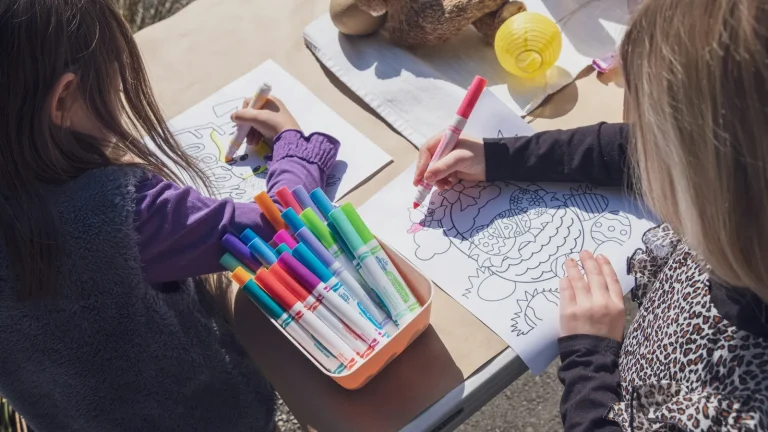
- Simple coloring pages. Big, bold outlines are easiest in a moving car. Vehicles are perfect for a road trip theme.
- Sticker scenes. A blank page plus stickers: make a road, a farm, a sky full of planes.
- Draw-what-you-see. Older toddlers draw something they spotted: a truck, a cow, a bridge. Scribbles count.
Group 4 • Rest-stop wiggle breaks
7 ways to burn energy fast
- Run-to-the-tree races. Pick a landmark and race to it. Let them win.
- Animal walks. Hop like a bunny, stomp like a dinosaur, waddle like a penguin to the bathroom and back.
- Bubble break. A small bottle of bubbles at a rest stop gets everyone moving.
- Freeze dance. Play a song on your phone; everyone freezes when it stops.
- Picnic and play. Eat at a picnic table instead of in the car so you can watch closely and they can move.
- Leaf or rock hunt. Find one red leaf, one round rock, one stick for the “treasure” bag.
- Truck watching. At a big rest area, watch the trucks park and leave. Name colors and count wheels.
🔄 When an activity stops working
Best road trip activities by age
Toddlers change fast. Here’s what usually works at each stage, so you can pack the right things.
If your child is 4 or 5, they’ll enjoy many of the games in our guide to things to do when kids are bored, and the road trip is a great time to practice some of the independent play skills that make every day easier.
If your toddler gets carsick
Motion sickness can turn a fun drive into a miserable one, and some of the classic car activities can make it worse. The CDC’s Yellow Book chapter on motion sickness notes that children under 2 don’t usually get motion sickness, but susceptibility then rises and peaks between ages 7 and 12. So a preschooler who seemed fine as a baby may start getting queasy.
● Signs to watch for
Young children often can’t say “I feel sick.” Watch for going pale, sudden quietness, yawning, sweating, fussiness, refusing snacks, or saying their tummy hurts. The CDC lists symptoms such as pallor, sweating, drowsiness and nausea, usually building gradually.
● What helps, according to the CDC
- Looking out at the horizon. A view of the world outside can help. For forward-facing kids, point out things far ahead.
- Avoiding reading and close-up visual tasks. The CDC lists avoiding reading as a behavioral countermeasure. That includes books, coloring and screens. For kids who get carsick, save these for stops, hotel rooms and Grandma’s living room.
- Fresh air and music. The CDC mentions distractions such as fresh air on the face and listening to music. Crack a window, play a favorite song or an audio story.
- Rest. Being short on sleep can make motion sickness worse, so a well-timed nap helps twice.
- Calm, regular breathing. For older preschoolers, “smell the flower, blow out the candle” breathing can help.
⚠️ About medicine
Keep a carsick kit within reach of the front seat: a lined bag or bucket, wipes, a change of clothes for your child (and a T-shirt for you), a towel, and water. Being ready takes the panic out of it.
Screens on the road: a balanced plan
Let’s be honest: many families use a tablet on long drives, and that’s a real choice parents make. The AAP encourages families to make a Family Media Plan that fits their values, and for children 2 to 5 recommends limiting screen use to about one hour a day of high-quality programming. A long drive is an exception day for many families. A few ideas keep it in balance:
- Screens last, not first. Start with songs, games and the busy bag. Save a show for the hardest stretch (often the last hour).
- Try audio first. Audio stories and kids’ music give you much of the calm without the visual focus, which also helps kids prone to carsickness.
- Download ahead so you’re not dealing with spotty signal, and use a secured holder so the device can’t fly forward in a sudden stop.
- Have an “off” plan. Tell your toddler what comes after the show (“after this show, we stop for a picnic”) so turning it off isn’t a surprise.
If screens become a battle once you’re home, our guide on cutting evening screen time without a meltdown walks through gentle ways to reset.
Packing checklist + free printable
Pack the car the night before so the morning goes smoothly. Keep the activity bag within reach of whoever sits closest to your toddler, and keep backups in the trunk.
Road trip checklist for toddlers
- ☐Car seat checked: snug harness, chest clip at armpits, no puffy coat underneath
- ☐Blanket or coat to put over the buckled straps
- ☐Surprise bag: 4–10 small, soft, individually wrapped items
- ☐Sticker pad, painter’s tape, water-reveal pad or felt board
- ☐Chunky crayons + a few coloring pages + a sturdy board
- ☐Lovey, pacifier (if used), favorite board book
- ☐Downloaded songs and audio stories
- ☐Toddler-safe snacks for stops + water cups
- ☐Carsick kit: bags, wipes, towel, spare clothes for child and adult
- ☐Diapers, wipes, potty seat or travel potty if potty training
- ☐Printed road trip bingo and countdown page (below)
🎁 Free printable
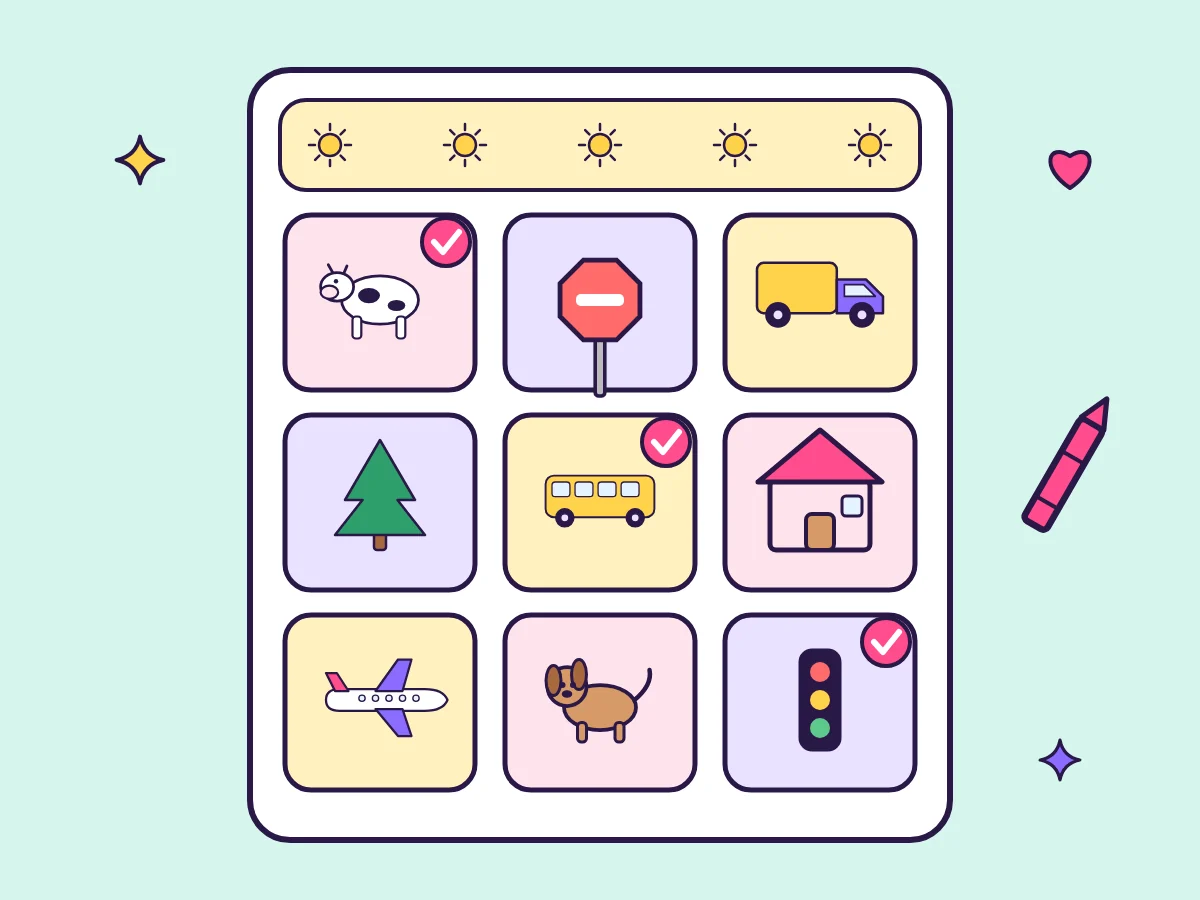
Free printable: Road Trip Bingo for Toddlers (3 pages)
We made this printable for this guide. It’s free and isn’t a page from any of our paid products. Slide the pages into a plastic sleeve and use a dry-erase crayon or stickers to mark them, so you can reuse them on the way home.
- Page 1: Picture bingo card A (cow, stop sign, truck, tree, bus, house, airplane, dog, traffic light)
- Page 2: Picture bingo card B (gas station, bridge, red car, cloud, sun, orange tree and more)
- Page 3: “Are we there yet?” countdown: color one car per stop or per hour
Free, no email needed. US Letter size; print at 100%. For personal and classroom use.
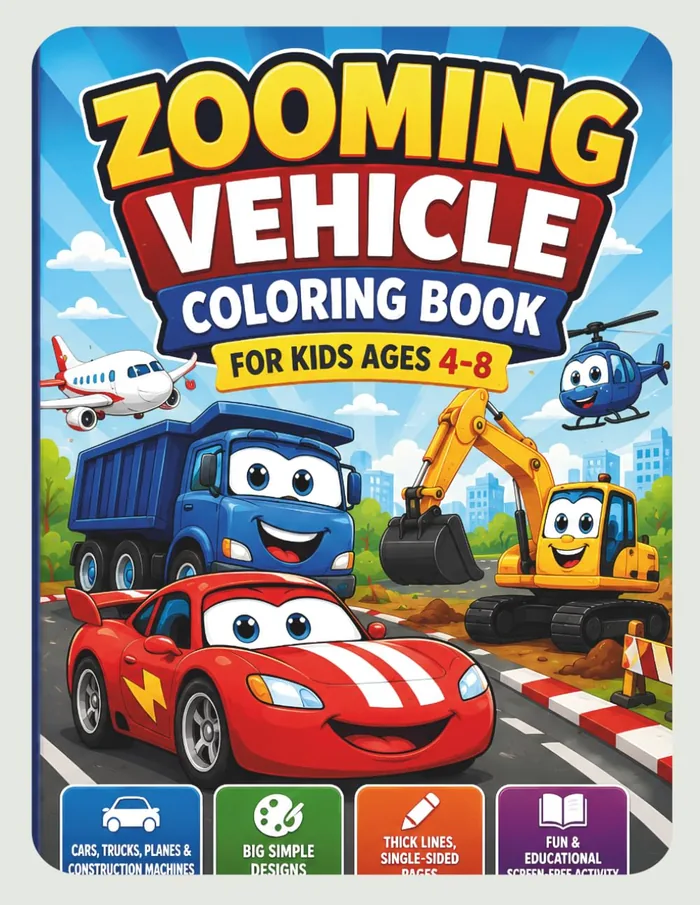
For vehicle-loving kids: our Zooming Vehicle Coloring Book
If your child spends the whole drive shouting “TRUCK!” every time one passes, a vehicle coloring book keeps that excitement going at rest stops, in the hotel and at Grandma’s house. We publish one: the Zooming Vehicle Coloring Book for Kids Ages 4–8 (paperback, sold on Amazon).
📖 What it is (and isn’t)
- Format: paperback, sold and shipped by Amazon.com. Nothing to print.
- Price: $9.99 on Amazon.com when we checked on 18 October 2026. Prices can change, so please check the listing.
- Inside (per the listing): 40+ illustrations of cars, trucks, planes and construction machines with thick, simple lines and large designs.
- Size: 68 pages, 8.5 x 11 inches, with single-sided pages (the listing says no bleed-through, even with markers).
- Ages: listed for ages 4–8. Younger toddlers can scribble on the big shapes with a grown-up’s help, but it’s designed for preschool and up.
- Not a car-seat toy for carsick kids. Like any coloring, it’s best at stops and destinations for children who get motion sickness.
How it helps on a road trip: because the pages are single-sided, you can tear out three or four vehicle pages before you leave and clip them to a sturdy board in the car, instead of handing back a whole book. Match the pages to what you’ll see (a dump truck, a bus, a plane if you’re heading to the airport) and ask your child to color the one they spot first. At the destination, the full book is a quiet activity for the hour before a big holiday meal when everyone is busy in the kitchen.
It’s not a fit if your child is under 2 or isn’t interested in vehicles; the free bingo printable above works for every age.
See the Zooming Vehicle Coloring Book on Amazon ($9.99) →
This is our own book, and we earn money if you buy it. Price checked on Amazon.com on 18 October 2026; please confirm on the product page: amazon.com/dp/B0H3NTR9DP. There’s no Payhip PDF edition of this book.
📚 Related books from ColorJoy
If this topic is on your mind, these titles from our own shelf fit well alongside it.

Funky Face Dog Coloring Book (Ages 4–8)
Compact 6×9 size fits a car-door pocket or diaper bag, with 20 funny dog faces in bold, easy lines.
$9.99 paperback on Amazon.com · Paperback, shipped by Amazon
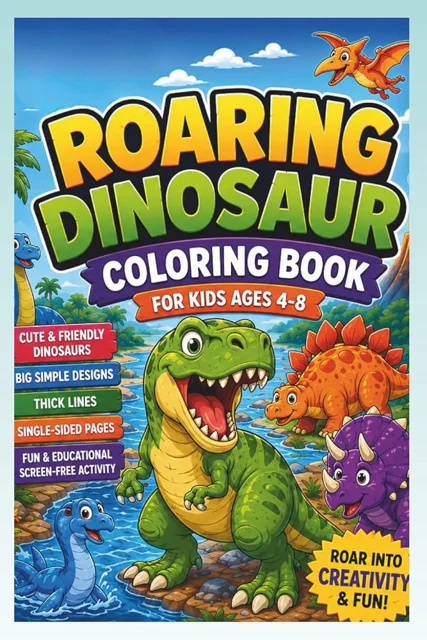
Roaring Dinosaur Coloring Book (Ages 4–8)
Another 6×9 travel-size book, with friendly dinosaurs for rest stops and the hotel room.
$9.99 paperback on Amazon.com · Paperback, shipped by Amazon
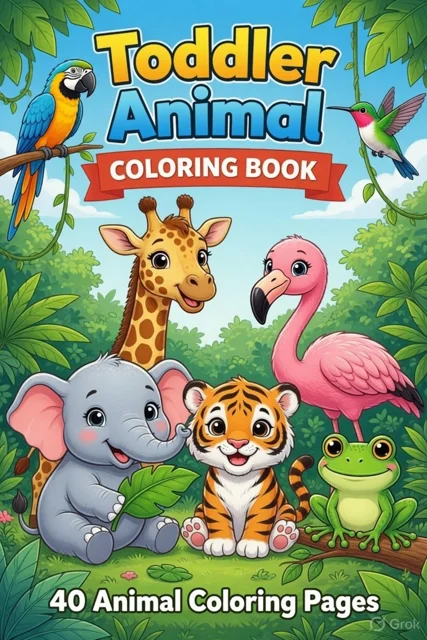
Toddler Animal Coloring Pages (printable PDF)
Print a handful of simple animal pages the night before you leave and clip them to a board (ages 3–8).
$1.99 printable PDF on Payhip · Instant PDF download; print at home
These are our own books and printables, and we earn money if you buy them. Prices as listed on Amazon.com and Payhip when we checked on 18 October 2026; prices can change, so please confirm on the product page.
FAQ & final thoughts
What are the best road trip activities for toddlers?
The ones that are soft, small and new to your child: sticker pads, painter’s tape, water-reveal pads, felt boards and board books, handed out one at a time. Mix them with no-prep games like songs, animal sounds and color spotting, and plan real stops for running around.
How often should we stop on a road trip with a toddler?
There’s no official rule. Many families find stopping every couple of hours, or at every meal, works well. A 10-minute run-around break often makes the next stretch much calmer than pushing through.
How do I keep a 1-year-old busy in the car?
Keep it simple: board books, soft toys, crinkly cloth books, action songs and peekaboo with a grown-up in the back. Time the drive around naps, because 1-year-olds have very short attention spans.
Is it safe for my toddler to eat snacks in the car?
The CDC advises avoiding letting young children eat in the car because it’s hard to supervise them. Many families save snacks for stops or have an adult sit beside the child. If you do snack on the road, choose soft foods and avoid choking hazards like whole grapes, popcorn and nuts.
Can my toddler wear a winter coat in the car seat?
The AAP advises against bulky coats or snowsuits under the harness, because padding can compress in a crash and leave the straps too loose. Use thin layers, buckle up, then add a blanket or the coat backwards over the straps.
What helps a toddler who gets carsick?
The CDC suggests looking at the horizon, avoiding reading and other close-up visual tasks, fresh air and music. Save coloring and books for stops. Ask your pediatrician before using any motion sickness medicine.
Should I use a tablet on a long drive?
It’s a family choice. Many parents save screens for the hardest stretch, try audio stories first, download shows ahead and secure the device. The AAP’s Family Media Plan can help you set limits that fit your family.
● Final thoughts
A road trip with a toddler will never be perfectly quiet, and that’s okay. Check the car seat, time the drive around sleep, pack a small bag of surprises, and stop to let your little one run. Then treat the drive as a string of short, doable chunks. Print the bingo cards, put on the song they love most, and enjoy the moment your toddler spots their first cow and yells it to the whole car.