Toddler Won’t Sleep: A 7-Night Routine That Doesn’t Need an App

US · UK · Canada parent guide · Screen-free wind-down · Nap windows · Pediatric sleep basics (not medical advice)
It is 7:55. The bath is done. The pajamas are on. And somehow your toddler is sprinting the hallway like it is morning recess. You have tried the story. You have tried the “last cuddle.” You have even tried the calm voice that only exists in parenting books. Still: toddler won’t sleep. The bedtime refusal is loud. The overtired second wind has arrived. And every sleep app on your phone is offering another chart, another button, another night of glowing blue light when what you actually need is a quieter room and a plan you can remember half-asleep.
This ColorJoy guide is for parents in the United States, the United Kingdom, and Canada who want a practical 7-night bedtime routine that does not require an app. You will get shared language around nap windows and pediatric sleep basics, region-neutral timing tips, and gentle pointers toward reputable guidance from sources such as the American Academy of Pediatrics / HealthyChildren bedtime tips and NHS advice on sleep and young children. Softly, we will also mention optional calm printables—because a quiet coloring page can be a kinder bridge than one more video—without turning bedtime into a sales pitch.
Disclaimer: This article is general parenting information, not medical advice. It does not diagnose or treat sleep disorders, night terrors, apnea, or other medical conditions. If your toddler’s sleep suddenly worsens, includes snoring, gasping, long pauses in breathing, extreme daytime sleepiness, or you are worried, contact your pediatrician, GP, or local health visitor. When in doubt, ask a clinician who knows your child.
Why Your Toddler Won’t Sleep (Bedtime Refusal + the Overtired Second Wind)
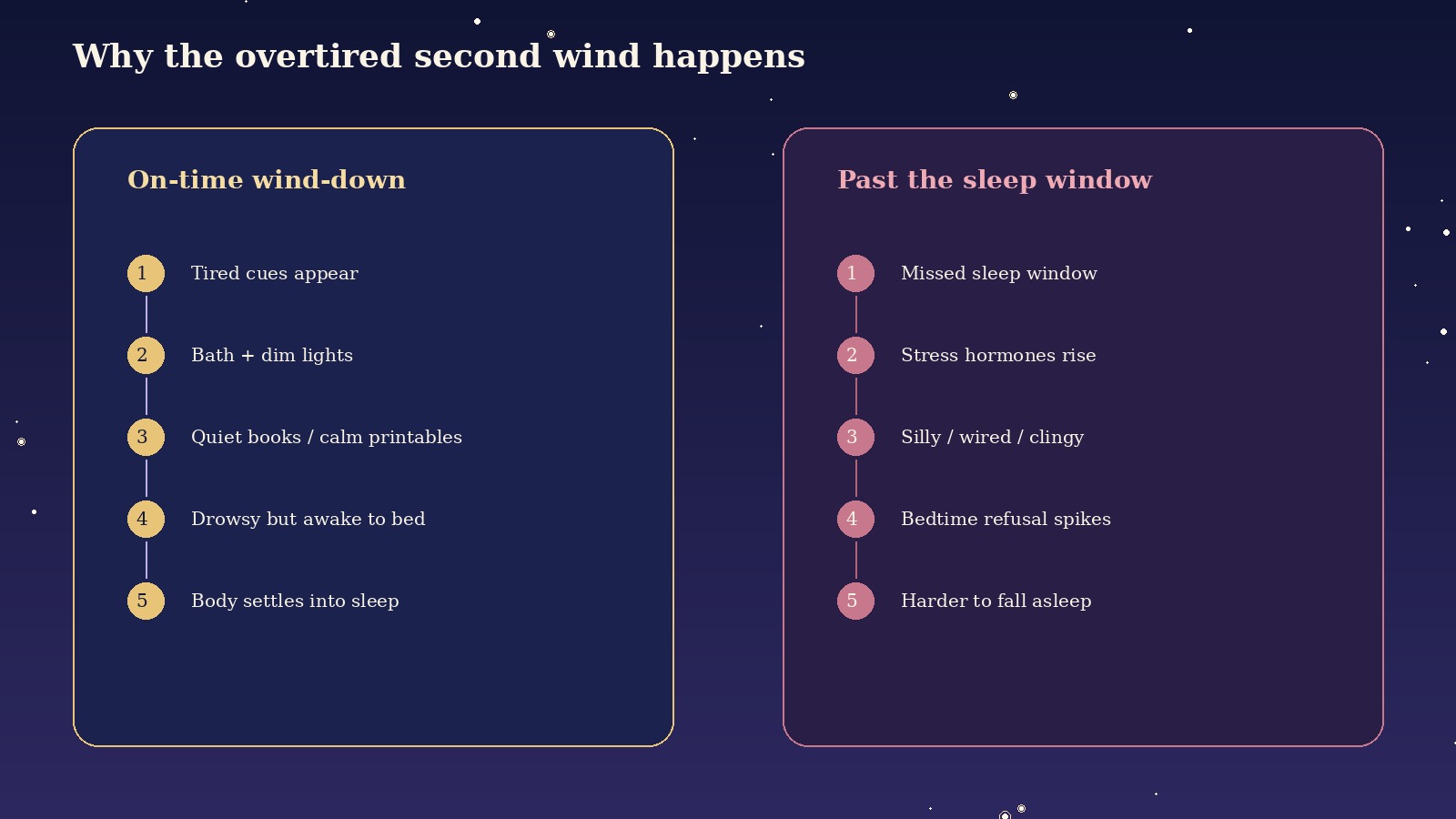
When a toddler won’t sleep, it rarely means they are “being difficult for fun.” More often, one of three things is stacking:
- 1. They missed their sleep window and are now wired (the classic overtired second wind).
- 2. The evening is too stimulating—bright lights, roughhousing, tablets, or a long wind-up with no clear landing.
- 3. Bedtime feels unpredictable, so stalling, calling out, and climbing out of bed become the toddler’s job description.
What bedtime refusal looks like in real homes
Bedtime refusal is the “one more book,” the sudden thirst, the phantom monster, the dramatic flop to the floor, the “I need Daddy,” then “I need Mummy,” then “I need the blue sock.” It shows up in US suburbs after late sports, in UK flats when darkness arrives before tea feels finished, and in Canadian apartments where winter evenings stretch forever. The geography changes. The pattern does not.
Why the overtired second wind feels so personal
Toddlers have a biological sweet spot for falling asleep. Push past it, and the body can release alerting chemicals that make a child look more energetic—not less. Parents often describe it as: They were rubbing their eyes at 6:40… and by 7:30 they are bouncing off the walls. That is the overtired second wind. Fighting it with more activity (or more screen “help”) usually makes the next hour harder.
The practical takeaway for a 7-night bedtime routine: protect the window more than you chase perfection. An earlier, calmer start often beats a later “perfect” routine that never begins.
What pediatric-style guidance tends to emphasize
Across AAP-style and NHS-style messaging, you will hear overlapping themes: consistent routines, calm activities before bed, limited screens in the wind-down hour, and putting children to bed drowsy but awake when that is your family’s goal. The HealthyChildren bedtime tips and NHS sleep guidance linked in the introduction are solid parent-facing starting points—short, predictable sequences matter more than perfection.
None of these sources replace your child’s clinician. They do help SEO-minded parents find trustworthy anchors—and they help you remember you are not inventing bedtime from scratch.
Nap Windows and Timing Basics for Toddlers
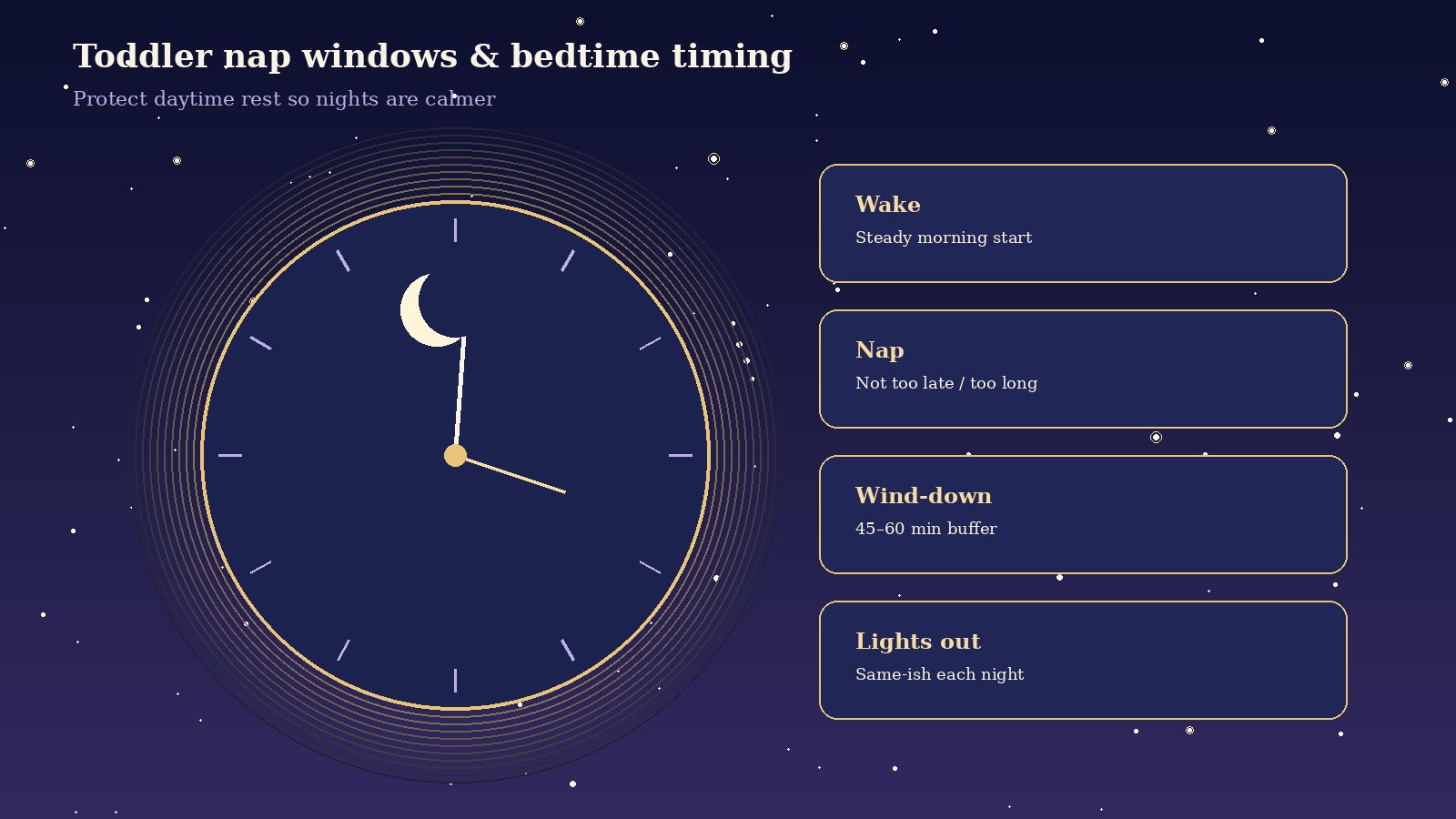
If your toddler won’t sleep at night, start with daytime timing before you buy another white-noise gadget.
A simple, region-neutral frame
Many toddlers (roughly ages 1–3, with huge individual variation) do best with:
- A steady morning wake time (even on weekends, within about an hour).
- One daytime nap for many older toddlers (younger toddlers may still take two).
- A nap that is not too late—late naps are a common fuel for bedtime refusal.
- A bedtime that matches the child’s sleep need, often earlier than adult social clocks prefer.
Total sleep across 24 hours for many toddlers lands in a broad band often cited around 11–14 hours including naps. Your child may sit at either end. Watch mood and morning wake-ups more than a single “perfect” chart.
Nap windows without an app
You do not need an app to track nap windows. Use a paper notepad on the fridge for seven days:
- Wake time
- Nap start / nap end
- First tired cues in the evening (eye rubbing, zoning out, clinginess, silliness)
- Lights-out time
- How long until asleep (rough estimate is fine)
Patterns appear fast. If nap ends at 4:15 and bedtime is “supposed” to be 8:30, your toddler may hit an overtired second wind every night. The fix is often earlier bedtime, slightly earlier nap, or a shorter nap—not a louder lullaby playlist.
US / UK / Canada timing notes (lightly)
- United States: After-school care and evening activities can push dinner late. Protect a wind-down buffer even if bedtime shifts seasonally with daylight.
- United Kingdom: Early winter darkness can make evenings feel longer. Dim lamps earlier; do not wait for “proper night” to start the calm routine.
- Canada: Long winter indoor stretches make screen swaps tempting. Plan a physical “evening basket” so quiet play is the default when the sun disappears at 4:30.
Wind-Down Without Apps: A Calm Pre-Bed Hour

If the battle begins at the tablet handoff, read ColorJoy’s companion guide on how to cut evening screen time without a meltdown. This article assumes a simpler goal: a wind-down that does not need an app.
The 45–60 minute buffer
Aim for a stretch before lights-out where:
- Overhead lights drop; lamps take over
- Roughhousing ends
- Screens are charging in another room
- Voices get quieter (even if you are tired and want to scroll)
That buffer is where the 7-night bedtime routine either succeeds or frays.
Optional quiet activities (printables welcome, not required)
Screen-free does not mean silent monastery. It means low-arousal. Ideas that work across US, UK, and Canadian homes:
- One or two familiar books (not a brand-new cliffhanger series at 7:50)
- Soft music or quiet humming—no dance party
- Simple puzzles with large pieces
- Stickers on a scrap page
- Calm coloring or preschool worksheets from a printed ColorJoy set, used as an optional quiet corner—not a new demand
Keep the activity short. If coloring wakes your child up, switch to books only. The point is a bridge, not a curriculum block at bedtime.
A sample wind-down sequence (adjust the clock to your family)
- 1. Announcement: “Bath in five minutes.”
- 2. Bath + pajamas + teeth
- 3. Dim lights + water cup ready
- 4. Two books or five quiet minutes of coloring
- 5. Lovey / comfort object check
- 6. Lights out phrase you will use all seven nights
- 7. Leave (or stay briefly, if that is your chosen method—consistency matters more than celebrity methods)
The 7-Night Bedtime Routine (Centerpiece)

This is the heart of the article: a 7-night bedtime routine for families whose toddler won’t sleep and who are done outsourcing the plan to an app. Each night has one job. Do not try to fix nap, screens, room setup, and calling-out scripts on the same evening. Stack gently.
Night 1 — Observe Without Overhauling
Job: Gather truth, not trophies.
Tonight you change almost nothing except your attention. Write down:
- When tired cues first appeared
- What happened in the hour before bed (screens? park? visitors?)
- Exact bedtime refusal tactics your toddler used
- How you responded (rescues, threats, extra books, lying down)
- Morning mood tomorrow
Why Night 1 matters: Parents often “fix” bedtime mid-chaos. Observation reduces shame and shows the real levers—usually timing and stimulation, not a missing gadget.
Script: “Tonight we’re practicing noticing. You’re safe. Lights out after two books.”
Night 2 — Start Wind-Down 15–20 Minutes Earlier
Job: Beat the overtired second wind by meeting the sleep window.
If Night 1 showed cues at 6:50 and chaos at 7:40, pull the whole sequence earlier. Bath starts sooner. Books start sooner. You are not “making bedtime early forever”—you are testing whether an earlier landing reduces bedtime refusal.
Tips:
- Warn in the afternoon: “Tonight bath is a little earlier.”
- Keep the same order of steps so the change feels familiar.
- If your toddler still wakes at the usual morning time, they may simply need that earlier night sleep.
Script: “Bodies sleep better when we start cozy time sooner. Two books, then lights out.”
Night 3 — Fix the Nap / Day Timing Leak
Job: Stop daytime rest from sabotaging night sleep.
Use your fridge notes. Common fixes:
- Cap a long afternoon nap (for some toddlers, waking by a set time helps)
- Move nap slightly earlier
- Protect outdoor light and active play earlier in the day so the body is ready for night
Avoid cutting the nap entirely in one dramatic gesture unless your clinician or your child’s age-and-mood pattern clearly supports it. Many toddlers still need daytime sleep; the issue is often placement, not existence.
Script: “Nap helps your body. Tonight we’ll still do the same cozy steps.”
Night 4 — Install One Clear Limit Script
Job: Reduce the negotiation marketplace.
Pick one limit you will hold for the next four nights:
- Only two books
- One water cup already by the bed
- Door open / night light preference stated once
- No new toys after lights out
Write the script on a sticky note for yourself. Tired parents improvise; improvisation invites debate.
Sample scripts for bedtime refusal:
- “I hear you want another book. We already did two. I love you. Goodnight.”
- “Water is in your cup. I’ll check on you after I count to 100 in the kitchen.”
- “It’s dark-o’clock. You can be mad. I’m still keeping you safe in bed.”
Boring consistency beats clever speeches. NHS-style advice often emphasizes calm returns to bed with minimal fuss—the spirit is the same: less entertainment at 2 a.m., more predictability.
Night 5 — Swap Screens for a Quiet Basket
Job: Remove the highest-arousal evening habit for one protected buffer.
If tablets have been the default, Night 5 is when the charging basket wins. Offer a replacement that is already visible: crayons, a simple printable, stickers, or a puzzle. Optional ColorJoy printables can live in that basket year-round so you are not inventing a new idea at 7:20 (see the calm wind-down shelf below).
If screens are already gone, use Night 5 to remove a different stimulant: tickle fights, YouTube in the background, or bright kitchen overheads during dessert.
Script: “Tablet is charging. You can color one page or pick books. Then bath.”
Night 6 — Protect the Buffer Like a Boundary
Job: Make the calm hour non-negotiable for adults, too.
Night 6 is about your follow-through. No “quick email.” No starting a new show. No grocery order that takes twenty minutes of bright phone light at the table while your toddler watches your face glow.
Dim the house. Put your own phone on a dresser. Sit on the floor for the quiet activity. Children borrow our nervous systems. If you are buzzing, they will too.
Checklist:
- Lamps on, overheads off
- Devices charging away from the sofa
- Same lights-out phrase as Night 4
- Partner / co-parent briefed so you do not undermine each other
Night 7 — Settle the Rhythm (and Plan the Next Week)
Job: Lock the pattern and review.
On Night 7, run the routine you have practiced: earlier wind-down if it helped, nap timing tweak if it helped, one clear limit script, quiet basket, protected buffer. After lights out, jot:
- What improved (even 10%)
- What still sparks bedtime refusal
- One adjustment for next week (not five)
Celebrate boring. Boring is the goal. A toddler who falls asleep with less drama is a win—even if nights are not perfect yet.

A note on comfort objects and the sleep environment
Many toddlers settle more easily with a familiar lovey once they are past infancy and your clinician’s safe-sleep guidance allows soft toys. Keep the room comfortably cool, dim, and boring after lights-out. Blackout curtains help in northern summers when UK and Canadian evenings stay bright late; white noise can mask hallway sound in open-plan US homes. None of these tools replace timing—but they support the 7-night bedtime routine once the overtired second wind is less in charge.
If separation anxiety spikes at bedtime, shorter, more frequent check-ins can reassure without turning into a party. Stay boring. Stay warm. Stay consistent. That combination is how bedtime refusal loses its audience.
Calm wind-down shelf (optional)
When screens go into the charging basket, a small shelf of quiet paper options can make the swap feel easier. These printables and coloring books are optional—never required for the 7-night plan.
Free printable sample: Download a free Magical Butterfly sample page to try a calm page tonight.
Optional ColorJoy books for a gentle pre-bed bridge (browse or get the paperback):
- Calming Mindful Coloring Book for All Ages
- Bold & Easy Fairy Tales Coloring Book for Kids Ages 4-8
- Floral Girl Coloring Book for Pretty Girls
- Cute Wild Animals Coloring Book for Kids
- Roaring Dinosaur Coloring Book
For a fuller screen-free set, see the preschool learning bundle on ColorJoy, or browse the Magical Butterfly coloring book page.
Some book links go to online retailers where ColorJoy books are listed. We may earn from qualifying purchases. This article is not medical advice.
Common Mistakes That Keep Bedtime Refusal Alive
1. Waiting until the second wind to “start bedtime”
If you begin the routine when your toddler is already silly-wired, you are climbing a hill in roller skates. Start earlier for a week before you decide “routines don’t work.”
2. Adding more stimulation to “tire them out”
A late park sprint or wrestling match can backfire. Daytime movement is wonderful. Right-before-bed high arousal often feeds the overtired second wind.
3. Letting the routine become a 70-minute variety show
Long routines create more opportunities to stall. Aim for a short, repeatable sequence. Sleep Foundation-style guidance often points to roughly half an hour of calming steps for many children—adjust to your bath habits, but do not build a Broadway show.
4. Different rules with different adults
If one caregiver offers three extra books and the other offers zero, your toddler will audition for the better deal every night. Align on Night 4’s script.
5. Using the phone as the soother, then wondering why the room feels “wrong” without it
Phones work—until they do not. If you need a bridge, prefer low-light audio (no screen) or your voice, then fade it as nights improve.
6. Expecting Night 1 to feel like Night 7
Behavior change lags. Toddlers test whether the new limit is real. Hold the line kindly for the full week.
7. Ignoring red-flag medical clues
Chronic loud snoring, gasping, very restless sleep with pauses, or sudden severe changes deserve a clinician visit. A 7-night routine is not a substitute for medical care.
FAQs: Toddler Won’t Sleep, Bedtime Refusal, and Second Wind
How long should a 7-night bedtime routine take each evening?
Most families do well with a 20–40 minute wind-down once the sequence is familiar. Baths add time. Keep books capped. If the routine regularly runs past 60 minutes, trim steps—not patience.
What if my toddler leaves the room repeatedly?
Decide your safe response in advance: calm return to bed, minimal talk, same phrase. Some families use a brief check-in schedule. The key is low entertainment value and high consistency. If safety is a concern (climbing furniture, running toward stairs), prioritize a safe sleep environment and speak with your pediatrician or health visitor about strategies that fit your home.
Should I drop the nap so my toddler will sleep at night?
Not automatically. Many toddlers still need a nap; a late or long nap is the more common culprit. Track for a week before dropping. If you experiment, change one variable at a time.
Is melatonin a solution for bedtime refusal?
Do not start supplements because an internet chart suggested it. Discuss any sleep aid with a clinician. Behavioral timing and routine changes are the first-line tools in this article.
What if only one parent can run bedtime?
Simplify. A shorter routine done the same way beats a perfect routine that only exists on weekends. Write the steps on a card for babysitters and grandparents.
Can quiet printables really help when a toddler won’t sleep?
They help some children as a pre-bed bridge, not as a magic sleep cure. Keep them optional, calm, and time-limited. If paper play energizes your child, switch to books only. ColorJoy’s printables are designed for screen-free calm—not for replacing medical advice.
When should I call a pediatrician or GP about sleep?
Call sooner if you see breathing concerns, extreme daytime sleepiness, developmental regression you cannot explain, or if family exhaustion is becoming unsafe (for example, driving while severely sleep-deprived). Also seek help if you suspect a sleep disorder rather than ordinary bedtime refusal.
Bringing It Together: A Calmer Week Without an App
When your toddler won’t sleep, the loudest night is rarely fixed by the newest download. A 7-night bedtime routine works because it is memorable: observe, start earlier, fix nap timing, install one script, swap screens for quiet play, protect the buffer, then settle the rhythm. You address bedtime refusal and the overtired second wind with timing and calm—not with more glowing rectangles at 8 p.m.
Keep guidance from trusted public sources nearby—HealthyChildren bedtime trouble tips and NHS sleep and young children—and keep your own notes on the fridge. For optional quiet pages, use the calm wind-down shelf above. If evening tablets are still the main fuse, return to ColorJoy’s companion guide on cutting evening screen time without a meltdown (linked in the wind-down section).
You do not need a perfect child or a perfect night. You need seven slightly more predictable evenings—and a room that feels like night again. If tomorrow is messy, return to Night 1’s curiosity: what time did the cues start, and what one lever will you pull? That is how families across the US, UK, and Canada turn “toddler won’t sleep” from a nightly crisis into a solvable pattern.
Medical reminder: This ColorJoy article is educational only. It is not medical advice and does not claim to cure sleep disorders. Contact a qualified healthcare professional for personalized guidance.
© ColorJoy · colorjoy.online · Screen-free printables & preschool learning for calm homes