Early writing • Ages 3–6 • Free printable
How to Teach a Child to Write Their Name: A Step-by-Step, Pressure-Free Guide (+ Free Printable Kit)
Your preschooler’s friend can already write her name, the kindergarten forms are asking whether your child “writes first name,” and every time you sit down with a pencil, your child scribbles, says “I can’t” and slides off the chair. Take a breath. Writing a name is a big, multi-step skill, and children get there at very different times. This guide explains when most kids are ready, what research says about names and letters, a gentle 8-step method, 20 playful name activities and a free 5-page printable kit.

🌟 By the end of this page you’ll have…
- what is normal: when most children recognize, trace and write their name (based on CDC milestones)
- the readiness signs to look for before you bring out a pencil
- a step-by-step method that goes from “that’s my letter!” to the whole name
- 20 hands-on name writing activities for preschoolers, from play dough to sidewalk chalk
- a free 5-page printable: highlighter name practice, name puzzle cards, warm-up strokes, letter tracing and a progress tracker
🎨 New here? Hi, we’re ColorJoy
ColorJoy makes bold, easy coloring books and printables for little hands, plus practical guides for real family life. Our promise for this guide: no drilling and no tears, just short, playful practice that builds real skills. Working on letter sounds too? See how to teach letter sounds to preschoolers.
Real-life moments
Sound familiar?
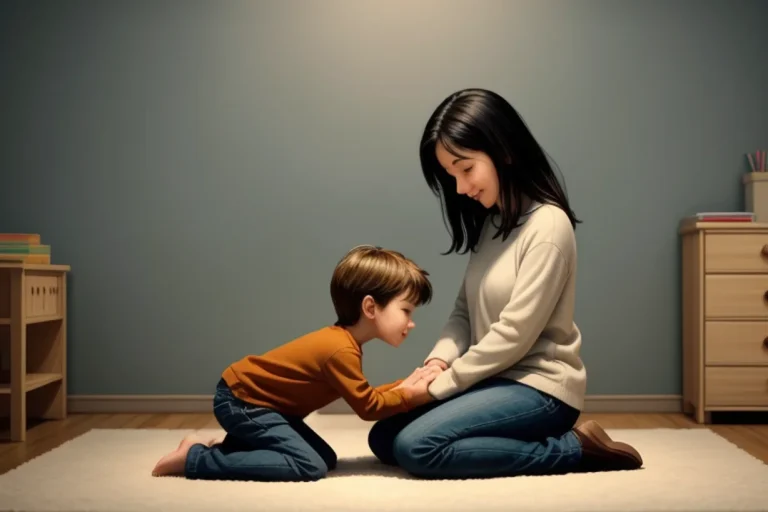
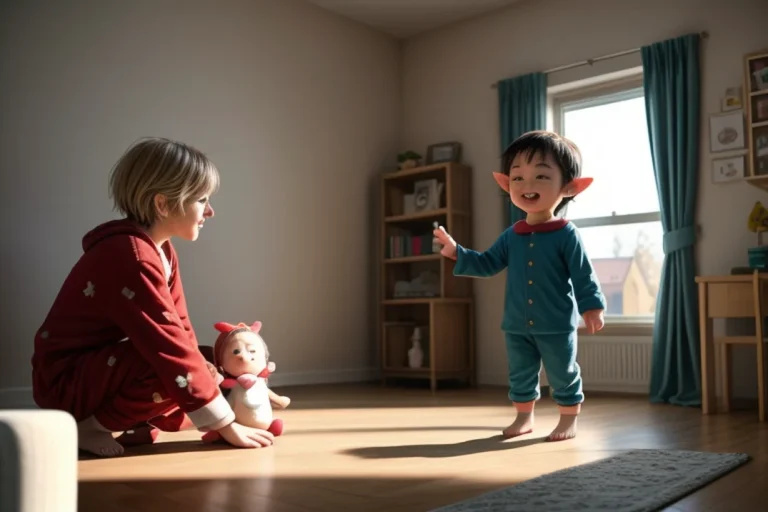
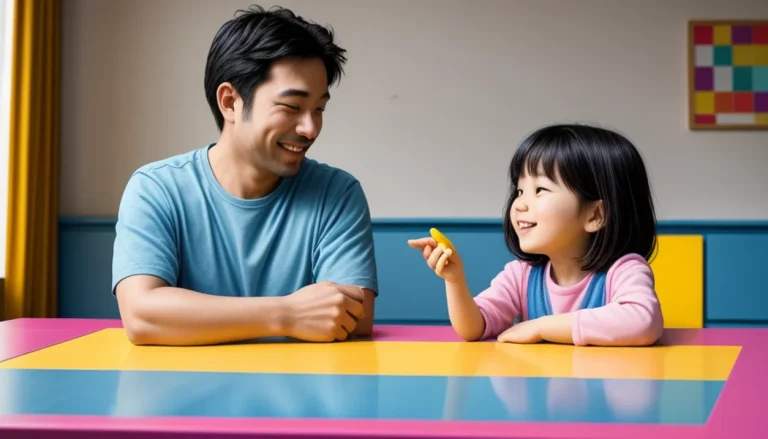
If you are teaching a preschooler to write their name, you may know one of these moments.
The comparison
At pickup, another child proudly shows a perfect name on her artwork. Yours is a big circle with a smiley face.
Try this: every child is on their own timeline. The CDC lists “writes some letters in their name” as a milestone by 5, not 3 or 4.
The “I can’t!”
You write the name, hand over a pencil, and your child melts down after one wobbly letter.
Try this: go back a step. Build the name with letter cards or play dough first; writing comes after recognizing and building.
The fist grip
Your 3-year-old grips the crayon like a dagger and presses so hard the paper rips.
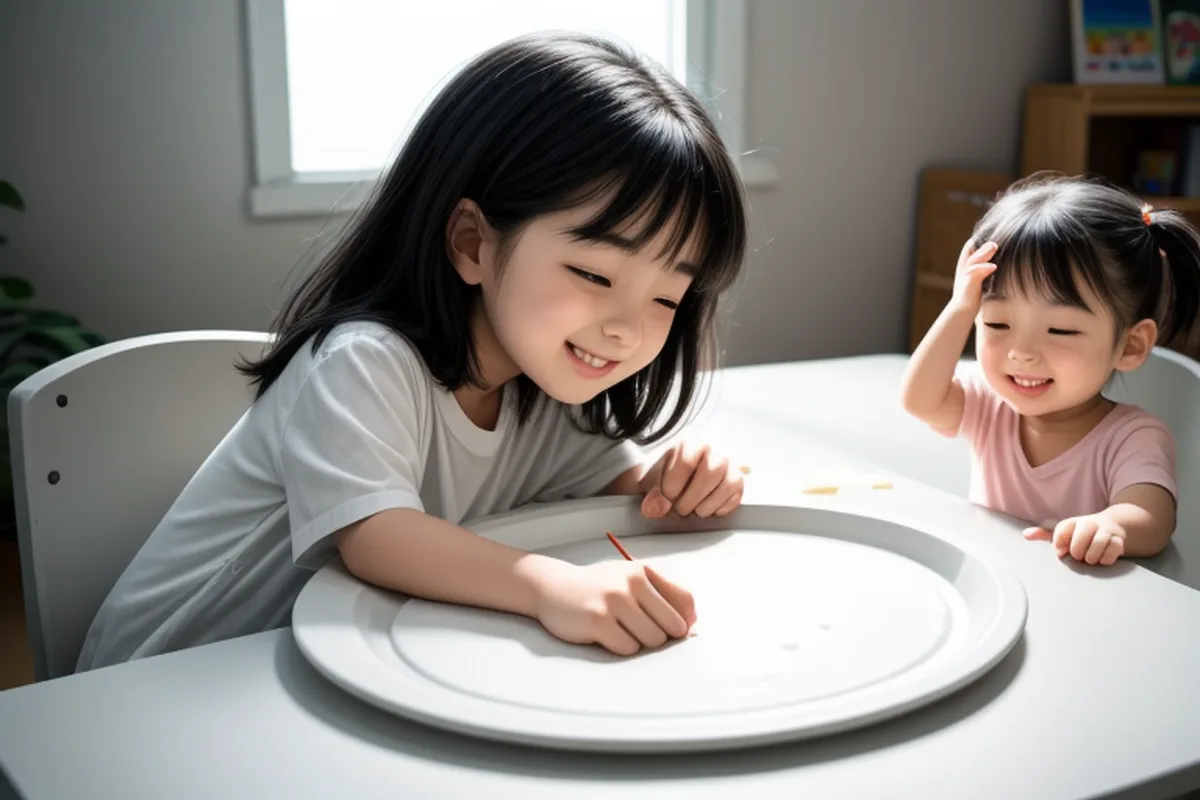
Try this: that is normal at 3. Short crayons, play dough and drawing on a wall-taped sheet help the grip mature on its own.
The timeline
When do children learn to write their name?
Writing your name looks simple to an adult. For a young child, it combines several skills at once: knowing which letters are in the name, remembering their order, controlling a crayon well enough to make lines and curves, and having the patience to finish. These skills grow at different speeds, which is why the age range is wide.
The CDC’s developmental milestones (things most children, 75% or more, can do by a certain age) give a helpful picture. By 3, most children say their first name when asked and draw a circle when shown how. By 4, most hold a crayon or pencil between fingers and thumb (not a fist) and draw a person with three or more body parts. By 5, most write some letters in their name and name some letters when you point to them. Note the wording: some letters, by 5.
| Age | What many children do | What you can do |
|---|---|---|
| 2–3 | Scribble, say their name, may spot “their” letter on signs | Point out their name everywhere: cubby, cup, artwork. Lots of scribbling and play dough. |
| 3–4 | Draw lines and circles, recognize their written name, may make the first letter | Name puzzles, finger tracing in salt or sand, big crayons on big paper. |
| 4–5 | Hold a crayon with fingers, write some letters of their name, often wobbly or reversed | Highlighter tracing, building the name with cards, short 5-minute practice. |
| 5–6 | Write the whole first name, more and more readable | Practice on real things: cards, labels, signing artwork. Start lowercase if school uses it. |
🧠 Why there is no rush
Writing a name too early, with lots of pressure, can create a child who “hates writing” before school even starts. Strong hands, lots of drawing and a positive feeling about letters at 3 and 4 do more for later handwriting than worksheets.
Readiness
Readiness signs: is your child ready to write their name?
Look for most of these before you expect pencil-on-paper name writing. If a few are missing, start with the activities for that step.
- Recognizes their own written name (on a cubby, a cup, a card)
- Can draw a circle and a straight line when shown
- Holds a crayon with fingers rather than a whole fist, at least some of the time
- Shows interest: “What does that say?” or pretends to write
- Can sit and focus on a table activity for 5 minutes
- Knows at least the first letter of their name
Not there yet? Wonderful: that means you get to do the fun pre-writing stage. Play dough, puzzles, coloring and drawing all build the hand strength writing needs. The CDC even suggests playdough squishing for 3-year-olds because it “builds hand and finger muscles for writing” (CDC tips). Our fine motor activities for 3-year-olds are a great place to start.

The research
Why names are a child’s first “real” word
For many children, their name is the first word they can recognize in print, and research suggests it is a powerful doorway into letters. In a study published in the Journal of Experimental Child Psychology, Rebecca Treiman and Victor Broderick found that preschoolers and kindergartners knew the name of the first letter of their own first name better than other letters, and preschoolers were better at printing that letter than other letters (Treiman & Broderick, 1998). The advantage was strongest for the first letter and much weaker for the rest of the name.
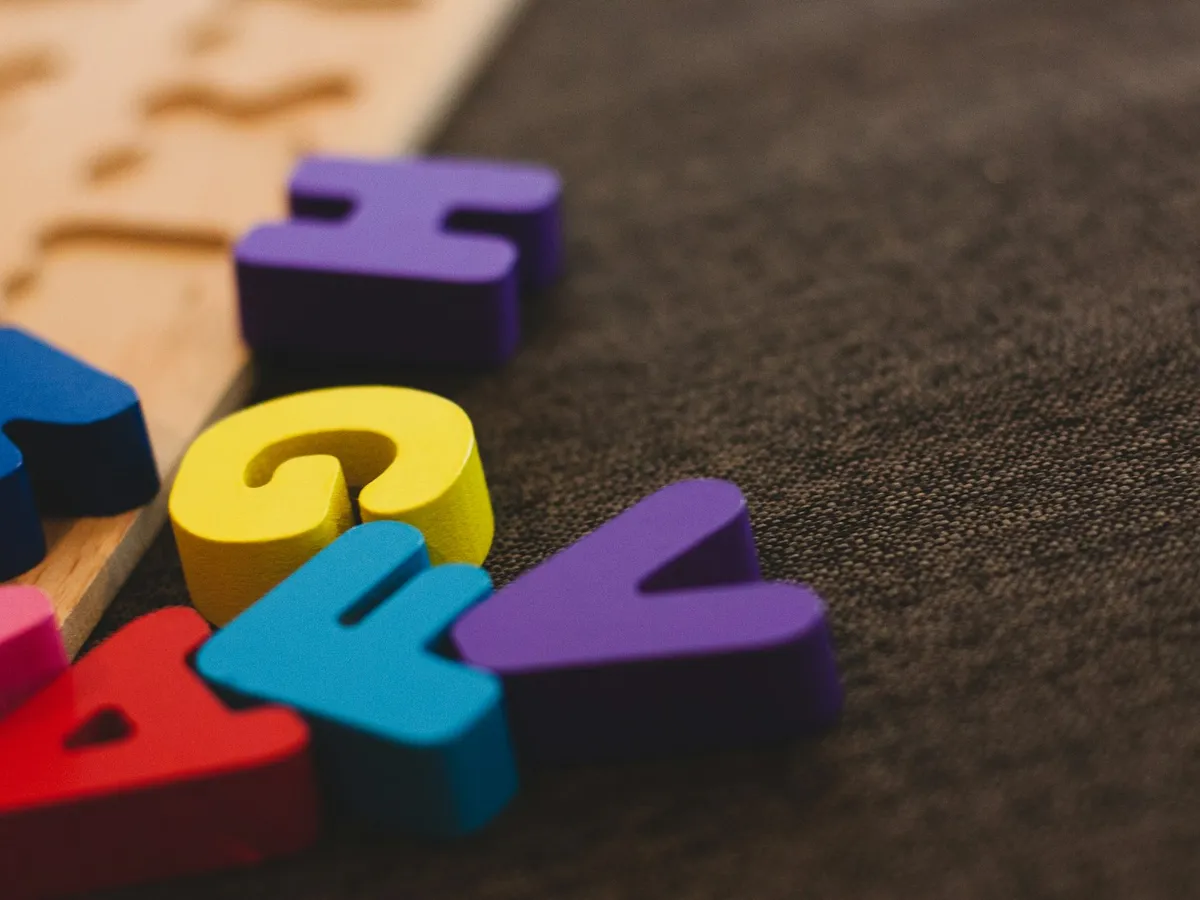
What does that mean at home? Start with the first letter. Make it “their” letter: find it on cereal boxes, road signs and books. Once they own that letter, add the next one. It also means that a child who knows their name letters is not necessarily ready to read; letter sounds are a separate skill (our letter sounds guide covers that).
Letter case
Capital letters or lowercase? What to teach first
This is one of the most common questions, and the honest answer is: it depends on your child’s age and school.
| Approach | Why parents choose it | Watch out for |
|---|---|---|
| All capitals first (MIA) | Capitals are mostly straight lines and big curves, easier for young hands. Many 3-year-olds start here naturally. | They will need to relearn the name in “title case” for school. |
| Capital + lowercase (Mia) | This is how names are written in school and on forms, so there is less relearning later. | Lowercase letters like a, e and g are harder; expect slower progress. |
| Ask the preschool | Consistency between home and school helps the most. | Some programs have a preferred style; follow it if they do. |
A gentle middle path many families use: for children under 4, let them write whatever they can (capitals are fine). From about 4, write their name with a capital first letter and lowercase letters after, the way they will see it at school. Our printable uses this style.
💡 Make the first letter special
Put a green dot or a tiny star where the first letter starts. It reminds children where the name begins and which way to go.
Grip
Pencil grip and posture: what really helps
- Use short crayons. Breaking crayons in half encourages fingertips instead of a fist.
- Draw on a vertical surface. Paper taped to a wall or an easel puts the wrist in a good position and strengthens the shoulder.
- Feet on the floor. A low chair or a box under their feet helps kids sit steadily, which frees the hand.
- Model, don’t force. Show a relaxed grip on your own pencil. Constantly moving a child’s fingers often causes frustration.
- Thick tools first. Chunky crayons, washable markers and triangle pencils are easier to control. The AAP suggests water-based, unscented markers and art supplies conforming to ASTM D4236 (HealthyChildren).

Remember, the CDC lists a finger-and-thumb grip as a milestone by 4. A fisted grip at 2 or 3 is typical.
Step by step
How to teach a child to write their name: the 8-step method
Move through these steps slowly, over weeks or months. Spend as long as needed on each one, and feel free to go back. Five minutes a day is enough.
- See it everywhere. Write your child’s name on their cup, door, artwork and lunchbox. Read it aloud and run your finger under it.
- Own the first letter. “M is your letter!” Hunt for it on signs, books and boxes. Make it with your fingers, your body, play dough.
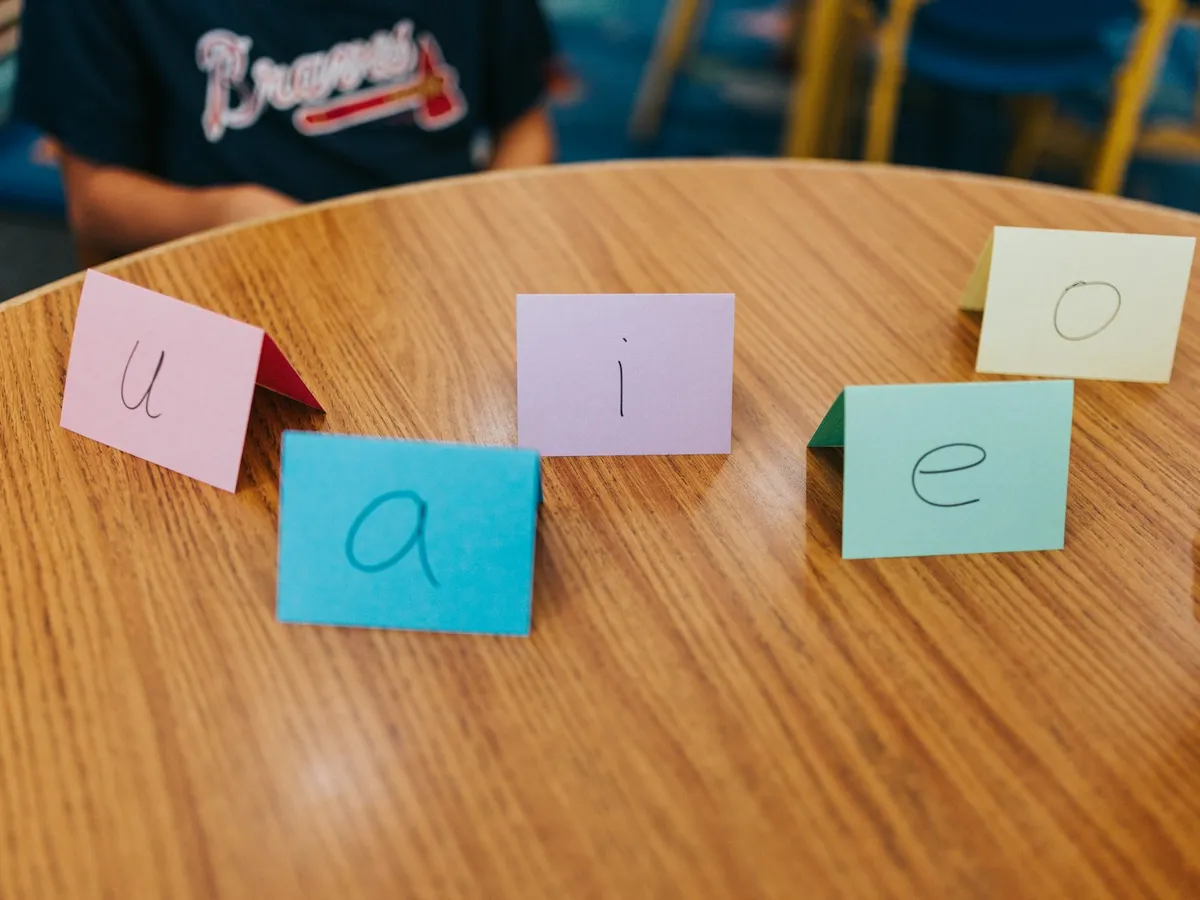
- Build it. Use letter cards or magnets to build the name next to a model card. Mix them up and build it again. (Printable page 2.)
- Warm up with strokes. Practice down lines, across lines, circles and crosses, the building blocks of most letters. (Printable page 3.)
- Trace with a finger. In a tray of salt, sand or shaving foam, on a steamy window, or in the air.
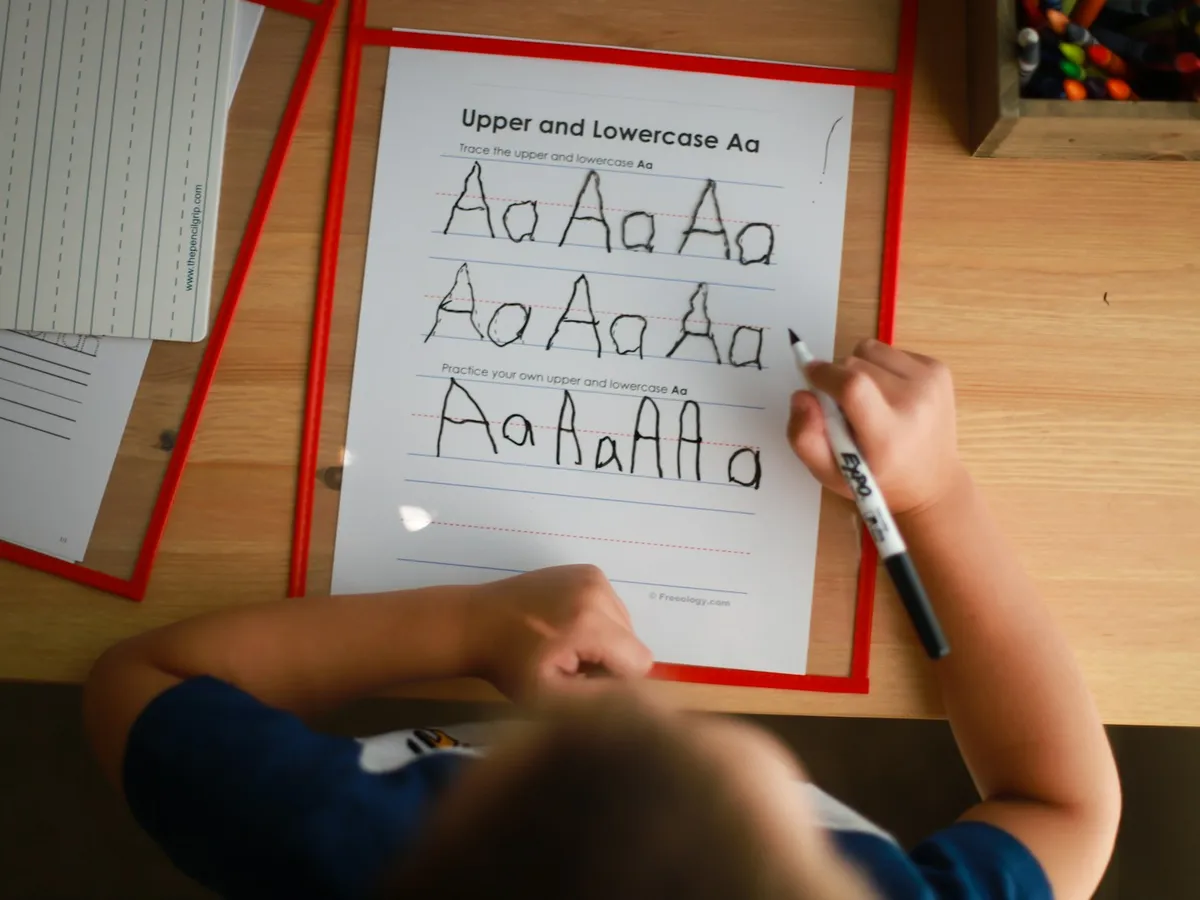
- Trace with a crayon. Write the name in highlighter; your child traces over it. Then write it lighter, then only dotted. (Printable page 1.)
- Copy it. Write the name at the top; your child copies it underneath. Praise effort: “You remembered the A!”
- Write it for real. Signing a birthday card, labeling a drawing, writing their name on a holiday gift tag. Real purpose is the best motivation.
Ready for more warm-up pages?
Tracing Worksheets: Lines, Shapes, ABC & Numbers (printable)
Pre-writing patterns (standing, sleeping, slanting and zigzag lines), shape tracing, A–Z tracing and trace-and-color pages, in that order. Instant download on Payhip: $3.99.
See it on Payhip ($3.99) →Our own book; we earn money if you buy it.
Activities
20 name writing activities for preschoolers (no worksheets needed)
Mix and match. The best practice is short, playful and different every day. Most of these use things you already have.
- Name huntHide letter cards around the room; your child finds them and puts them in order.
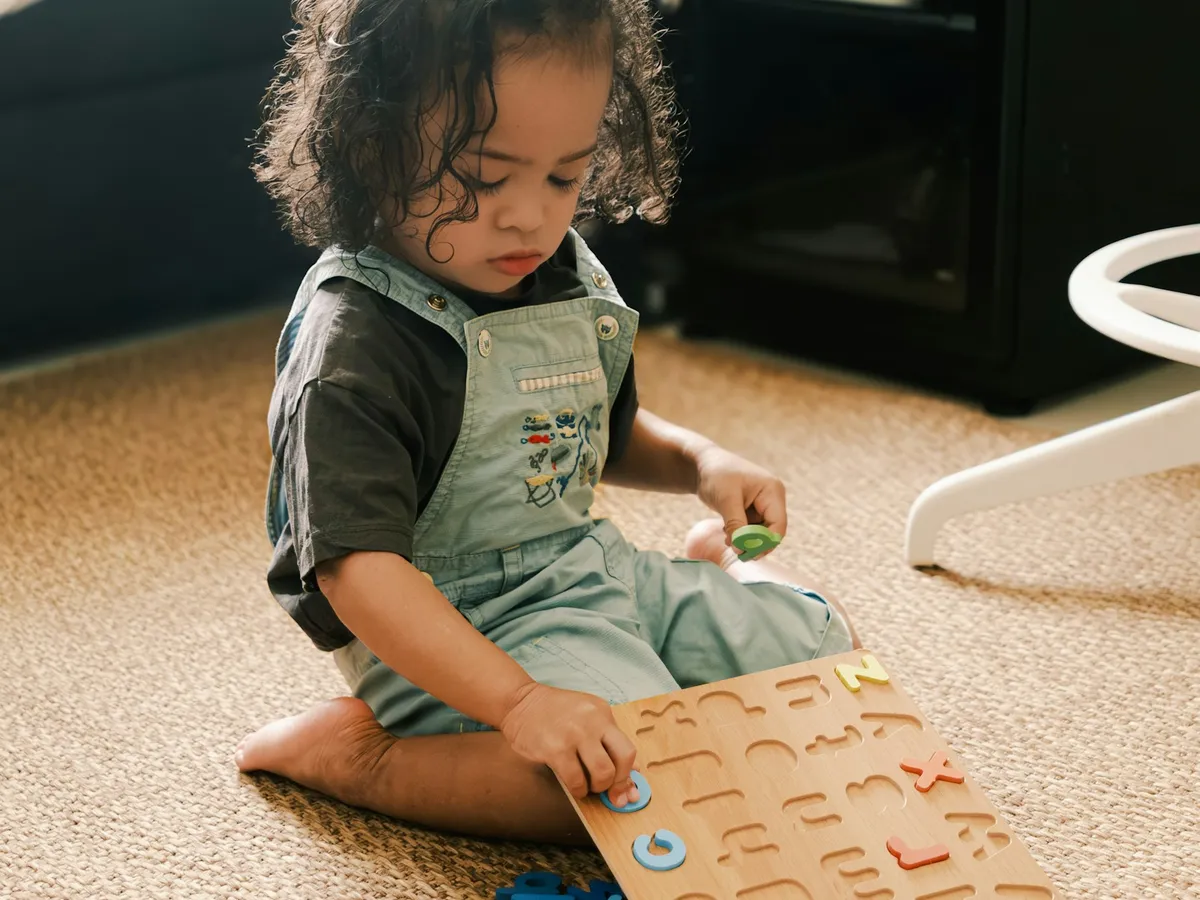
- Play dough lettersRoll snakes and shape the letters of the name on a name card.
- Salt tray writingPour salt in a baking tray and trace letters with a finger. Shake to erase.
- Rainbow writingTrace the same name three times in different colors.
- Highlighter tracingYou write in highlighter; they trace in pencil.
- Name puzzleWrite the name on a card strip and cut between letters; your child rebuilds it.
- Sticker dotsDraw the name in big letters and let them cover the lines with dot stickers.
- Sidewalk chalkBig letters outside: walk, hop and drive toy cars along them.
- Water paintingPaint the name on a fence or sidewalk with water and a brush. It disappears!
- Shaving foamSpread foam on the bath wall or a tray and write with a finger.
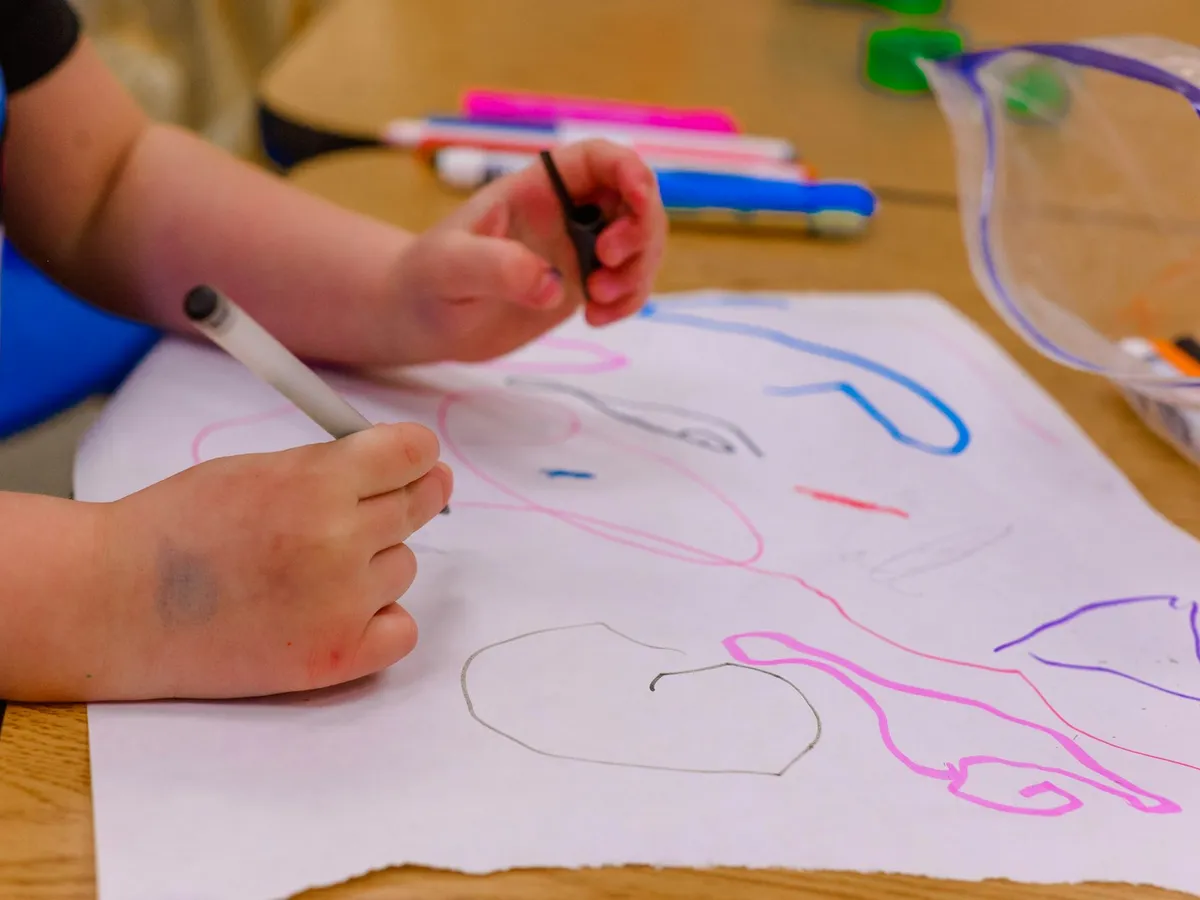
- Name in the airWrite letters in the air with a “magic finger,” saying the strokes aloud.
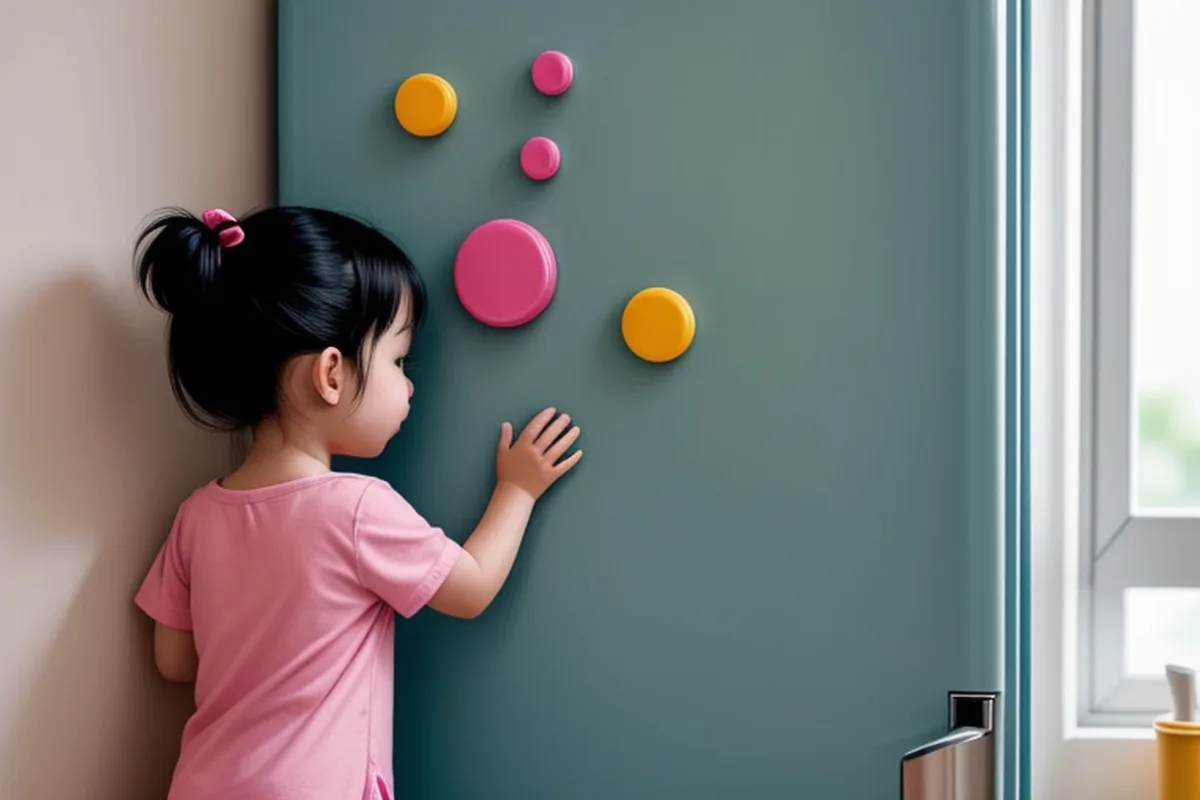
- Magnetic letters on the fridgeBuild the name while you cook dinner.
- Name songsSpell the name to a tune (like “B-I-N-G-O”).
- Rocks or buttonsLay rocks along big letter shapes (for kids who no longer mouth small objects; buttons are a choking hazard for younger ones).
- Stamp itUse letter stamps or cut potato stamps to print the name.
- Sign your artEvery drawing gets “signed,” even with only the first letter.
- Name crownWrite the name on a paper crown and decorate it.
- Find a friend’s nameSpot family and friends’ names: “Whose name starts like yours?”
- Gift tags and cardsIn December, let them write (or start) their name on cards and gift tags.
- Name coloring pageWrite the name in big bubble letters and let them color it in.
⚠️ Small parts
Magnetic letters with small magnets, buttons and small rocks can be dangerous for children who still put things in their mouths. Follow the AAP’s choking prevention advice, choose large pieces and supervise.
Your week
A one-week name writing plan (5 minutes a day)
| Day | Activity | Goal |
|---|---|---|
| Monday | Name hunt + build it with cards | Recognize letters and their order |
| Tuesday | Play dough letters | Feel the shapes, strengthen hands |
| Wednesday | Warm-up strokes (printable page 3) | Lines and circles |
| Thursday | Salt tray or shaving foam writing | Practice the movement without pressure |
| Friday | Highlighter tracing (printable page 1) | Pencil control with support |
| Saturday | Sign a drawing or a card | Real-life purpose |
| Sunday | Rest day, or chalk outside | Keep it fun |
Repeat the week as many times as you like, moving to the next step when your child is ready. If you are also building a calm daily rhythm, our daily routine chart for kids can include a “5-minute letters” slot.
Mistakes
Common mistakes (and what to do instead)
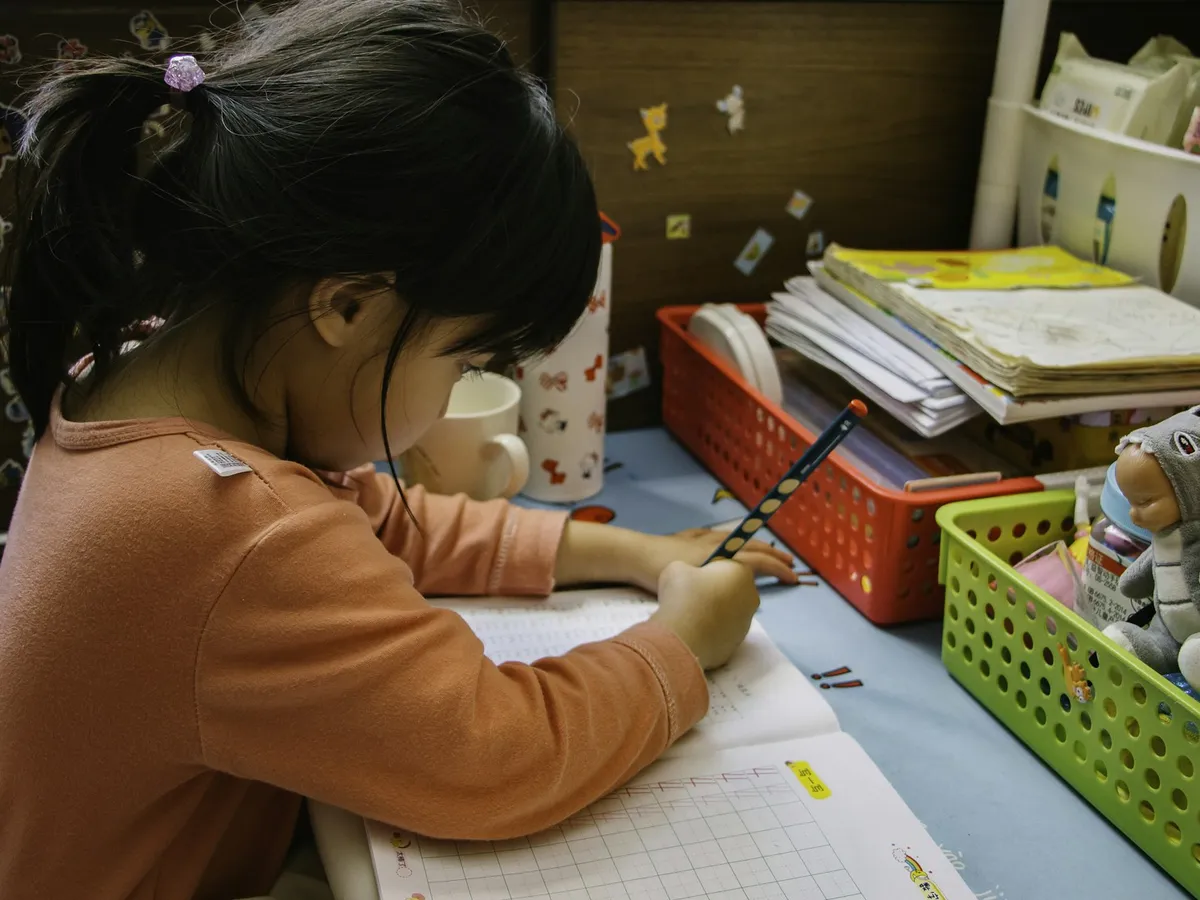
- Starting with worksheets. Before tracing, kids need to recognize and build their name. Start with play.
- Practicing too long. Stop after 5 to 10 minutes, or as soon as frustration shows. End on a success.
- Correcting every letter. Praise what is right (“You made a great M!”) and fix only one thing at a time.
- Worrying about backwards letters. Reversed letters are very common in preschoolers and young school-age children while they learn; gently model the right way.
- Forcing a perfect grip. Offer short crayons and vertical surfaces instead; grips mature with time.
- Comparing with siblings or friends. The range of normal is wide. Compare your child only with their own progress.
Concerns
When to check in with your pediatrician or teacher
Most children who are slow to write their name are simply still developing. Still, trust your instincts. Talk with your child’s doctor or teacher if your child:
- is 5 and does not write any letters of their name or name any letters (CDC milestones by 5)
- is 4 and cannot draw a circle or still holds every crayon in a tight fist
- avoids all drawing and coloring, or seems to have pain or weakness in the hands
- has lost skills they used to have
- has trouble with other milestones like speech, play or movement
The CDC advises acting early if you have concerns and asking about developmental screening. You don’t need a doctor’s referral to ask for a free evaluation: for a child 3 or older, the CDC suggests calling your local public elementary school and asking about a preschool special education evaluation (for children under 3, contact your state’s early intervention program). See the CDC’s guide Concerned about your child’s development?. An occupational therapist can help with grip and hand strength if needed.
Free printable
Free printable: name writing practice kit
🎁 Free printable
The ColorJoy Name Writing Practice Kit (5 pages, US Letter)
Page 1: highlighter name practice with handwriting lines (trace dark, trace light, first letter, then “I try!”). Page 2: name puzzle cards to fill in and cut out. Page 3: eight warm-up strokes to trace. Page 4: trace the capital letters A–Z and circle the ones in your name. Page 5: a “My name journey” tracker for grown-ups.
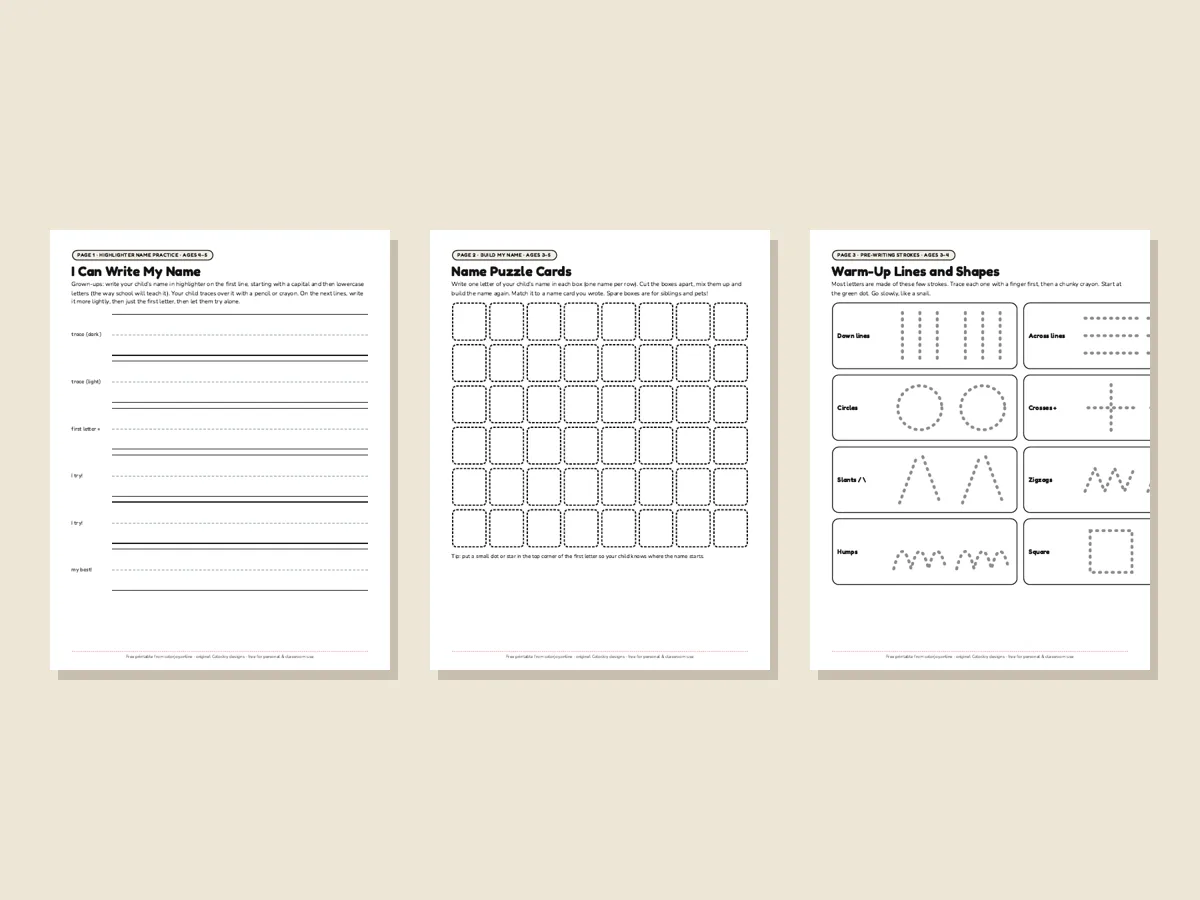
Download the free name writing kit (PDF) →
Free for personal and classroom use. No email or sign-up needed.
Tip: slip page 1 into a clear sheet protector and use a dry-erase marker, so you can practice every day without reprinting. Find more free pages in our activity ideas hub.
Your plan
What to do tonight (about 10 minutes)
You can start name practice tonight, no pencil required.
2 minutes
Make a name card
Write your child’s name in big, clear letters on a card. Add a star at the start.
3 minutes
Name hunt
Cut a second copy into letters and hide them; your child finds them.
3 minutes
Build it
Put the letters in order next to the name card. Say each letter together.
2 minutes
Celebrate
Tape the card on their bedroom door: “This is your room. That says your name!”
💛 Be kind to yourself
That’s it. No worksheet, no pencil, no tears. The writing will come, one letter at a time.
From the ColorJoy shelf
Our pick for name and letter practice: Alphabet & Number Tracing Worksheets
Our printable pick
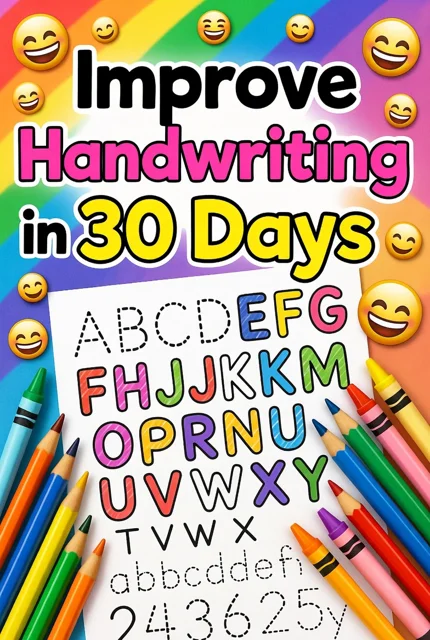
Alphabet & Number Tracing Worksheets PDF | Preschool & Kindergarten
Three printable PDFs: picture alphabet pages (every letter with a colorful illustration), big uppercase tracing with dotted lines, lowercase tracing with arrows showing stroke order, and number tracing 1–10. Large, kid-friendly fonts and lots of space. Instant download; print as many times as you need for your family or classroom.
$3.99printable PDF · instant download on Payhip
Our own printable; we earn money if you buy it. Price as listed on Payhip when we checked on 26 October 2026; please confirm on the product page.
Why it’s our pick: once your child has built and traced their name, the next step is learning to form every letter in it. This pack covers both capital and lowercase letters, with arrows for stroke order, which is exactly what name writing needs. It is listed for preschoolers ages 3 to 5 and kindergarten prep. Start with the picture pages and big capitals, then move to lowercase. A short daily routine of 10 to 15 minutes is the listing’s own suggestion; for younger children, 5 minutes is plenty.
Prefer a paperback? Our Phonics Practice Workbook for Kids Ages 4–6 on Amazon ($12.99) adds letter sounds and beginning reading. Browse all our books in the Mr A G author store on Amazon, or get the Kids Printable Mega Bundle on Payhip ($14.99), which includes these tracing worksheets plus the lines-and-shapes tracing pack, animal tracing, alphabet flashcards and coloring pages. Our full Payhip store is at payhip.com/BookBonbon.
📚 Related books from ColorJoy
If this topic is on your mind, these titles from our own shelf fit well alongside it.
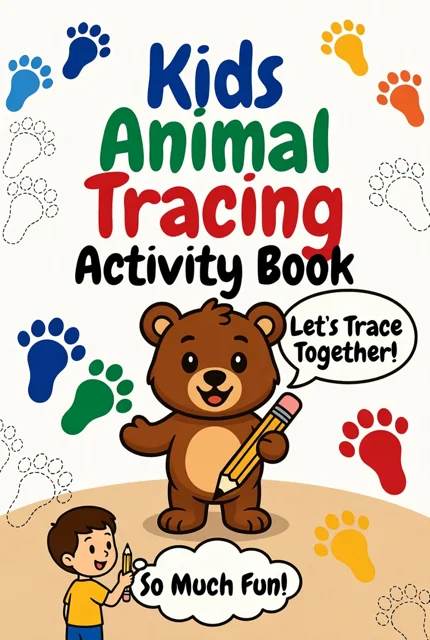
Animal Tracing Worksheets (printable PDF)
40 animal tracing pages with large dotted lines: pre-writing practice before letters, for ages 3 to 7.
$4.99 printable PDF on Payhip · Instant PDF download; print at home

Animal Alphabet Flashcards (printable PDF)
Animal alphabet flashcards for ages 2 to 6, handy for name hunts and “find your letter” games.
$3.99 printable PDF on Payhip · Instant PDF download; print at home

Phonics Practice Workbook (Ages 4–6)
Letter sounds and beginning reading activities for ages 4 to 6, the natural next step after name writing.
$12.99 paperback on Amazon.com · Paperback, shipped by Amazon
These are our own books and printables, and we earn money if you buy them. Prices as listed on Amazon.com and Payhip when we checked on 4 November 2026; prices can change, so please confirm on the product page.
Frequently asked questions
At what age should a child be able to write their name?
The range is wide. According to CDC milestones, most children (75% or more) write some letters of their name by age 5. Many 4-year-olds write part of their name, and many 5- and 6-year-olds write the whole first name. Writing the full name at 3 is not expected.
How do I teach my 3-year-old to write their name?
At 3, focus on recognizing the name and the first letter, building it with letter cards or magnets, and pre-writing play: play dough, drawing lines and circles, and finger tracing in salt or sand. Pencil writing usually comes later.
Should I teach my child to write their name in capital letters or lowercase?
Young children often find capitals easier. From about age 4, many families switch to a capital first letter followed by lowercase letters, the way names are written in school. Ask your child’s preschool which style they use and stay consistent.
Is it normal for my child to write letters backwards?
Yes. Reversed letters are very common in preschoolers and young school-age children while they learn. Gently model the correct direction and avoid making a big deal of it. Talk to a teacher or doctor if you have other concerns.
How long should name writing practice be?
About 5 minutes a day is enough for preschoolers, and up to 10 to 15 minutes for older 4- and 5-year-olds who enjoy it. Stop while it is still fun and end on a success.
What are fun ways to practice writing a name?
Try a name hunt with letter cards, play dough letters, salt tray or shaving foam writing, highlighter tracing, sidewalk chalk, water painting, magnetic letters and signing every drawing. Our free printable kit has tracing lines and name puzzle cards.
You are doing a great job ✏️
ColorJoy makes bold, easy coloring books and printables for little hands, plus practical guides for real family life. We share new learning guides and free printables every week, so come back for the next one.
For step-by-step letter practice, our pick is the Alphabet & Number Tracing Worksheets printable.
See the Tracing Worksheets on Payhip →
More early learning: how to teach colors to a 2-year-old, what age toddlers can color and quiet time activities for 3-year-olds.
Photos: Unsplash (Unsplash License). Illustrations: AI-generated for ColorJoy. Book images and printable art: ColorJoy / Mr A G. This guide is general information for families, not medical advice; talk with your child’s doctor about any developmental concerns.