Early reading • Ages 3–5
How to Teach Letter Sounds to Preschoolers: 7 Playful Games + a 4-Week Plan
Your preschooler can sing the whole ABC song, but when you point to the letter m, they look at you blankly. That’s completely normal. Knowing letter names and knowing letter sounds are two different skills, and the second one is what unlocks reading. This guide explains how to teach letter sounds to preschoolers in short, playful moments at home: what reading research recommends, which letters to start with, how to say the sounds clearly, seven games you can play in five minutes, a gentle four-week plan, fixes for common hiccups, and a free printable letter sound hunt.
✓ Research-based✓ 5-minute games✓ 4-week plan✓ Free printable
In this guide
- Letter names vs. letter sounds
- What the research recommends
- Is my child ready? An age-by-age guide
- Which letters to teach first
- How to say letter sounds clearly
- 7 letter sound games, step by step
- A gentle 4-week letter sound plan
- Common problems (and easy fixes)
- Letter sounds at home: a quick checklist
- Free printable: letter sound hunt + sound boxes
- Ready for more practice? Our phonics workbook
- FAQ & final thoughts
Letter names vs. letter sounds
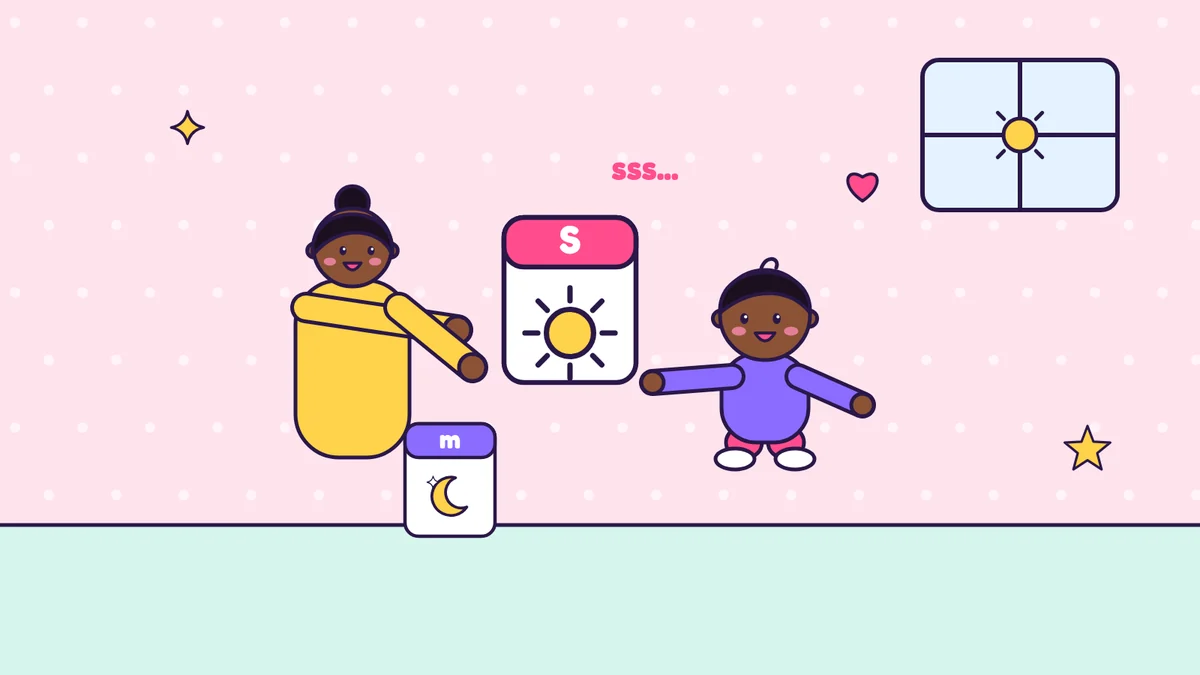
The letter name is what we call it in the ABC song: “em.” The letter sound is what it says in a word: /m/, the humming sound at the start of moon. To read the word mat, a child doesn’t need to think “em-ay-tee”; they need to blend /m/ /a/ /t/. That’s why letter sounds matter so much.
Letter sounds sit on top of a listening skill called phonological awareness. Reading Rockets explains phonological awareness as the ability to notice and work with the sounds of spoken language: words, syllables, rhymes, and the beginning and ending parts of words. Phonemic awareness is the most advanced part: hearing and playing with the individual sounds (phonemes) in a word, like the three sounds in sun.
The good news for parents: much of this can start with no letters at all. Clapping syllables in names, playing rhyming games and noticing that ball and bear start the same way all build the ears your child needs before letters make sense.
🌟 In one sentence
What the research recommends
The US Department of Education’s What Works Clearinghouse published a practice guide, “Foundational Skills to Support Reading for Understanding in Kindergarten Through 3rd Grade,” that pulls together reading research. Although it’s written for kindergarten and up, several of its ideas translate beautifully into playful preschool moments. Its recommendation on sounds is to help children develop awareness of the segments of sound in speech and how they link to letters. According to the guide’s summary:
- Linking sounds to letters pays off. The guide notes that being able to isolate sounds and link them to letters helps students read about 70% of regular one-syllable words, such as fish, sun and eat.
- Start simple. Teach consonants and short vowel sounds first, then move on to blends, digraphs (like sh, th, ch), silent-e and vowel teams later.
- Show both cases. Introduce uppercase and lowercase letters together.
- Use a memorable picture. Linking each letter to a picture and a short story or phrase (like “P is for Pig”) helps children remember the sound.
- Build words. Activities like sound boxes and letter tiles help children see how sounds go together to make words.
Notice what’s not on that list: long worksheets, flashcard drills or pressure. For a three- or four-year-old, a few minutes of play a day is plenty.
Is my child ready? An age-by-age guide
Children get interested in letters at very different times, and that’s okay. The CDC milestones give a rough picture: by 4 years, many children say words from songs, stories or nursery rhymes; by 5 years, many use or recognize simple rhymes, name some letters when you point to them and write some letters in their name. Use this table to match activities to where your child is now.
Which letters to teach first
There’s no single official order, but there are some smart principles, many of them echoed in the research guide above:
- Start with letters in your child’s name. They already care about those letters.
- Choose sounds that can be stretched. Sounds like /s/, /m/, /f/ and /l/ can be held (“sssss”), which makes them easier to hear and blend than quick sounds like /t/ or /p/.
- Mix in a short vowel early. You can’t build words without vowels. Short /a/ (as in apple) is a friendly first one.
- Pick letters that make lots of words. Many phonics programs start with a group such as s, a, t, p, i, n because together they make dozens of simple words: sat, tap, pin, nap, sip, pat, tin.
- Separate look-alikes. Teach b and d (and p and q) weeks apart so they don’t get mixed up.
A gentle first set for home: s, a, t, p, m, d. Our free printable uses exactly these, with a picture for each: sun, apple, tree, pumpkin, moon and dog.
How to say letter sounds clearly
This tip makes a surprisingly big difference. Many of us say consonant sounds with an extra “uh” on the end: “suh,” “muh,” “tuh.” But sat isn’t “suh-a-tuh.” Clean sounds make blending much easier for your child.
If you’re not sure, say a word slowly and listen to the very first bit: mmm-oon. That’s the sound. Many families find it helpful to listen to a short phonics song or an online sound guide once themselves, then teach without the screen.
7 letter sound games, step by step
Each of these takes about five minutes. Pick one or two a day, and repeat favorites often. Repetition is how sounds stick. For more learning-through-play ideas, browse our fun educational activities that feel like play.
● 1. Letter sound I Spy (ages 3–5)
You need: Nothing at all.
- Sit together in any room, the car or the grocery line.
- Say: “I spy something that starts with /sss/.” Stretch the sound.
- Let your child guess (sock, sofa, spoon). Any word with the right first sound is a win.
- Swap roles: let your child give the clue. Help them say the sound clearly.
- Start with one sound per game; mix two sounds once they’re confident.
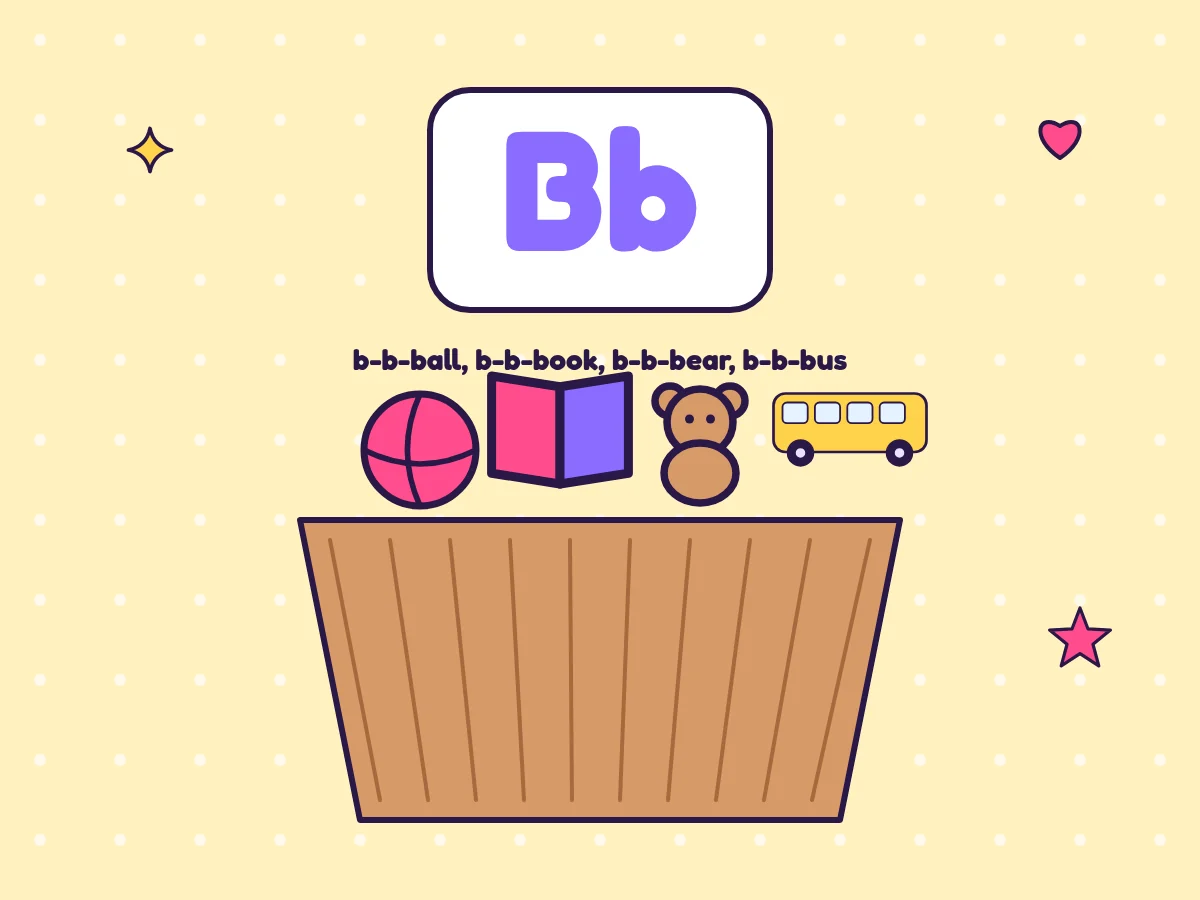
● 2. The sound basket (ages 3–5)
You need: A basket and a few small household items.
- Choose one sound for the day, like /m/.
- Hunt around the house together for things that start with that sound: mitten, mug, map, monkey toy.
- Put them in the basket and say each name, stretching the first sound: “mmm-ug.”
- Add one “silly” item that doesn’t fit and see if your child can spot it.
- Show the letter card (Mm) next to the basket so the sound links to the letter.
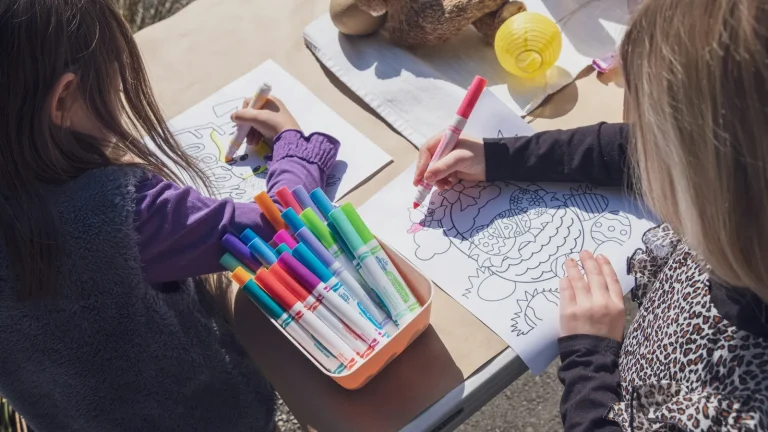
● 3. Letter sound hunt printable (ages 4–5)
You need: Our free printable and crayons.
- Point to a letter on the sheet and say its sound together.
- Name the picture (sun) and listen for the first sound.
- Color the picture.
- In the empty box, draw something else that starts with that sound.
- Do one or two letters a day, not the whole sheet at once.
● 4. Picture-and-story cards (ages 3–5)
You need: Index cards and a marker.
- Write one letter, uppercase and lowercase (Ss), on a card.
- Draw a simple picture that starts with that sound (a sun) and make up a tiny story: “Sammy the sun says ssss when it’s hot.”
- Act the story out with a motion, like wiggling your hand like a snake for /s/.
- Review old cards for a minute before adding a new one.
- Stick the cards on the fridge or the wall at your child’s eye level.
● 5. Rhyme time (ages 3–5)
You need: Nothing at all.
- Ask a rhyme question, like the CDC suggests for this age: “What rhymes with cat?”
- Accept silly made-up rhymes (zat!) because they still show your child is listening to sounds.
- Read rhyming books and pause before the rhyming word so your child can fill it in.
- Clap syllables in family names: Ma-ri-a (3 claps), Sam (1 clap).
● 6. Sound boxes (ages 4–5+)
You need: The sound boxes page from our printable, or three squares drawn on paper, and three coins or buttons (for kids past the mouthing stage).
- Say a short word slowly: sss-uuu-nnn.
- Your child pushes one counter into a box for each sound they hear: 3 sounds, 3 boxes.
- Point to each counter and say the sounds again, then blend them fast: “sun!”
- Once they know some letters, swap the counters for letter cards.
- Try other picture cards: dog, bus, cup, bed, hat.
● 7. Build a tiny word (ages 5+)
You need: Magnetic letters or letter cards for s, a, t, p, i, n.
- Lay out s a t and slide your finger under each letter as you say the sounds.
- Blend them together: “sat.”
- Change one letter: swap s for p to make pat. What changed?
- Let your child make a word for you to read (real or silly).
- Stop while it’s still fun; five words is a great session.

A gentle 4-week letter sound plan
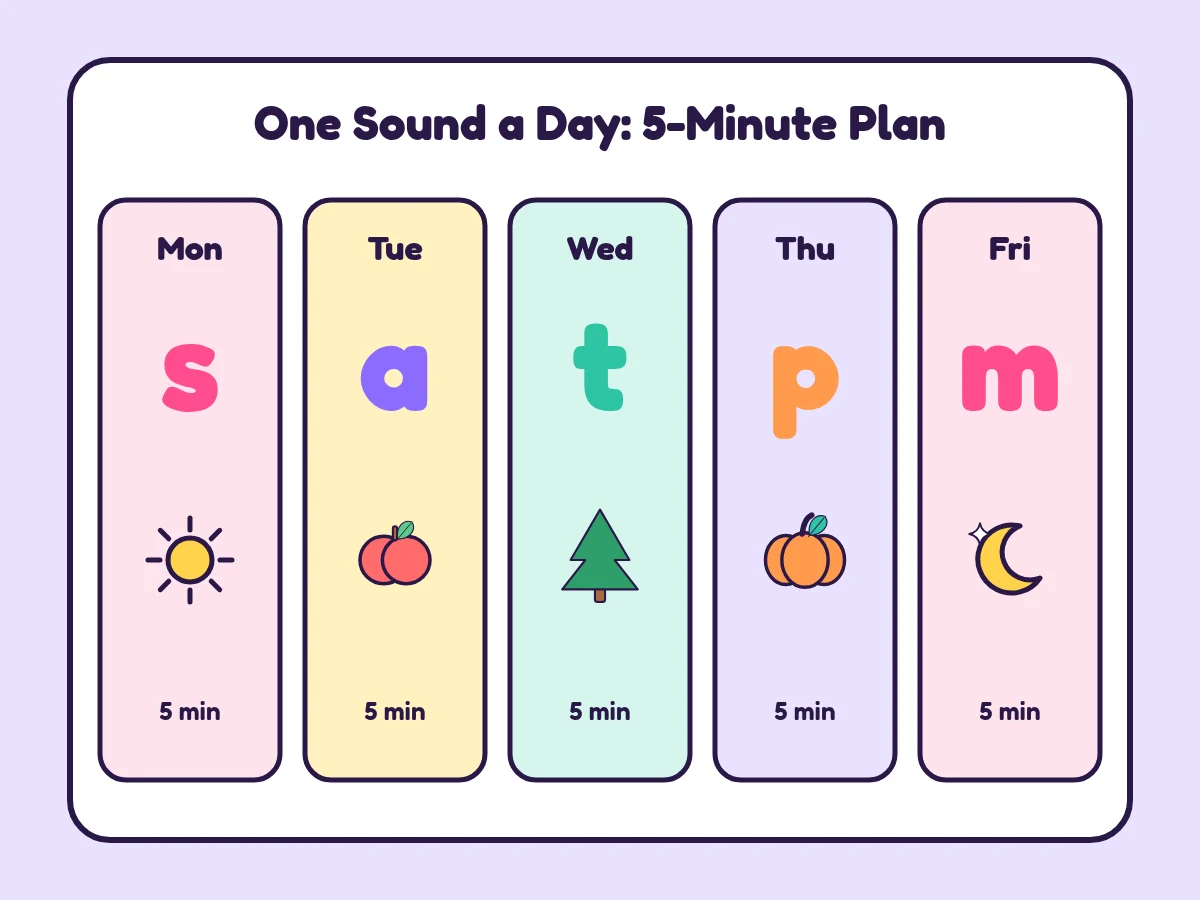
This plan introduces two sounds a week, with lots of review. It takes about 5–10 minutes a day, which matches the CDC’s note that many five-year-olds can pay attention for about 5 to 10 minutes. For younger children, shorter is better.
- Attach it to a routine. Do letter sounds at the same time each day, like after breakfast or at bath time. Our daily routine chart for kids can help you find a slot.
- Review before you add. Spend a minute on old sounds before introducing a new one.
- Go at your child’s pace. If a sound isn’t sticking, stay on it another week. There’s no race.
- Keep it playful. If your child is tired or grumpy, skip the day. Five happy minutes beat twenty tearful ones.
Common problems (and easy fixes)
💬 When to check in with a professional
Ready to add pencil skills? Our guide to alphabet and number tracing worksheets covers how tracing can support early handwriting once your child is ready.
Letter sounds at home: a quick checklist
- ☐Play one rhyme or syllable game a day (in the car counts).
- ☐Pick a small starting set of letters, like s, a, t, p, m, d.
- ☐Show uppercase and lowercase together (Ss).
- ☐Give each letter a picture and a tiny story.
- ☐Say clean sounds (sss, not suh).
- ☐Keep sessions to about 5–10 minutes and stop while it’s fun.
- ☐Review old sounds before adding new ones.
- ☐Read aloud every day and point out letters in books and signs.
- ☐Print the free letter sound hunt and sound boxes pages.
- ☐Celebrate effort, not perfection.
Free printable: letter sound hunt + sound boxes
We made a free two-page printable for this guide. Page one is a Letter Sound Hunt with six letters (Ss, Aa, Tt, Pp, Mm, Dd), each with a picture to color and an empty box where your child draws something else that starts with that sound. Page two is My Sound Boxes: three boxes plus six picture cards (sun, dog, bus, cup, bed, hat) for the sound boxes game.
🎁 Free printable
Free printable: Letter Sound Hunt + My Sound Boxes (2 pages)
We made this printable for this post. It’s free and isn’t a page from any of our paid products.
- Page 1: letter sound hunt for s, a, t, p, m, d
- Page 2: sound boxes with 6 picture cards to cut out
Free, no email needed. US Letter size; print at 100%. For personal and classroom use.
Tips
- Print on cardstock if you plan to reuse the sound boxes.
- Slip the pages into a sheet protector and use a dry-erase marker for endless practice.
- Use crackers or cereal pieces as counters for sound boxes (and eat them after!).

Ready for more practice? Our phonics workbook
Once your child has played with a handful of sounds and you’d like a bit more structure, our Phonics Practice Workbook for Kids Ages 4–6 (a paperback by Mr A G, our author name) gives them picture-based pages to work through at the kitchen table.
📚 What it is
- Format: paperback, 79 pages, 5.5 × 8.5 inches, printed and shipped by Amazon.
- Price: $12.99 on Amazon.com when we checked on 21 October 2026.
- Ages: the listing gives a reading age of 3–7 years.
- Inside (per the listing): letter sound recognition, beginning sounds, phonics review, simple word-building and picture-based activities that also grow vocabulary. Pages are single-sided, with the blank back free for extra practice.
How it helps: the workbook follows the same path as this guide: hear a sound, link it to a letter and a picture, then build simple words. Use it as the “quiet” part of your five minutes after a game like I Spy or the sound basket, one page at a time. It’s a fit for children who already enjoy coloring and sitting with a grown-up for a few minutes. For a younger three-year-old, start with the listening games above and save the workbook for later.
See the Phonics Practice Workbook on Amazon ($12.99) →
Like picture cards? We also sell a separate printable on Payhip, Animal Alphabet Flashcards (three PDF files for ages 2–6, $3.99 when we checked on 21 October 2026). It’s a different product, a set of alphabet cards that pairs well with the picture-and-story game above, not a digital copy of the workbook. You can browse all our books on our Amazon author page.
These are our own products, and we earn money if you buy them. Prices as listed when we checked on 21 October 2026; please confirm on the product page.
📚 Related books from ColorJoy
If this topic is on your mind, these titles from our own shelf fit well alongside it.
Tick-Tock Time Adventures: Telling Time Workbook (Ages 4–6)
When letters are going well, this clock workbook adds another early-learning skill with simple, picture-based pages.
$9.99 paperback on Amazon.com · Paperback, shipped by Amazon
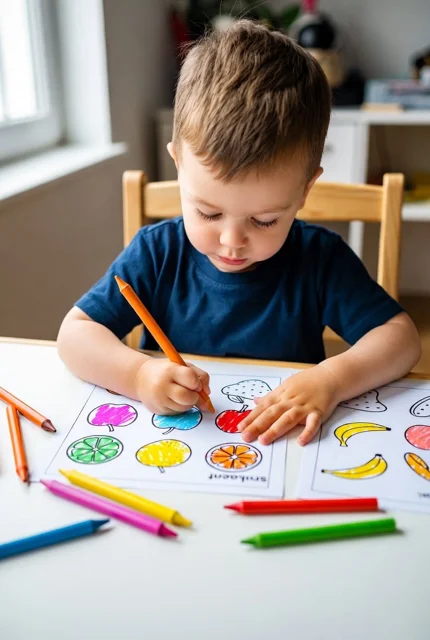
Preschool Coloring & Activity Bundle (printable PDF)
A printable pack with matching, cut-and-paste and coloring activities that builds the fine-motor skills early writers need.
$8.99 printable PDF on Payhip · Instant PDF download; print at home
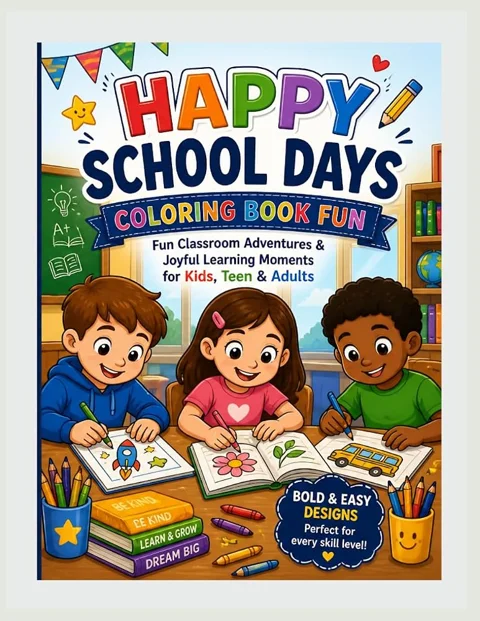
Happy School Days Coloring Book
School-themed coloring pages to make talking about preschool and kindergarten feel exciting.
$13.99 paperback on Amazon.com · Paperback, shipped by Amazon
These are our own books and printables, and we earn money if you buy them. Prices as listed on Amazon.com and Payhip when we checked on 21 October 2026; prices can change, so please confirm on the product page.
FAQ & final thoughts
At what age should a child know letter sounds?
Children vary widely. The CDC notes that by 5 years many children name some letters when you point to them and recognize simple rhymes. Many preschoolers learn a few letter sounds between 3 and 5, and most formal phonics teaching happens in kindergarten. Follow your child’s interest and keep it playful.
Should I teach letter names or letter sounds first?
Both are useful, and many families teach them side by side. For reading, the sound is what matters most, so use the sound often in play (“S says sss”) and show uppercase and lowercase letters together, as the What Works Clearinghouse guide suggests.
What letter sounds should I teach first?
Start with letters in your child’s name and sounds that can be stretched, like s and m, plus a short vowel like a. A set such as s, a, t, p, i, n is popular because it makes many simple words.
How long should a phonics session be for a preschooler?
Short: about 5 to 10 minutes, or less for younger children. Many five-year-olds can pay attention for 5 to 10 minutes, according to the CDC. Several tiny sessions a day work better than one long one.
How do I teach letter sounds without worksheets?
Use games: letter sound I Spy, a sound basket, rhyming questions, picture-and-story cards and sound boxes with counters. Point out letters on signs, cereal boxes and in bedtime books.
What if my preschooler isn’t interested in letters?
That’s okay. Focus on listening games, rhymes, songs and reading aloud, and try again in a few weeks. If you have concerns about hearing, speech or development, talk with your pediatrician.
● Final thoughts
Teaching letter sounds doesn’t need a classroom, a schedule or a stack of drills. A few minutes a day of noticing sounds, linking them to letters and pictures, and building tiny words is enough to give your preschooler a happy head start. Print the free letter sound hunt, pick your first sound, and have fun hissing like a snake together.