Telling Time Workbook for Kids Ages 4–6: Learn to Read an Analog Clock
It is 7:15 on a school morning. You ask your five-year-old to check the wall clock. They see the short hand near 7, the long hand on the 3, and announce with full confidence: “It is 7:03. Time for cartoons.”
To an adult, that clock face is obvious. To a 4-, 5-, or 6-year-old, it is a round puzzle with twelve numbers and two arrows that do not mean the same thing. The “3” is not three minutes. It is fifteen. That rule is invisible until someone teaches it in small steps.
Learning to tell time is a real early-math milestone. It sits between counting and the daily schedule: bus time, lunch time, bedtime. A telling time workbook for kids ages 4–6 works when it treats the clock as a picture first, then a skill — not as a quiz.
This guide covers how analog clocks confuse young learners, what a strong workbook actually contains, and how children move from “o’clock” to “half past.” More screen-free learning ideas live on colorjoy.online.

Why Kids Ages 4–6 Struggle to Read an Analog Clock
Digital numbers on a microwave just sit there. An analog clock asks a child to notice two hands, two jobs, and a circle that starts over every hour.
The biggest mix-up is almost always the hands. The short one is the hour. The long one is the minutes. Until that difference is over-taught with pictures, kids guess — and guessing sounds a lot like “7:03.”
The second mix-up is the 3, 6, and 9. Those numbers are landmarks, not minute counts. A workbook that labels them too early, before o’clock is solid, usually creates more fog.
How to Choose a Telling Time Workbook for Preschool and Kindergarten
Teachers look for four things. Parents can use the same checklist.
Start With O’Clock Before Half Past
Whole hours first. Half-hours second. Quarter hours later. A jump to “3:15” on page four is how kids quit.
Hour Hand vs Minute Hand on a Kids Clock
Short and long must look different in length and color. Crowded faces hide the lesson.
Clock Practice Pages Kids Will Finish
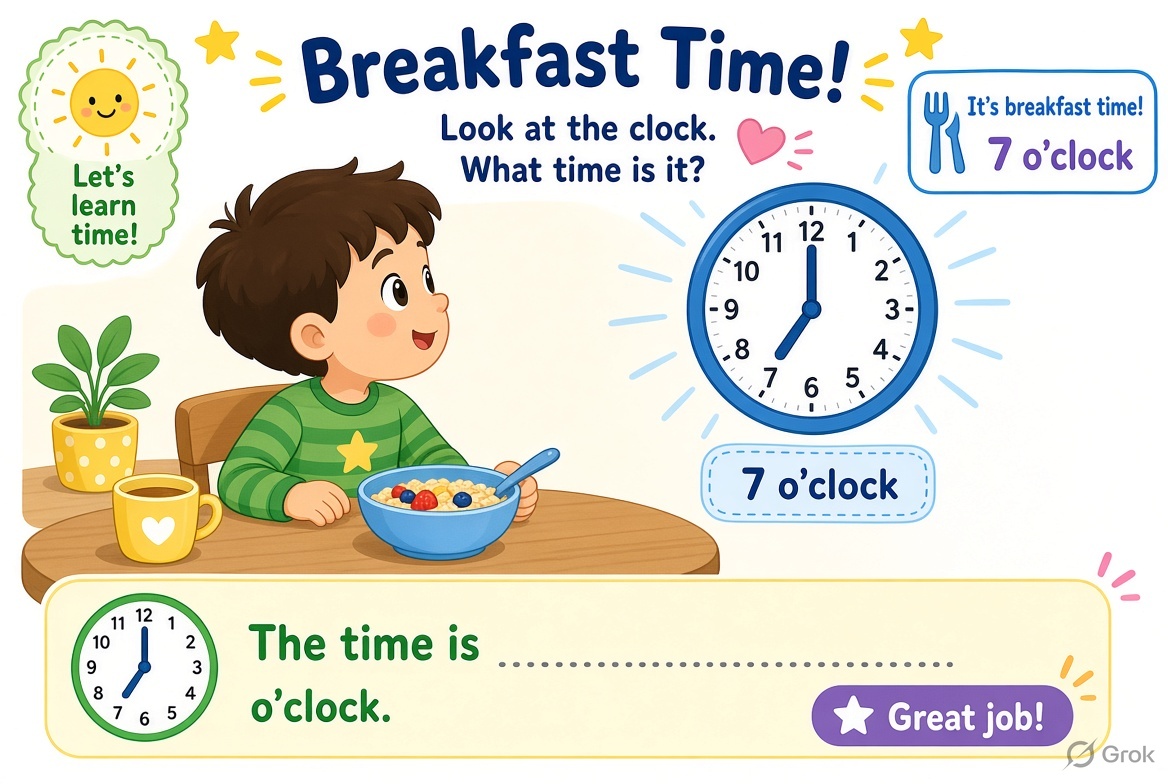
Matching, drawing hands, and coloring a breakfast-time scene keep a six-year-old at the table.
The fourth piece is daily life. A clock that only lives on a worksheet stays abstract. A clock next to “wake up,” “lunch,” and “bedtime” starts to mean something.
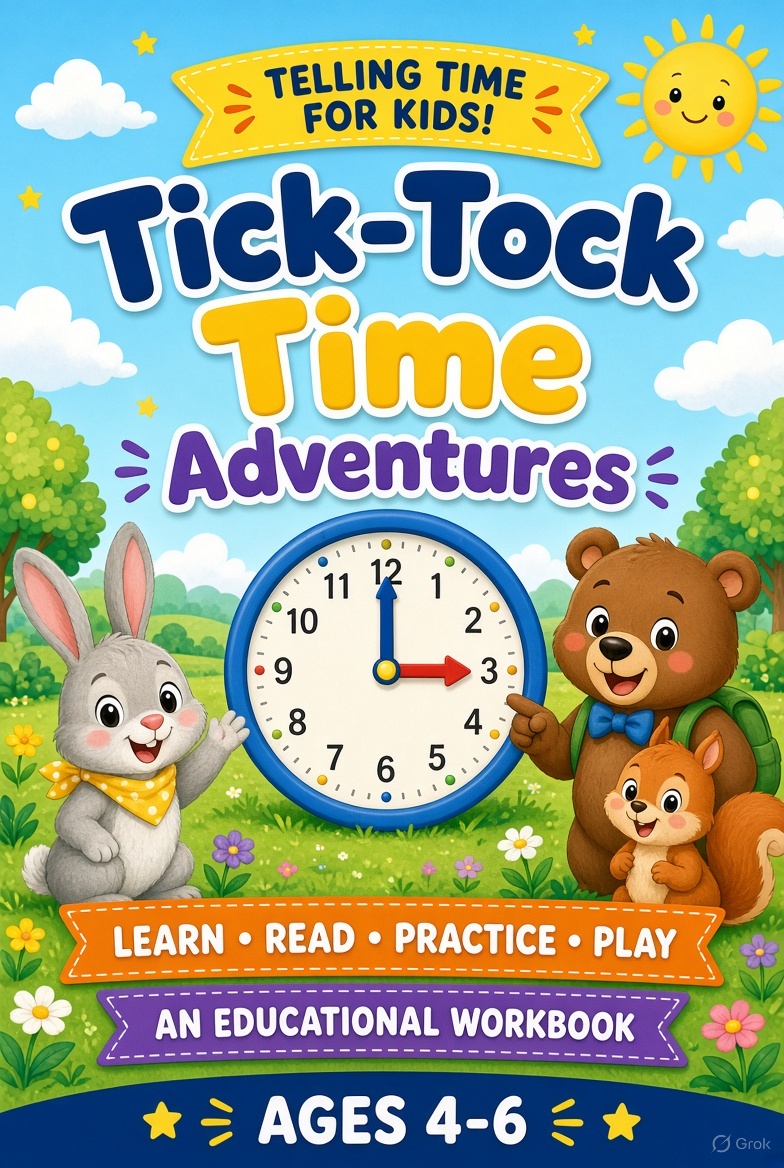
Tick-Tock Time Adventures is built around that path: clock parts, then o’clock, then half past, then matching a face to a digital box, then drawing the hands. Animal guides repeat the same line until it sticks — short hand for the hour, long hand for the minutes.
Analog Clock Practice Path for Pre-K and Kindergarten

Clock Face Numbers 1 to 12
1. Clock anatomy. Trace 1 through 12. Find 12 at the top, 6 at the bottom, 3 on the right, 9 on the left. No reading yet — just the map.Reading O’Clock on an Analog Clock
2. Whole hours. The long hand stays on 12. The child only has to name where the short hand points. “It’s 4 o’clock” is the first real win.Half Past and :30 Clock Practice
3. Half-hours. The long hand points to 6. The short hand sits between two numbers. This is “half past” and :30.Match Analog Clocks to Digital Time
4. Analog next to digital. Match a drawn clock to 3:00 on a digital box. Kids already see those numbers on phones and ovens.Draw Hour and Minute Hands
5. Draw the hands. Given a time, they draw a short arrow and a long arrow from the center. That is motor skill and understanding in one move.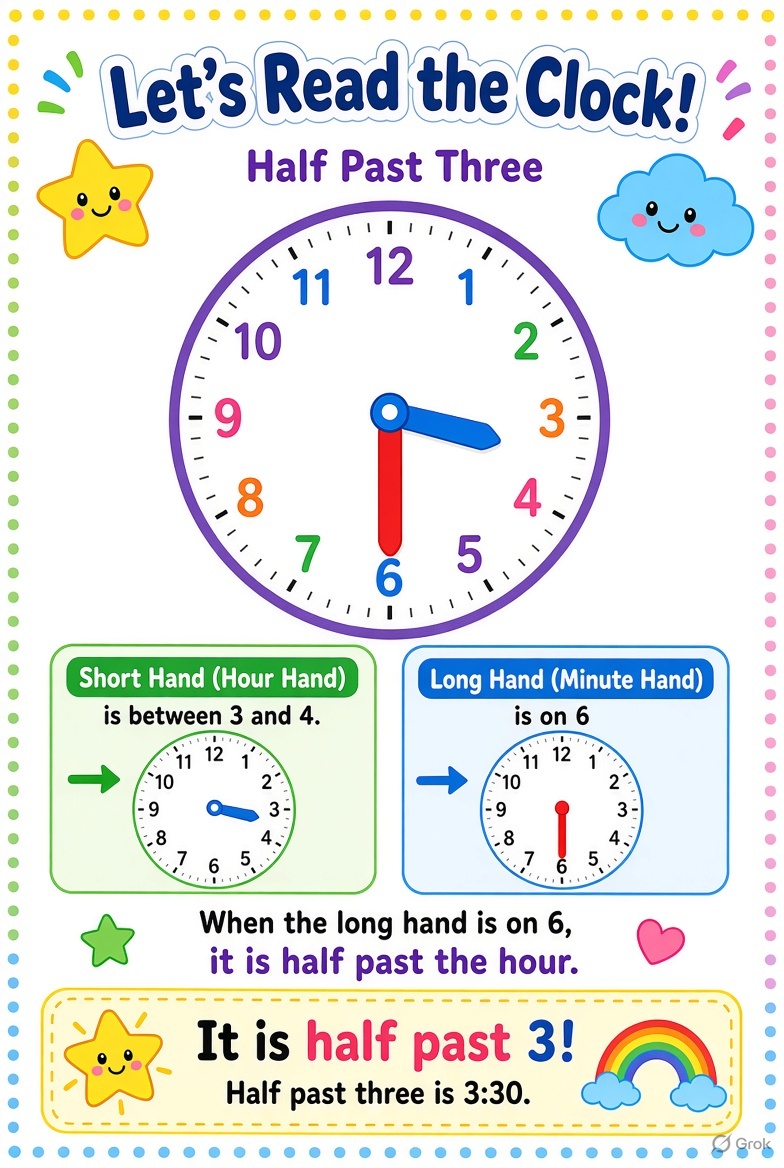
Benefits of Learning to Tell Time in Kindergarten
Reading a clock is not only a kindergarten checklist item. The circle itself teaches kids that time moves and then starts again. That picture helps later with halves and quarters.
Number order from 1 to 12 gets another workout. So does pencil control, if the book asks them to draw hands instead of only circling answers.
The home payoff is smaller and more immediate. A child who can see that the short hand is near 7 starts to expect breakfast, shoes, and the door. Mornings do not become magic. They become a little more predictable.
Telling Time Workbook FAQ for Ages 4–6
Is age 4 too early?
Not for o’clock. A four-year-old can learn “the short hand points to 5, so it is 5 o’clock.” Leave minutes for later.
Why bother with analog if everything is digital?
A digital clock shows a moment. An analog clock shows time as a shape that fills and empties. That picture supports later math.
What should they write with?
Pencil or erasable colored pencil for drawing hands. Crayons are fine for matching and coloring routine scenes.
How long should a session last?
Ten minutes is enough. One page of o’clock clocks, then stop while it still feels easy.
How American Parents Can Practice Telling Time at Home
Keep a wall clock where breakfast happens. Ask “Where is the short hand?” before you ask “What time is it?” When the workbook page matches that same clock, the lesson stops being a puzzle on paper.
If you want a structured path from clock parts to half past, Tick-Tock Time Adventures is the telling time workbook this guide is written around — ages 4–6, preschool through kindergarten, one skill per stretch of pages.
For more calm practice ideas at home, visit colorjoy.online.
Tick-Tock Time Adventures: Telling Time Workbook for Kids Ages 4–6
If mornings still sound like “It is 7:03 — cartoon time,” your child is not behind. They just have not been shown the clock in the right order yet.
Tick-Tock Time Adventures is a telling-time workbook made for kids ages 4–6. It starts where preschoolers actually are: a circle, twelve numbers, and two hands that look confusing until someone names them clearly.
- Short hand vs long hand taught first — the mix-up that causes most wrong answers
- Whole hours before half past, so confidence comes before the hard part
- Breakfast, playtime, and bedtime clocks so time means something at home
- Matching, drawing hands, and simple scenes instead of dry drill pages
- A skill that helps kindergarten mornings, bus time, and “five more minutes” talks
A finished page is not just a worksheet. It is a child who can look at the kitchen clock and tell you it is time to go.
Paperback arrives at your door. Sit down with one page after breakfast — that is enough.
