Newborn Baby Care Guide for First-Time Moms: Birth to 3 Months, Made Calm
Tiny person asleep on your chest, a dozen questions in your head? This newborn baby care guide explains what’s normal in the first 12 weeks, why babies do what they do, which myths to ignore, and when to call the doctor. It’s grounded in AAP, NHS, CDC and Canadian Paediatric Society guidance.
 You’ve got this, mama ♡
🩺 Please note: This newborn baby care guide is general information, not a substitute for your pediatrician, GP or health visitor.
Newborn Care for First-Time Moms: Quick Answers
Key takeaways from this newborn baby care guide
- Frequent feeding is biology, not a supply problem.
- Safe sleep every time: back, flat, firm, empty, in your room.
- Crying often peaks at 6–8 weeks and eases by 3–4 months.
- 100.4°F (38°C)+ under 3 months: call a doctor right away.
- Low mood lasting over 2 weeks deserves a call to your doctor.
Chapter 01 · Week 1
The First 24 Hours and First Week: What’s Normal
Many newborns are alert for an hour or two after birth, then remarkably sleepy for the rest of day one. Birth is hard work for babies too. On night two, many want to feed almost constantly. This “cluster feeding” feels alarming, but it’s how your baby tells your body to make more milk.
Looks worrying, usually normal
- Early weight loss. Most babies regain their birth weight by about 10–14 days.
- Black, tar-like poop (meconium), turning green, then yellow, over the first week.
- A slight yellow tinge on days 2–5 (mild jaundice), which your team will check. Yellowing in the first 24 hours needs same-day care.
Chapter 02 · Feeding
Newborn Feeding: What’s Normal and Why
A newborn’s stomach is tiny, so small, frequent feeds are exactly what nature intended: around 8–12 in 24 hours, often more for breastfed babies. That’s why this newborn baby care guide says to watch your baby, not the clock. Breast milk, formula or both can raise a healthy baby. Breastfed babies usually need vitamin D drops.

Quick win: spot early hunger cues
- Rooting
- Lip smacking
- Hands to mouth
- Stirring and fussing
- Crying (a late cue)
How do I know my baby is getting enough?
Look at what comes out and how your baby grows. After about day 5, expect at least six heavy wet diapers a day, regular soft poops, steady weight gain at checkups, and a mostly content baby after feeds. Fewer wet diapers, dark pee, or a very sleepy baby who won’t feed are reasons to call.
Spit-up vs vomiting
Small, effortless spit-ups are common (the stomach valve is still immature). Call your doctor for forceful or repeated projectile vomiting, green or bloody vomit (urgent), or spit-up with poor weight gain.
Chapter 03 · Sleep
Newborn Sleep: Safe Sleep Rules and Realistic Expectations
Newborn sleep is light and noisy. Many babies sleep around 14–17 hours in 24, but rarely more than 2–4 hours at a stretch, because tiny tummies need refilling.
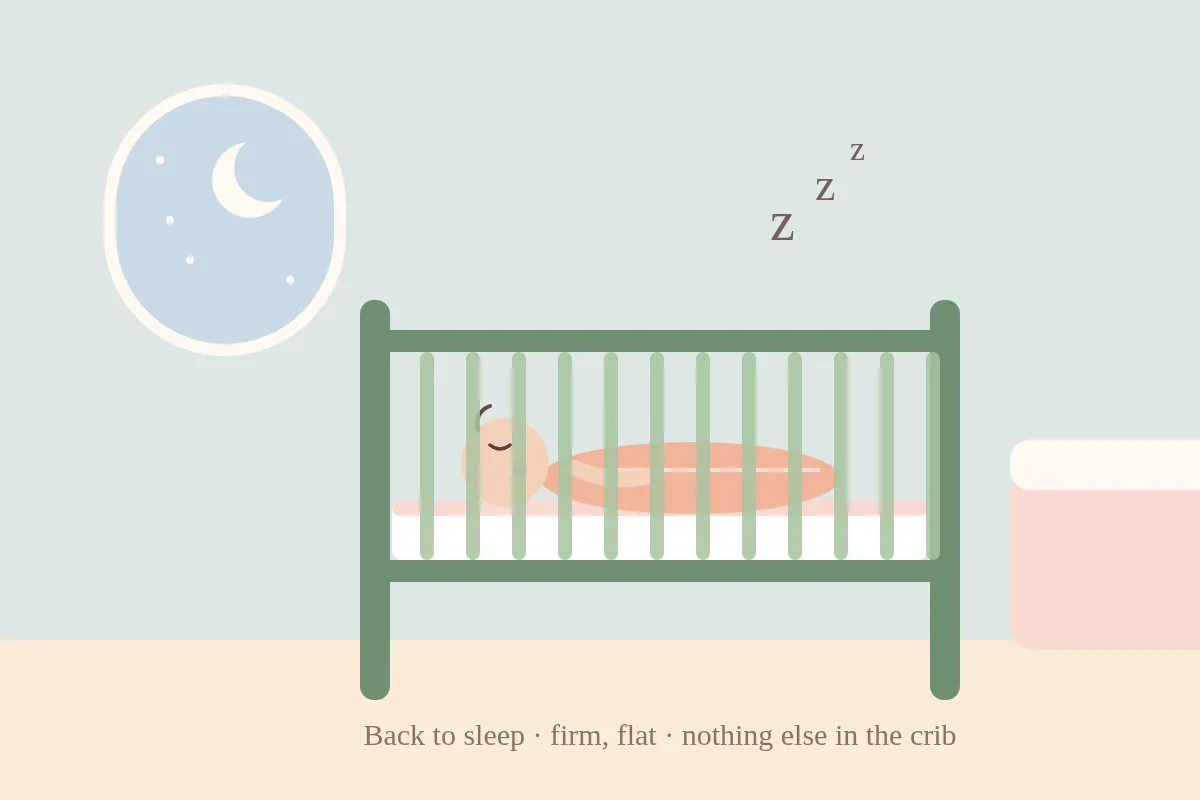
Safe sleep basics (AAP & NHS)
- Back to sleep, every sleep, naps included. Side sleeping isn’t safe either. Once baby rolls both ways alone, you needn’t flip them back.
- Their own firm, flat surface: crib, bassinet, cot, Moses basket or play yard, fitted sheet only. No inclined sleepers, nests or loungers.
- Nothing else in the crib: no pillows, bumpers, loose blankets or toys. Use a wearable blanket if chilly.
- Room-share, don’t bed-share, ideally for 6 months. Never sleep with baby on a sofa or armchair.
- Don’t overheat: one layer more than you, no hats indoors. The NHS suggests 16–20°C (61–68°F).
- Smoke-free home and car.
- If you swaddle, keep baby on their back and stop once they try to roll.
Read the full AAP safe sleep guidance on HealthyChildren.org. (The NHS explains safer co-sleeping if it happens. The AAP advises against bed-sharing.)
Why is my newborn awake all night?
In the womb, your daytime movement rocked your baby to sleep. Their body clock usually settles over the first couple of months. Quick win: bright, chatty days and dim, boring night feeds.
Knowing the rules is one thing. Getting through the nights is another.
The book’s Sleep Better Nights section picks up where this page stops, turning “what’s normal” into clear, actionable steps you can lean on at 2 a.m., so nights feel less like guesswork and more like a rhythm you’re building together…
Continue in the book →Chapter 04 · Crying
Why Is My Newborn Crying? What’s Normal
Crying is your baby’s only language, and it tends to increase until about 6–8 weeks, then eases. Often there’s no clear reason, and that’s not a sign you’re doing something wrong.
The usual suspects
- 🍼 Hungry (even if they just ate)
- 🧷 Wet diaper
- 💨 Needs a burp
- 🥱 Overtired
- 🌡 Too hot or cold
- 🤱 Wants closeness
- 🤒 Unwell (check temperature)
The Period of PURPLE Crying
Dr. Ronald Barr and the National Center on Shaken Baby Syndrome describe a normal phase of extra crying, often from about 2 weeks to 3–4 months:
- PPeak around 2 months
- UUnexpected
- RResists soothing
- PPain-like face
- LLong-lasting
- EEvening: often worse
Is it colic? Doctors often use the “rule of threes”: crying 3+ hours a day, 3+ days a week, for 3+ weeks, in an otherwise healthy baby. It usually improves by 3–4 months.
Why do womb-like sensations soothe? Your baby spent nine months somewhere snug, loud and moving. Dr. Harvey Karp’s “5 S’s” (The Happiest Baby on the Block) are built on that idea. Any soothing position is for your arms only. Sleep is always on the back.

…the one that says “you’re doing better than you think” while still giving you the clear, actionable steps you crave.From the book’s description. See its Understand & Soothe Crying section. Explore the crying section →
Never shake a baby. Here’s what to do at your limit
Shaking can cause brain injury or death in seconds. Feeling desperate during endless crying happens to loving parents. The safe plan:
- Put your baby down on their back in their crib or cot.
- Walk away for 5–10 minutes. Breathe, drink water.
- Call or text someone you trust, or a helpline (below).
- Check on your baby every 5–10 minutes until you feel calmer.
Share this plan with every caregiver.
Chapter 05 · Everyday care
Cord, Bath and Diaper Worries, Answered

“The cord stump looks gross.” It dries, darkens and usually falls off within 1–3 weeks. Keep it clean and dry. Call for spreading redness, a smelly discharge, active bleeding, or a stump still there after 3 weeks.
“How often should I bathe baby?” Less than you’d think. Newborns don’t get very dirty, and frequent baths dry the skin. Sponge baths until the cord falls off, and never leave your baby alone in water, even for a second.
“Their bottom is red.” Diaper rash is very common. Call if it blisters, bleeds or won’t clear.
Chapter 06 · Development
Newborn Development 0–3 Months: What You’ll Start to See
Treat milestones as signposts, not a test. The CDC describes what most babies (75%+) do by certain ages. See the CDC’s 2-month milestone checklist.
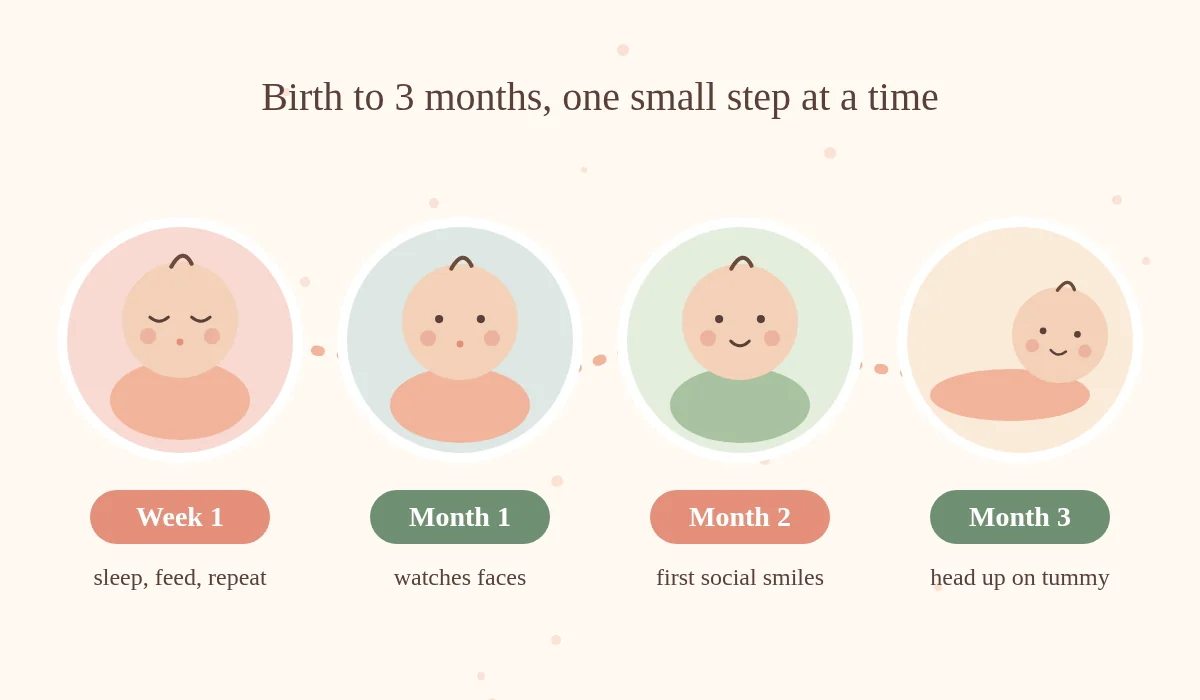
Why tummy time matters

Because babies sleep on their backs, supervised awake tummy time builds neck strength and prevents flat spots. The AAP suggests starting soon after you get home and building to 15–30 minutes a day by about 7 weeks. Quick win: chest-to-chest while you recline counts.
Tell your doctor if your baby doesn’t react to loud sounds, isn’t smiling at people by about 2–3 months, or loses skills.
Support Baby’s Growth: the book walks you through the development changes from birth to 3 months in simple, reassuring language. See the growth section →
Chapter 07 · Myths & mistakes
Newborn Myths vs Facts (and Common First-Time Mom Worries)
Common first-time mom worries
Ranges are wide. Your doctor watches your baby’s own steady progress.
Parenting is learned, one feed at a time. Feeling unsure means you care.
Worst-case forums fuel anxiety. Use your nurse line or one trusted guide.
Chapter 08 · Checkups
Checkups and Vaccines in the US, UK and Canada
No newborn baby care guide replaces checkups. They track growth, feeding and jaundice, so bring every question.
| 🇺🇸 United States | 🇬🇧 United Kingdom | 🇨🇦 Canada | |
|---|---|---|---|
| Early checks | 3–5 days, then ~1 month | Newborn exam within 72 hours, blood spot test ~day 5, health visitor at 10–14 days | First week, then ~1 month (varies by province) |
| Vaccines | Often hepatitis B at birth; routine shots from 2 months; ask about RSV protection | NHS routine vaccines at 8, 12 and 16 weeks | Provincial schedule, usually from 2 months |
Chapter 09 · Red flags
Red Flags: When to Call the Doctor Right Away
You’ll never be “that annoying mom” for calling about a newborn. This part of our newborn baby care guide is complete and always free.
| ✓ Usually normal | ! Call now or get urgent help |
|---|---|
| Feels warm after a feed, but the thermometer reading is normal | 100.4°F (38°C) or higher in a baby under 3 months, even if they seem fine. Don’t give fever medicine unless a doctor says so |
| Snuffles, hiccups, sneezes, brief breathing pauses (under 10 seconds) | Struggling to breathe, grunting, ribs sucking in, pauses of 20 seconds or more, or blue, grey or pale lips. Call 911 / 999 |
| Mild yellow tinge on days 2–5 that your team is monitoring | Jaundice in the first 24 hours, spreading to tummy or legs, or with a very sleepy baby. Pale, chalky poop |
| 6+ wet diapers a day after day 5 | Fewer wet diapers, dark pee, dry mouth, sunken soft spot, no tears (signs of dehydration) |
| Sleepy newborn who wakes to feed | Floppy, hard to wake, weak or high-pitched cry, or refusing feeds |
| A rash that fades when pressed | A rash that doesn’t fade under a pressed glass, or a seizure (911 / 999) |
The NHS guide to fever in children and the Canadian Paediatric Society’s fever and temperature-taking advice agree: a baby under 3 months with a fever needs urgent care. A digital rectal reading is most accurate for newborns.
Chapter 10 · You
Caring for You: Recovery and Postpartum Mental Health
Bleeding (lochia) can last up to about 6 weeks, and rest and help are part of recovery. In the US, ACOG advises contact with your OB within 3 weeks. In the UK, you’ll be offered a 6–8 week postnatal check.
Get urgent care if you soak a pad in an hour, pass large clots, or have fever, chest pain, trouble breathing, a severe headache, vision changes, or a painful, swollen leg.
“Baby blues” (very common)
- Weepy, anxious, irritable or overwhelmed
- Starts a few days after birth
- Fades within about 2 weeks
Postpartum depression / anxiety
- Lasts longer than 2 weeks, or gets worse
- Persistent sadness, panic or trouble bonding
- Thoughts of harming yourself or your baby. Get help now
Postpartum depression affects roughly 1 in 8 to 1 in 10 new mothers and is treatable.
| Where | Who to contact |
|---|---|
| 🇺🇸 US | Your OB or doctor · National Maternal Mental Health Hotline 1-833-TLC-MAMA (1-833-852-6262), call or text 24/7 · Postpartum Support International HelpLine 1-800-944-4773 · Crisis: 988 · Emergency: 911 |
| 🇬🇧 UK | Your midwife, health visitor or GP · NHS 111 · Samaritans 116 123 (free, 24/7) · Emergency: 999 |
| 🇨🇦 Canada | Your family doctor, midwife or public health nurse · Health line 811 (most provinces/territories) · Suicide Crisis Helpline 988, call or text · Emergency: 911 |
- Feeding Made Simple
- Sleep Better Nights
- Understand & Soothe Crying
- Support Baby’s Growth
- Practical checklists
- Simple explanations
- Real emotional support for you
- From the very first night home through the first 3 months
See the complete version in the Newborn Baby Care Guide book, all in one place.
Peek inside the bookFor later years (bookmark these)
Later, our 7-night routine for when your toddler won’t sleep picks up where this guide leaves off. Also see how to cut evening screen time without a meltdown. For ages 3–5, try the ColorJoy preschool learning bundle.
Chapter 11 · FAQ
Newborn Baby Care Guide FAQs
Why does my newborn want to eat all the time?
A tiny stomach and fast-digesting milk make 8–12 feeds in 24 hours normal. Cluster feeding builds supply. Six or more wet diapers a day after day 5, plus weight gain, show it’s enough.
Why does my newborn sleep all day and wake at night?
Their day-night body clock hasn’t developed yet. It usually settles over the first couple of months.
What is the safest way for my newborn to sleep?
On their back, every sleep, on a firm, flat surface with only a fitted sheet (no pillows, bumpers, blankets or toys), in your room for at least 6 months. Never sleep with baby on a sofa or armchair, and avoid overheating and smoke.
Why is my newborn crying so much in the evenings?
It’s the normal “PURPLE crying” phase, peaking at 6–8 weeks and easing by 3–4 months. Call your doctor if crying comes with fever, vomiting or poor feeding.
What temperature is a fever in a newborn?
100.4°F (38°C) or higher. Under 3 months, call your doctor right away (UK: NHS 111 or your GP urgently), even if your baby seems well. Don’t give fever medicine unless a doctor tells you to.
When will my baby smile?
Most babies smile socially by about 2 months. Mention missed milestones to your doctor.
What if my baby won’t stop crying and I feel overwhelmed?
Put your baby on their back in their crib, walk away for 5–10 minutes, and call someone or a helpline. Check back every 5–10 minutes. Never shake a baby.
Is it baby blues or postpartum depression?
Baby blues fade within about 2 weeks. If low mood lasts longer, worsens or includes thoughts of harm, contact your doctor or midwife, or call 1-833-TLC-MAMA (US), Samaritans on 116 123 (UK) or 988 (US and Canada).
- 📖 Paperback
- 48 pages
- Large 8.5 × 11 in
- Birth to 3 months
From the ColorJoy bookshelf
This Page Tells You What’s Normal. The Newborn Baby Care Guide Book Walks You Through It.
NEWBORN BABY CARE GUIDE for First-Time Moms: Everything You Need to Know From Birth to 3 Months. A Calm, Simple Guide to Feeding, Sleep, Crying & Baby Development.
It’s 3 a.m. and your mind is racing: Did they eat enough? Is this normal? Forty tabs later, you’re more anxious.
You’ve read the what and why. The book is your calm companion for the how, from the first night home through month 3, written with warmth and zero judgment.
Free Newborn Baby Care Guide vs the Book
What this page gives you
- What’s normal in the first 12 weeks, and why
- Safe sleep basics and red-flag signs (always free)
- Myths vs facts and a few quick wins
- Where to get help in the US, UK and Canada
What the book adds
- Depth: simple explanations for feeding, sleep, crying and growth
- Step by step: clear, actionable steps and practical checklists
- All in one place: first night home through month 3
- Offline on the nightstand: a paperback, with no scrolling at 3 a.m.
- Real emotional support for you, not just the baby
- Gift-ready for baby showers and expecting friends
What’s inside
- 🍼Feeding Made Simple: calm answers to “Is my baby eating enough?”
- 🌙Sleep Better Nights: newborn sleep, explained simply.
- 🫶Understand & Soothe Crying: what your baby may be telling you.
- 🌱Support Baby’s Growth: development from birth to 3 months.
- 💛Confident, supported, prepared: practical checklists plus reassurance that you’re doing better than you think.
Who it’s for, and who it’s not for
✓ Perfect for
- First-time moms, expecting or already home
- Anyone tired of endless googling
- Friends looking for a thoughtful baby shower gift
✗ Probably not for
- Parents who want a medical textbook or clinical reference
- Families with babies well past 3 months (it covers birth to 3 months)
- Replacing your pediatrician, GP or health visitor. It’s a companion
A thoughtful baby shower gift
Onesies get outgrown in weeks. Confidence lasts. Tuck this paperback into a shower basket with a note that says “You’ve got this.”
Give yourself a calmer first 3 months
The best time to have a calm newborn baby care guide on your nightstand is before the 3 a.m. questions start.
Grab Your CopyPaperback · 48 pages · 8.5 × 11 in · by Mr. A. G.