Cute-spooky tone
Festive, a little mysterious, never nightmare fuel. Smiling pumpkins beat dripping fangs every time for this age.
October has a feeling no other month quite matches. The air gets sharper. Leaves scrape along the sidewalk. And in almost every household with a young child, a little spark of make-believe starts early.

Halloween is one of the most imaginative stretches of childhood. For a few weeks, ordinary evenings can hold costumes, paper bats, and friendly monsters. A porch light looks different. A pumpkin on the steps feels like a character. Kids this age live right on the line between what is real and what could be real if they color it orange enough.
Parents, grandparents, and teachers feel a different side of the same month. School parties stack up. Candy appears earlier than anyone planned. Tablets come out because they are fast and quiet. Halloween cartoons are everywhere. The house gets louder, later, and a little harder to settle at bedtime.
That is the October dilemma in plain language. You want the season to feel special. You also want one stretch of the afternoon that does not depend on a glowing screen. Coloring is not a new idea, and that is part of why it still works. A child sits down with crayons and a page of cheerful pumpkins or smiling ghosts, and the room changes speed. The excitement of the month does not disappear. It just finds a quieter place to land.
This guide is written for American families with kids ages 4 to 8 — the years when imagination is huge and pencil control is still growing. It explains why “cute-spooky” Halloween pages hold attention, what to look for in a page, how different book formats fit real life, and how coloring supports skills that show up later in school. If you also want more screen-free indoor ideas for busy weather days, you can find related parent guides on colorjoy.online.
Four-year-olds and eight-year-olds can share a holiday and still need very different pages. A preschooler colors with the whole arm. An older child wants a moon to shade and a hat ribbon to fill in. The sweet spot is a page that feels exciting to both without scaring the younger one or boring the older one.
Three things usually decide whether a Halloween page becomes a favorite or ends up under a pile of mail.
Festive, a little mysterious, never nightmare fuel. Smiling pumpkins beat dripping fangs every time for this age.
Bold outlines for little hands. Extra corners and backgrounds for kids who want to invent their own night sky.
Single-sided pages let kids use markers without ruining the drawing on the back.
The “cute versus spooky” balance is the one parents notice first. Young children like a shiver. They do not like a page that follows them to bed. Friendly jack-o’-lanterns, goofy spirits, little witches with round cheeks, and bats that look more like stuffed animals than horror-movie extras keep the season fun.
Line weight matters just as much. If the outlines are faint or the spaces are tiny, a four-year-old gets tired and scribbles through the whole pumpkin. If the page is only one giant shape with nothing else to do, a seven-year-old finishes in three minutes and asks for the tablet. Clean, thick lines with a little room around the character give both ages a way in.
Then there is paper. Marker bleed is a small problem that feels big to a child who just finished a ghost they liked. Single-sided printing sounds like a printing detail. In a real kitchen, it is the difference between pride and frustration.
The last piece is variety. Kids this age get bored when every page is “another pumpkin, same face.” A good set moves: pumpkin patch, then a cauldron, then a night sky, then a trick-or-treat walk. Novelty is not extra. It is what keeps them coming back after dinner.
Kids do not color “Halloween” in the abstract. They color a face, a hat, a bucket of candy. Each classic icon does a slightly different job in a child’s mind.
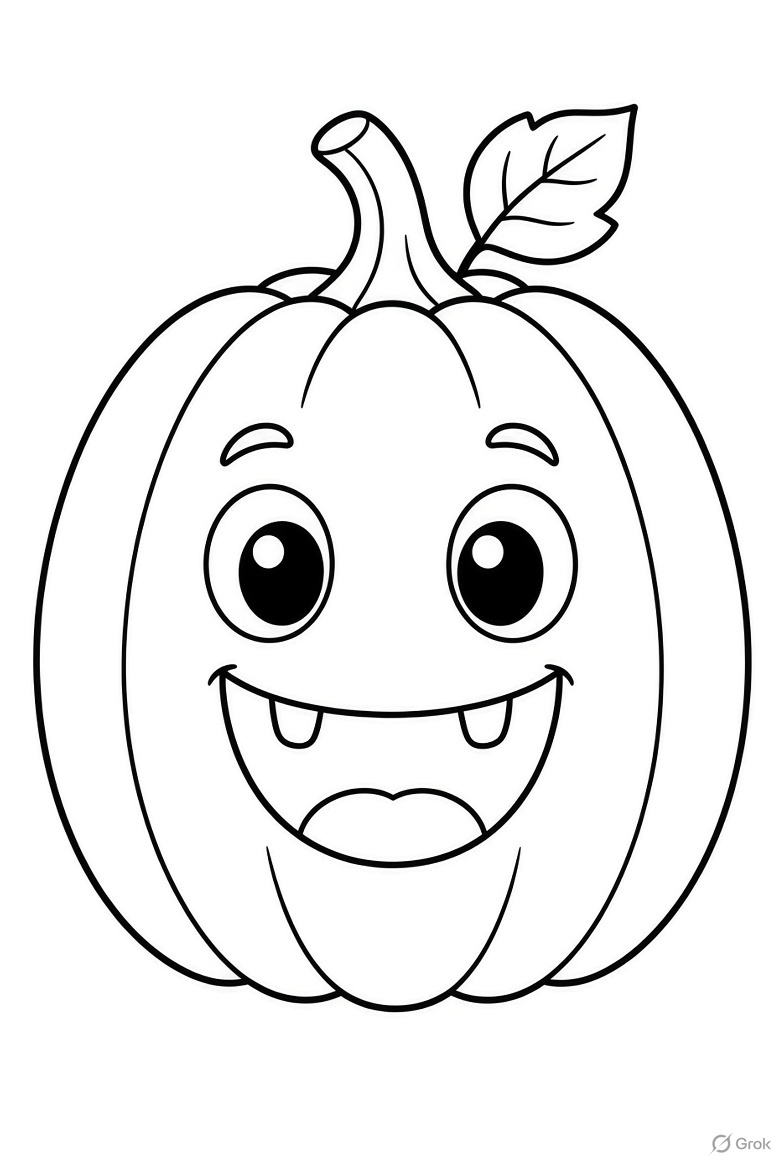



Pumpkins are the warmest symbol of the month. They belong to farms, porches, and grocery-store bins as much as they belong to Halloween night. When a child colors a toothless grin or a stacked pumpkin tower, they are practicing faces. Happy, surprised, silly — those expressions are social practice hiding inside an art page. Warm colors come naturally here: amber, gold, rust, deep orange. Even a child who “doesn’t like coloring” will often stay with a pumpkin because it feels familiar.
You can make it a tiny conversation without turning it into a lesson. “Does this one look like our porch pumpkin?” is enough. Some kids give the pumpkin a name. That is not off-task. That is how this age thinks.
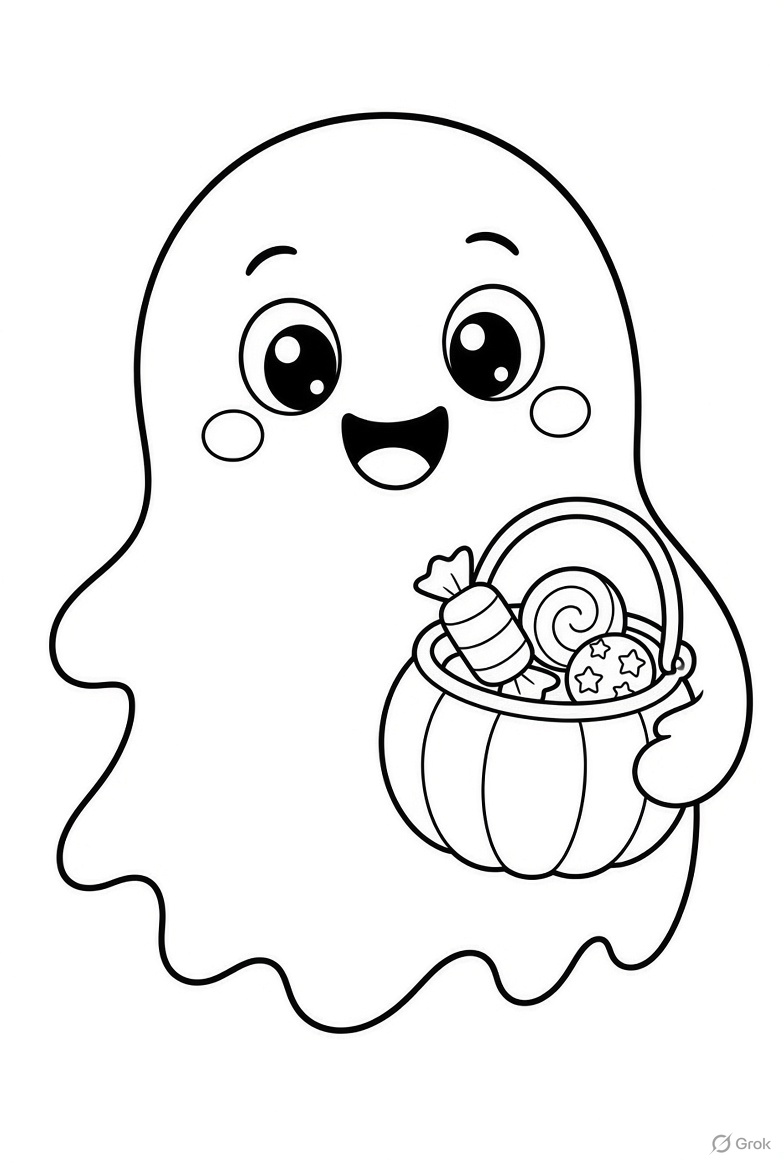
Ghosts are where cute-spooky really earns its keep. A shadowy figure with no face can worry a four-year-old. A round ghost in a tiny hat, holding a candy bucket, becomes a friend who happens to float. That shift matters. It lets a child play with the idea of “something unseen” without carrying it into the dark hallway at 8 p.m.
Parents sometimes worry that any ghost is too much. Watch the drawing, not the category. If the ghost is smiling, chubby, and busy with candy, most kids in this range treat it like a cartoon neighbor.
Witches are story engines. A broom, a moon, a pot of something glowing — kids start inventing before the page is half colored. What is in the cauldron? Who is the witch visiting? Why is the hat that color? You do not have to prompt much. The picture already asks the questions.
This is also a good page for older kids in the 4–8 window. They will decorate stars, potion bubbles, and cloak folds. Younger kids can ignore the background and just color the hat and the smile. One page, two ways in.
These pages quietly sneak in nature. Bats hang upside down. Owls stay up late. Spiders build rather than “attack.” A child who colors a bat on a branch is looking at a real animal that happens to have a holiday reputation. If your child is the type who asks why the sky is dark so early in October, these pages give you a place to answer.
Costume pages hit closest to real life. Kids recognize the bucket, the sidewalk, the porch light. Coloring a night they are already waiting for builds excitement in a form you can pause. It is useful the week of Halloween, when the countdown talk never stops and a quiet table activity is worth gold.

Most October coloring does not happen in a styled playroom. It happens after school, next to a snack, with one child asking where the orange crayon went. That is fine. The goal is not a museum page. The goal is twenty or thirty minutes where nobody is negotiating screen time.
Put a small stack of pages on the table before the energy spikes. Keep crayons in one cup. If you have a four-year-old and a seven-year-old, give the younger one a single big pumpkin and the older one a night scene. Same holiday, different workload.
Finished pages can live on the fridge for a week and then become wrapping for teacher gifts, party signs, or a window display. The art does not need a plan. It just needs to stay visible long enough for the child to feel it counted.
Not every Halloween collection is trying to do the same job. A full-size book on the kitchen table is not the same tool as a slim pack in a tote bag. Matching the format to the day saves you from buying something that looks festive and then never leaving the closet.
| What you need | Single-sided book | Small travel pack | Toddler sheets | Classroom pack |
|---|---|---|---|---|
| Best ages | 4–8, mixed skills | 4–8, short bursts | 2–4, early grip | 5–9, group work |
| Paper | One drawing per sheet | Often two-sided | Large and simple | Tear-out or copy-ready |
| Best tools | Markers, crayons, pencils | Crayons, pencils | Washable crayons | Pencils, gel pens |
| Where it shines | Quiet home afternoons | Cars, waiting rooms, bags | First coloring wins | Centers and hallway art |
If the book will live on a shelf and come out after school, choose full pages printed on one side. Kids can press hard. They can use a marker. They can cut a pumpkin out later without destroying the next drawing. This is the format that supports the longest, calmest sessions.
Compact sets earn their keep on highway drives, soccer-sideline waits, and as a non-candy extra in a treat bag. They will not give you an hour of deep focus. They will give you fifteen useful minutes. That is a fair trade in October.
Ages 3 and 4 want one big object and almost no background clutter. A single ghost. One pumpkin. Thick lines. If a page is busy, they feel behind before they start.
Teachers need pages that can be handed out fast and pinned up later. Mixes that include a coloring sheet plus a simple dot-to-dot or word hunt are practical for mixed-ability groups. Perforated or copy-friendly pages matter more than fancy covers.
Adults call it a holiday pastime. Occupational therapists and early-childhood teachers see the same activity as quiet training. Screens can entertain. They do not build the same hand strength or the same sense of “I made this and it is still here.”
Fine motor control. Gripping a crayon, turning a page, staying near a curved pumpkin line — these are the small motions that later hold a pencil on a worksheet. October is a long month. A few short sessions add up.
A calmer nervous system. Costume parades, class parties, and extra sugar can stack. The back-and-forth of coloring is repetitive in a good way. Many kids talk less, breathe slower, and stop bouncing once the page has a job for their hands.
Spatial sense. Where does the eye go? How big is the hat compared with the head? Should the night sky be one color or many? Those are visual decisions, not just decoration.
Choices that belong to the child. A witch hat does not have to be black. A ghost can be pink because it lives in a candy shop. When adults resist correcting the colors, kids practice deciding. That sounds small. It is how confidence looks at six.
Proof that lasts. A game score disappears when the iPad sleeps. A finished page can hang on a bedroom door through November. Kids this age still care a lot about work you can touch.
None of this means coloring replaces outside play, reading aloud, or sleep. It means October needs at least one activity that is festive and still gentle. Cute-spooky pages do that job without a setup that takes twenty minutes or a cleanup that takes thirty.
The fastest way to drain a coloring session is to turn it into a correctness test. “Stay in the lines.” “Pumpkins are orange.” “That’s not how a bat looks.” Kids hear the holiday joy leave the room.
Better prompts sound like curiosity. “What kind of potion is in that pot?” “If this ghost lived in a candy shop, what color would it be?” “Which house on the page would you visit first?” You are inviting a story, not grading a worksheet.
If two siblings share the table, give them different pages on purpose. Shared pages become shared arguments. Separate pages become parallel play, which is often the peace you actually wanted.
And if a child abandons a page halfway, leave it out. Plenty of kids return after snack or after a bath and finish the moon. Halloween coloring is not a race to a complete set.
Markers and dark crayons travel. On a two-sided sheet, yesterday’s pumpkin can shadow today’s ghost. Single-sided pages keep each drawing clean enough to hang, cut, or gift.
Ages 4–5 do well with thick crayons and washable triangular markers. Ages 6–8 often want colored pencils or gel pens for tiny stars and hat buckles. Keep washable options in the house anyway. October clothes already work hard.
Not realistically, and it does not have to. Think of coloring as one reliable alternative when the house is buzzing. Twenty quiet minutes after school still changes the evening.
Stay in the cute-spooky lane. Skip jagged teeth, dark graveyards, and anything that looks like a jump scare. Start with pumpkins and costumes. Add a smiling ghost only when your child asks for one.
Teachers use Halloween pages for quiet time, fine-motor warm-ups, and hallway displays. The same page can be art in the morning and a talking prompt about nocturnal animals in the afternoon.
The last seven days before October 31 are when homes get the most chaotic. Costumes still need a safety pin. Someone cannot find the candy bucket. School wants a decorated treat bag by Thursday. Coloring will not organize the week for you, but it can put a pause in the middle of it.
Try a tiny rhythm instead of a big plan. Monday: one pumpkin page after snack. Tuesday: a ghost, and you ask one question about where it lives. Wednesday: a costume scene, because that is when kids start rehearsing trick-or-treat in their heads. Thursday: whatever they want to finish from earlier in the week. Friday: display day. Tape three pages in the hallway or on the fridge and let the child give a two-sentence tour.
That tour sounds precious. It is actually practical. Kids who explain their picture are less likely to immediately demand another episode. They already had an audience.
If rain cancels backyard time, pull the same stack back out. Halloween pages work twice. They are seasonal, so they still feel new in week three, unlike a random printed worksheet that already looks like homework.
Grandparents can join without a craft degree. A shared page at the kitchen table is easier than a costume-making session and still feels like we did Halloween together. Keep expectations low. The point is company, not a matching set of perfect jack-o-lanterns.
When Halloween night finally arrives, those pages have already given the month a shape. The candy and the dark street can be the peak. They do not have to be the only memory of October.
The hidden magic of this month is not more decoration. It is a child who gets to meet the season at child speed. Cute and spooky coloring pages are a small tool for a loud stretch of the calendar. They give kids friendly monsters, warm colors, and a job for restless hands. They give adults a pocket of calm that does not require batteries.
On a wet afternoon, during a family gathering, or in a classroom counting down to dismissal, a pumpkin page is enough. Choose pictures that smile back. Leave room for wild color choices. Hang the finished work where the child can see it on the way to breakfast.
That is how Halloween stays imaginative without taking over the whole house — one crayon, one friendly ghost, and a little October quiet you can actually feel.
For more screen-free ideas that work on rainy days and restless weekends, visit colorjoy.online.
If the ideas above sound like your house — high energy, early candy, and a tablet that appears the minute it rains — you do not need another complicated craft kit. You need pages that are cute enough to feel festive and simple enough for a four-year-old to start without help.
Halloween Colouring Book for Kids Ages 4–8 is built for that exact window. Friendly pumpkins. Smiling ghosts. Little witches. Night-sky bats. The kind of “spooky” that stays fun after the lights go out.
This is the quiet October tool hiding in plain sight: one book, a cup of crayons, and twenty calmer minutes before dinner.
In an elementary hallway, Halloween can either become visual noise or a calm project kids are proud to point at. Teachers who use cute-spooky pages as a center activity often see two things. First, the room gets quieter without anyone being told to be quiet. Second, children who rush through worksheets sometimes linger on a witch hat because the page feels like play.
A simple classroom move is to offer two choices: a large single character for kids who need a win, and a fuller night scene for kids who want more to do. Same tray of crayons. No public ranking of who finished “better.” Hang the work at kid eye level, not only above the whiteboard.
That is enough structure. The holiday already provides the theme. The page provides the pause.
Make the season easier with our stress-free Halloween guide and a dinosaur coloring book.